Independent. Human-Curated. Established 2007.
How to Write a White Paper: The Complete Guide
Senior Editor · 15+ years covering small business, freelancing, and online publishing.
Key Takeaways: Writing a White Paper
- 1A white paper is a persuasive "Problem/Solution" tool, not a sales brochure.
- 2Successful B2B white papers build Lifetime Domain Equity by positioning your brand as the authority.
- 3Structure follows: Abstract → Problem → Background → Solution → Conclusion.
- 4Distribution strategy matters as much as writing quality — gate it for lead generation.
The fastest way to write a white paper in 2026 is a hybrid approach: use AI (like Claude or ChatGPT) to outline the structure and synthesize data, but use human subject matter experts to inject proprietary insights, entity validation, and brand voice so it doesn't read like generic AI content.
This guide walks through the modern AI-assisted workflow for writing B2B white papers that actually convert — what to template, what to prompt, what to keep human, and how to avoid the generic-AI smell that buyers spot within two paragraphs.
Key Concept: What Is a White Paper?
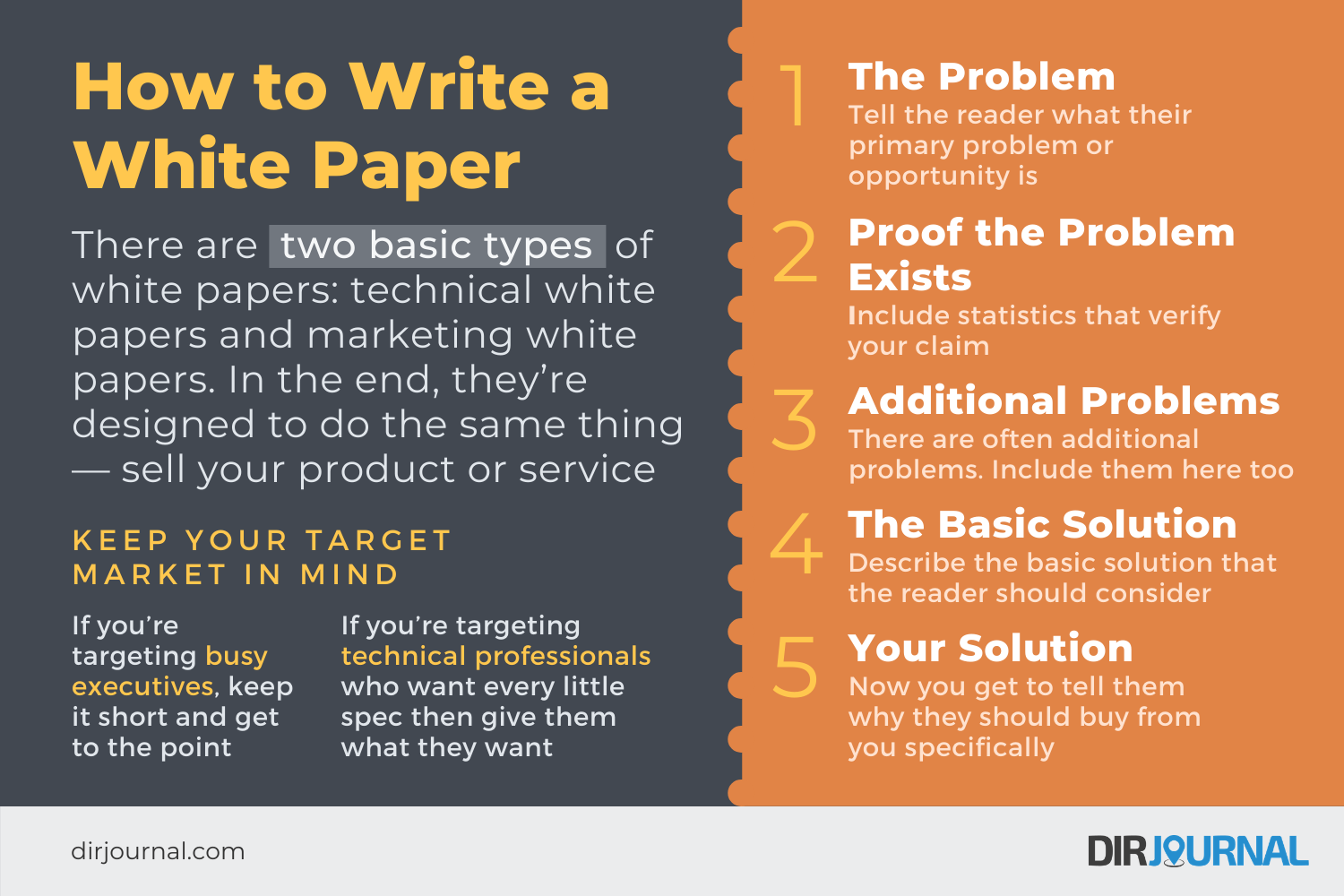
A white paper is a long-form report designed to do two things: educate and persuade. In a B2B context, it is the document an executive reads before approving a six-figure purchase decision — denser than a blog post, more substantive than a brochure, more decision-oriented than an academic paper. The two types: technical white papers (specs and architecture, aimed at engineering or IT decision-makers) and marketing white papers (problem and solution, aimed at executive buyers). This guide focuses on the marketing variant since that is where AI-assisted workflows have the largest leverage.
DirJournal · Interactive
White Paper Outline Generator
Enter your topic, audience, and argument. Get a complete section outline built to professional B2B standards.
What Should a White Paper Say to the Reader?
The intended internal monologue, from the reader's perspective:
White Paper: "You have a problem, whether you know it yet or not — a big problem for your business."
Reader: "Oh. That is a problem."
White Paper: "That problem is tied to other problems you may not have connected."
Reader: "I didn't realize. Quick, give me a solution."
White Paper: "Here is the type of solution that fixes this class of problem — independent of vendor."
Reader: "OK, that sounds right. Any specific recommendation?"
White Paper: "Yes — here is why our specific solution fits."
Reader: "Sign me up."
The Five Elements of a White Paper
- The Problem (or Opportunity) — a one-page intro framing the primary problem or opportunity in terms the buyer feels.
- Proof the Problem Exists — third-party data, market research, statistics that validate the claim.
- Additional Problems — surface adjacent problems the same solution addresses, building urgency.
- The Basic Solution — describe the type of solution generically, focused on benefits not features.
- Your Specific Solution — a final page that names your specific product, why it fits, and the call to action.
The AI-Assisted White Paper Workflow
In 2026, the right workflow is hybrid. AI handles the outline, the data synthesis, the first draft, and the formatting; the human handles the proprietary insight, the customer anecdote, the entity validation, and the brand voice. Throughput goes from weeks to days, and the document reads like considered B2B content rather than generic AI output.
The 3-Prompt Framework
Below are three battle-tested AI white paper prompts that map to the three phases of the workflow. Each is designed to be pasted into Claude, ChatGPT, or Gemini with minimal modification.
Prompt 1 — Outline
You are a B2B content strategist drafting a white paper for [TARGET BUYER, e.g. mid-market CFOs]. The paper sells [PRODUCT/SERVICE] by first making the buyer feel the cost of [CORE PROBLEM]. Produce a detailed five-section outline using the structure: (1) The Problem, (2) Proof the Problem Exists, (3) Additional Problems, (4) The Basic Solution, (5) Our Specific Solution. For each section list 3-5 talking points and 2 data points to validate. Keep the language enterprise-appropriate, not consumer-marketing.
Prompt 2 — Executive Summary
Given the following white paper outline [PASTE OUTLINE], write a 180-220 word executive summary that a [BUYER TITLE] would read in 60 seconds and forward to their team. Lead with the problem framed in dollars or operational risk, not in vague impact terms. Close with a single sentence about what the paper recommends. No filler, no "in today's competitive landscape" openers.
Prompt 3 — Section Draft
Write Section [N] of the white paper, titled "[SECTION HEADING]". Target length 400-600 words. Use the talking points from the outline. For every data claim, mark it with [VERIFY: SOURCE NEEDED] so the human reviewer can validate or replace. Do not invent statistics. Match the tone of [PASTE 200 WORDS OF EXISTING BRAND CONTENT].
How to Use AI for B2B White Papers Without Sounding Generic
Knowing how to use AI for B2B white papers is mostly about what NOT to outsource to the model. The proprietary insight — the customer anecdote you can only tell because you actually shipped a product, the data you collected from your own user base, the angle your competitors do not see — has to come from the human subject matter expert. The AI's job is structure, synthesis, and first-draft acceleration. The human's job is everything that makes the document defensible: facts that survive fact-checking, entity references that pass schema validation, voice that matches the brand's existing content footprint.
The white paper generation framework that produces convertible content is therefore three layers: AI generates structure and first draft, the SME injects proprietary insight and validates data, and a final human editor enforces brand voice and removes the AI tells. Skip any of the three and the paper either reads like AI sludge (skip the human) or takes three weeks instead of three days (skip the AI).
Formatting and Length
There is no single correct format. The two most common: single-column full-page (works when chart-heavy content needs the space) and two-column with sidebar (works when pull-quotes and small visual breakouts carry the narrative). Pick one per company and stay consistent across releases.
Length: 5-10 pages is the sweet spot for executive-audience marketing white papers in 2026. Technical white papers run longer (15-30 pages is normal). The right test is not page count but whether the document earns the reader's continued attention page by page.
Titles: the title must signal who the document is for and what problem it addresses — not be clever. Clever titles work in consumer marketing; in B2B they get ignored. "[Solution Category] for [Specific Buyer Role]: How to [Solve Specific Problem]" is a workable formula.
AI-Assisted Drafting vs. Hiring a White Paper Writer
For most B2B marketers in 2026, the right answer is hybrid: AI handles the structural work and first draft, a senior in-house person handles the proprietary insight and final pass. The case for hiring a specialist freelance white paper writer is narrower than it used to be — limited to highly regulated industries (legal, medical, financial fiduciary content) where compliance review burden outweighs the productivity gain of AI assistance.
If you do hire externally, the new evaluation criteria are: does the writer use AI as part of their workflow (and disclose it), do they bring subject-matter depth in your category, and can they collaborate with your in-house SMEs rather than producing in isolation. The pricing that defined freelance white paper writing through 2024 has compressed significantly — most hybrid AI-plus-human engagements now price in the low-to-mid three figures for a 5-10 page paper.
Next Steps: Apply This to Your Next Paper
The fastest way to test the workflow is on a real paper, not a practice one. Pick the next white paper on your marketing roadmap, run the 3-prompt framework above to get an outline and first draft, then layer in your proprietary content and brand voice. The throughput gain becomes obvious by the second paper, and the convertibility lift becomes obvious by the fourth or fifth — once you have calibrated which AI outputs need the heaviest human pass.