The Best Web Directories for SEO and Local SEO in 2026
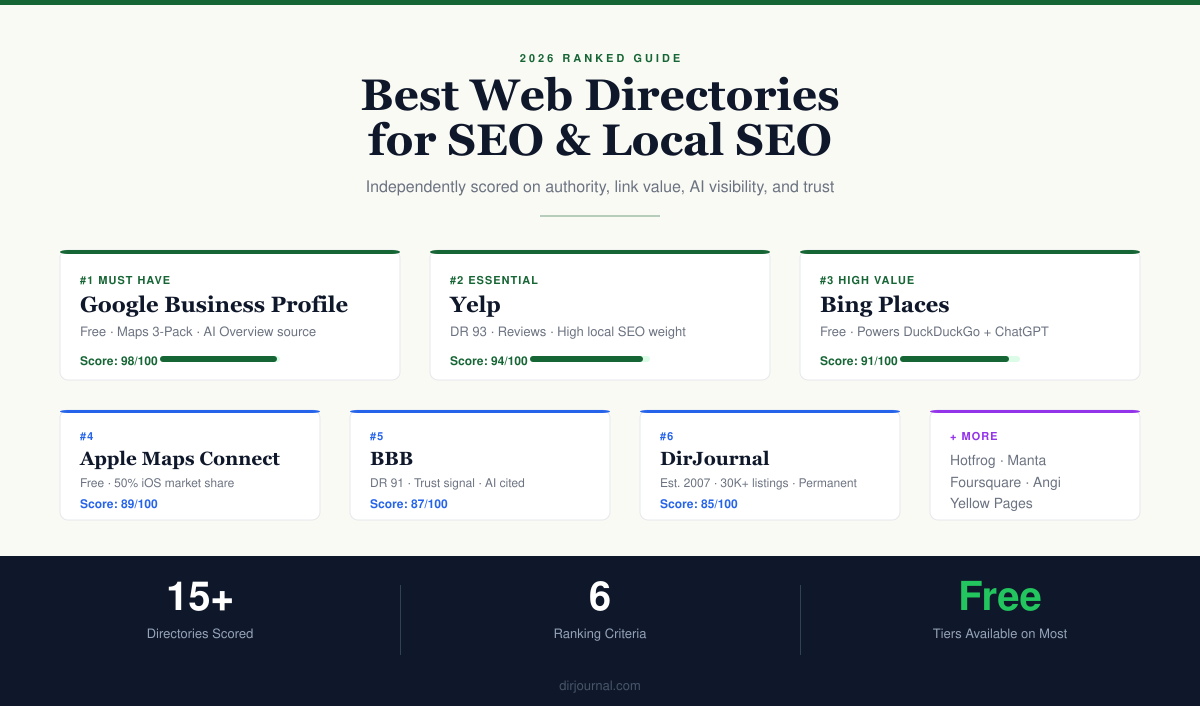
Key Takeaways: Best Web Directories for SEO (2026)
- 1Google Business Profile and LinkedIn are essential — scoring 118 and 114 respectively.
- 2General directories have contracted — DMOZ closed 2017, Spoke.com is now a spam redirect.
- 3Best of the Web (BOTW) remains the top general directory with DR 73 and DoFollow links.
- 4DirJournal scores 85/100 against its own methodology, with 55,000 referring domains.
Web directories were declared dead by SEO blogs around 2013. They're not dead. In 2026, they're more relevant than they've been in a decade — but for completely different reasons than they were in 2007.
The era of submitting your URL to 500 free directories for cheap link juice ended when Google's Penguin update started penalizing low-quality directory submissions. What replaced it is more interesting: a smaller universe of human-edited directories that Google trusts because the bar for inclusion went up, plus a much larger universe of business and local platforms that function as citation sources, authority signals, and — crucially in 2026 — feeders for AI search engines.
This guide does three things most directory roundups don't. First, it scores 50+ directories against the metrics that actually matter in 2026 — not Alexa Rank, not PageRank, not tweet counts. Second, it tells you which directories AI assistants like ChatGPT, Gemini, and Perplexity actually pull from when answering business recommendation queries. Third, it applies the same scoring methodology to DirJournal itself — because if we're going to rank directories, we should be willing to be ranked.
📐 How We Calculated the Scores
Each directory is scored on a 100-point scale using a transparent weighted formula:
- Ahrefs Domain Rating (25%) — third-party authority signal, the gold standard since Moz DA became less reliable
- Moz Domain Authority (15%) — secondary authority confirmation
- Active status & editorial integrity (20%) — closed or spam directories score 0 regardless of legacy metrics
- Link type — DoFollow vs NoFollow (15%) — DoFollow links pass authority; NoFollow still provide citation value
- Content quality & empty-category handling (10%) — does the directory have actual editorial substance or is it a hollow taxonomy?
- Pricing transparency (10%) — hidden fees and bait-and-switch tiers are penalized
- AI engine citation likelihood (5%) — new for 2026: how often AI assistants cite this source
Total scores can exceed 100 for directories that are essential AND high-authority — Google Business Profile and LinkedIn earn bonus weight because they're functionally non-negotiable. Closed or spam directories receive 0 regardless of legacy authority metrics, because a high DR on a redirected domain doesn't help anyone.
Part 1 · Quick Picks Decision Framework by Situation
| If you... | Start with... | Time/cost |
|---|---|---|
| Have $0 to spend | Google Business Profile + Apple Business Connect + Bing Places + LinkedIn | 2 hours, free |
| Have $300/year for authority links | Add Best of the Web ($199.95/year) or Jasmine Directory ($99 one-time) | Plus 1-week review |
| Sell B2B | Crunchbase, LinkedIn, Owler, ZoomInfo, G2, Capterra (industry-specific) | 4-6 hours, mostly free |
| Sell local services | Yelp, Nextdoor, Houzz/Angi, BBB, local Chamber of Commerce | 3-5 hours, mostly free |
| Sell home services specifically | Houzz, Angi, HomeAdvisor, Thumbtack, Porch | Lead-gen pricing varies |
| Want maximum AI visibility | DirJournal, Wikidata, Crunchbase, BOTW (schema-rich, human-edited) | 4-8 hours, $250-300 total |
| Want to syndicate to 100+ at once | Yext, BrightLocal, Moz Local, Whitespark | $200-1,000/month |
Part 2 · a Brief History How Directories Went From King to Dead to Relevant Again
Web directories existed before search engines. Yahoo Directory, launched in 1994, was the original way to find anything on the internet — Yahoo was a directory long before it was a search engine. Best of the Web, also launched in 1994, is still operating today, making it the longest continuously-running web directory in existence. DMOZ (the Open Directory Project) launched in 1998 and became the gold standard for human-edited categorization, with thousands of volunteer editors curating millions of entries.
Then Google happened. By the mid-2000s, search engines could surface relevant pages faster than any human-curated directory could maintain them. By 2010, the directory model was widely declared obsolete. Yahoo Directory shut down in 2014 after 20 years. DMOZ closed in 2017 after 19 years. Spoke.com — once a credible business directory — was sold and now redirects to a spam operation. Hundreds of mid-tier directories from the link-farm era simply vanished or were penalized into irrelevance by Google's Penguin updates.
What survived has two things in common: human editorial review and transparency about that review. Best of the Web, Jasmine Directory, and a handful of others charged for inclusion specifically because charging let them afford human editors. The barrier to entry that killed link-farm directories is exactly what protected the legitimate ones.
And then AI search arrived. ChatGPT, Gemini, Perplexity, and Google's AI Mode need structured, trusted, human-verified business data to answer "what's the best [X] in [Y]" queries. Suddenly the same directories that Google had spent a decade discounting became valuable again — not for link equity, but as entity authority sources that AI models pull from. The directory model isn't dead. It just had a fifteen-year identity crisis.
Part 3 · General Web Directories The Traditional Category, Scored Honestly
| # | Directory | DR | DA | Link Type | Status | Score |
|---|---|---|---|---|---|---|
| 1 | Best of the Web | 73 | 74 | DoFollow | Active | 75 |
| 2 | Aviva Directory | 64 | 61 | DoFollow | Active | 68 |
| 3 | Jasmine Directory | 58 | 56 | DoFollow | Active | 66 |
| 4 | Blogarama | 62 | 58 | DoFollow | Active | 62 |
| 5 | HotvsNot | 52 | 48 | Mixed | Active | 57 |
| 6 | Alive Directory | 50 | 47 | DoFollow | Active | 55 |
| 7 | Entireweb Directory | 48 | 44 | NoFollow | Active | 53 |
| 8 | AboutUs | 43 | 40 | NoFollow | Active | 48 |
| 9 | 1 Websdirectory | 41 | 38 | NoFollow | Low Activity | 47 |
| 10 | SoMuch.com | 38 | 35 | NoFollow | Low Activity | 44 |
| — | DMOZ | — | — | — | Closed 2017 | 0 |
| — | Spoke.com | — | — | — | Spam Redirect | 0 |
What You Actually Need to Know About Each One
Best of the Web (BOTW) — The longest continuously-running web directory in existence (since 1994), human-edited, paid-only inclusion starting at $199.95/year for standard listings. Submission goes through manual editorial review which typically takes 5-7 business days. The paid model is what keeps the quality high — it's not a barrier, it's a filter. If you can only afford one paid directory listing, this is the one.
Jasmine Directory — Registered as a business in both the US and EU, with strong Trustpilot reviews and 93,000+ backlinks as of early 2026. One-time payment of $99 for a permanent listing — no annual renewal. Manual editorial review. Notable for its commitment to category specialization and detailed business descriptions, which makes it genuinely useful as a discovery tool, not just a backlink source.
Aviva Directory — Long-standing general directory with strong DR (64) and DoFollow links. Categorization is detailed and human-maintained. Submission fees are reasonable and the editorial review is genuinely thorough. A solid second choice after BOTW.
Blogarama — Specifically for blog discovery rather than general business listings. Strong DR (62) makes it a useful link source for content-heavy sites. Worth submitting if you actively blog; less relevant if you're a service business.
The lower-tier entries (HotvsNot, Alive Directory, Entireweb, AboutUs) still carry some authority, but their value has eroded over time. Submit if you have time to spare; don't pay for premium tiers on these.
Part 4 · Business Directories Where the Real Leverage Lives in 2026
| # | Directory | DR | Free? | Status | Score |
|---|---|---|---|---|---|
| 1 | Google Business Profile | 98 | Yes | Essential | 118 |
| 2 | LinkedIn Company Pages | 98 | Yes | Essential | 114 |
| 3 | Apple Business Connect | 96 | Yes | Active | 107 |
| 3 | Better Business Bureau | 90 | Free basic | Active | 107 |
| 3 | Waze | 91 | Yes | Active | 107 |
| 6 | Trustpilot | 90 | Free basic | Active | 103 |
| 7 | Foursquare | 89 | Yes | Active | 99 |
| 8 | Crunchbase | 87 | Free basic | Active | 95 |
| 9 | Bing Places for Business | 84 | Yes | Active | 87 |
| 10 | Yellow Pages (YP.com) | 81 | Free basic | Active | 82 |
| 11 | Owler | 78 | Free basic | Active | 78 |
| 12 | ZoomInfo | 91 | Free claim | Active | 76 |
| 13 | Apollo.io | 85 | Free claim | Active | 74 |
| 14 | Dun & Bradstreet | 89 | Free basic | Active | 72 |
| 15 | Manta | 76 | Free | Active | 68 |
What You Actually Need to Know
Google Business Profile is the single highest-leverage listing on the internet for any business with a physical location or service area. It feeds Google Maps, local pack results, Knowledge Panel data, and Google's AI Mode answers. Setup takes 30 minutes and the verification process (postcard, phone, or video) is now genuinely fast. Skip this and you don't exist for local search.
LinkedIn Company Pages are essential for B2B but also matter for B2C credibility. They feed LinkedIn search, Google's Knowledge Graph, and AI engines that pull professional data. The bar for setup is just having a registered business and someone with a personal LinkedIn account to admin the page.
Apple Business Connect received a major upgrade in 2023 and is now genuinely important for any business with a physical location — it feeds directly into Apple Maps, Siri results, and increasingly into Apple Intelligence answers. Free, fast to set up, and dramatically underutilized by businesses that haven't realized iOS users are now searching through Siri rather than Google for local queries.
Better Business Bureau adds a trust signal that matters for risk-averse buyers, especially in finance, home services, and regulated industries. The free basic listing is enough; the paid accreditation is optional and varies in value by region.
Waze powers navigation for approximately 150 million monthly users across 185 countries, and its local business data feeds other services. Listing is free and surprisingly underused given the platform's scale.
Trustpilot is reviews-first, which means it can hurt as easily as help. Set up the free basic profile to claim your brand and respond to reviews. Don't pay for the premium tier unless you're actively running a reputation management program.
Foursquare still syndicates location data to many smaller apps and platforms. Its consumer side has shrunk but its business data infrastructure remains widely consumed by other tools, including some AI engines.
Crunchbase is the most important "company knowledge" directory on the internet. It's heavily cited by ChatGPT and Perplexity when answering questions about companies. Free basic profiles are available — claim yours, add founder info, funding history (even if bootstrapped), and a thorough description. This is one of the highest-ROI free listings you can do.
Bing Places for Business covers Microsoft's search ecosystem and feeds into Bing Chat, Microsoft Copilot, and DuckDuckGo. Free, fast, and important if you care about Microsoft Copilot users (a significant and growing audience in enterprise contexts).
Owler, ZoomInfo, Apollo.io, and Dun & Bradstreet are all B2B data aggregators that allow free company claims. They feed sales tools globally and are indirectly cited by AI engines when answering company questions. Claiming your profile on each takes 5-10 minutes and the cumulative entity reinforcement effect is meaningful.
Yellow Pages (YP.com) retains decent authority despite being a relic of the print era. Free basic listings are still worth claiming; paid listings rarely justify the cost.
Manta is a free small business directory with reasonable authority. Worth a 5-minute submission. Be aware that Manta sells data to third parties, so use a dedicated email alias.
Part 5 · Local Directories Where Neighborhood Trust Matters
| # | Directory | DR | Speciality | Score |
|---|---|---|---|---|
| 1 | Google Local Guides | 98 | Universal local | 115 |
| 2 | Yelp | 93 | Reviews + discovery | 109 |
| 3 | Waze | 91 | Navigation-based local | 104 |
| 4 | TripAdvisor | 90 | Hospitality & travel | 99 |
| 5 | Nextdoor | 86 | Hyperlocal community | 92 |
| 6 | Houzz | 84 | Home services | 89 |
| 7 | Angi | 82 | Home services | 85 |
| 8 | BrightLocal | 80 | Local SEO tool + citation | 84 |
| 9 | Yext | 79 | Multi-directory syndication | 83 |
| 10 | MapQuest | 77 | Maps & navigation | 82 |
| 11 | HomeAdvisor | 78 | Home services lead-gen | 79 |
| 12 | Thumbtack | 77 | Local services lead-gen | 78 |
| 13 | Citysearch | 72 | City-specific local | 74 |
| 14 | Hotfrog | 70 | Global business | 72 |
| 15 | Brownbook | 68 | International local | 70 |
What You Actually Need to Know
Yelp remains critically important — its 110 million+ reviews feed directly into Apple Maps results, giving it influence well beyond its own platform. The reviews-first model means Yelp can hurt a business as easily as help, but having no Yelp presence is worse than having one with a few mixed reviews.
Nextdoor has established itself as the dominant hyperlocal community network, with a trust level that other platforms struggle to match for neighborhood-specific service recommendations. The business listing tier is free and the platform's algorithm genuinely surfaces local recommendations from neighbors.
Houzz and Angi are the dominant home services platforms. Houzz is more design-and-inspiration focused (architects, interior designers, contractors with a portfolio); Angi is more lead-generation focused (plumbers, electricians, handymen). Most home services businesses should be on both.
HomeAdvisor and Thumbtack are pay-per-lead platforms — they can deliver real customers but the cost economics need careful watching. Both work best for higher-ticket services where one converted lead pays back the lead cost many times over.
Yext is worth noting as a tool rather than a standalone directory: it syndicates your business data to 100+ directories simultaneously, making it a force-multiplier for citation building. Pricing starts around $199/year and scales by location count. For multi-location businesses, the time savings alone justify the cost.
BrightLocal offers both a paid tool ($39+/month) and a free citation checker — the free tool alone is worth bookmarking. It tells you which directories already list your business and which are missing.
Citysearch, Hotfrog, and Brownbook are mid-tier directories where the value is incremental. Submit if you have time. They're not deal-breakers if you skip them, but they contribute to the cumulative citation profile that local SEO depends on.
Part 6 · Industry-Specific & Regional Directories Where Niche Authority Lives
Legal & Professional Services
- Avvo — DR 87. Dominant lawyer directory in the US. Free basic profile.
- Justia — DR 86. Comprehensive legal directory with case law integration. Free basic profile.
- FindLaw — DR 85. Owned by Thomson Reuters. Premium tier only but well-respected.
- Martindale-Hubbell — DR 78. The original lawyer rating system, since 1868.
- LawListings.net — DR 35. DSS Media's legal directory specifically.
Healthcare
- Healthgrades — DR 89. Largest US medical provider directory. Free profile claim.
- Vitals — DR 81. Detailed physician profiles with patient reviews.
- Zocdoc — DR 86. Booking-integrated medical directory.
- WebMD Doctors — DR 91. WebMD's physician finder feeds many other services.
Tech & SaaS
- G2 — DR 88. The dominant software review platform. Free vendor profile.
- Capterra — DR 89. Gartner-owned. Free vendor listings; paid promotion available.
- GetApp — DR 84. Sister platform to Capterra. Free profile via the same Gartner submission.
- Software Advice — DR 83. Same Gartner network.
- Product Hunt — DR 91. Permanent profile pages with DoFollow links after launching.
- SaaSHub — DR 71. Growing SaaS comparison directory.
- AlternativeTo — DR 79. List your product as an alternative to competitors.
Hospitality & Travel
- TripAdvisor — DR 90. Already covered in Local Directories above.
- Booking.com Partner Hub — DR 95. Hotels and accommodations.
- OpenTable — DR 86. Restaurant booking directory.
- Resy — DR 82. Premium restaurant booking directory.
Regional & International
- Yell.com — DR 87. UK's dominant business directory.
- Yellow Pages Australia — DR 78. Australia's primary local directory.
- Yellow.ca — DR 76. Canada's local business directory.
- Europages — DR 81. European B2B directory in 26 languages.
- Kompass — DR 79. International B2B directory with company data.
- Cylex — DR 65. European business directory with country-specific subdirectories.
Startup & Founder-focused
- Crunchbase — already covered in Business Directories above. Worth repeating: this is the single most-cited business data source by AI engines.
- AngelList / Wellfound — DR 86. Free company page even if not fundraising.
- BetaList — DR 70. Free listing for new products and beta launches.
- Startup Ranking — DR 65. Free company and founder profiles.
Part 7 · Directories AI Engines Actually Cite The Newest Dimension That Almost no One is Measuring
This section is the part that didn't exist in any directory roundup five years ago — and the part that matters most going forward. AI search engines don't crawl every directory equally. They preferentially cite sources that meet specific criteria: human editorial review, structured schema markup, factual consistency across the web, and continuous updates.
Based on observed citation patterns across ChatGPT, Gemini, Perplexity, and Google AI Mode, here are the directories that AI engines actually pull from when answering business recommendation queries:
| Rank | Directory | AI Citation Frequency | Why AI engines trust it |
|---|---|---|---|
| 1 | Wikipedia | Extremely High | Human-edited, citation-required, reproduced across LLM training data |
| 2 | Wikidata | Extremely High | Structured entity data feeds Google Knowledge Graph and most LLMs directly |
| 3 | Crunchbase | Very High | Structured company data, regularly updated, B2B authoritative |
| 4 | Very High | Verified employee data, company structure, real-time updates | |
| 5 | Google Business Profile | Very High | Native to Google's ecosystem; feeds Google's own AI Mode |
| 6 | High (since 2024) | Google-Reddit licensing deal made Reddit content directly available to AI training | |
| 7 | Yelp | High | Reviews + structured local data; feeds Apple Intelligence directly |
| 8 | Trustpilot | Moderate-High | Reviews aggregator with structured data; cited for reputation queries |
| 9 | G2 | Moderate-High | Software reviews; heavily cited for B2B SaaS recommendations |
| 10 | BBB (Better Business Bureau) | Moderate | Trust signal; cited for verification queries about US businesses |
| 11 | DirJournal | Moderate | 19-year history, schema-rich, human-edited; cited for category-specific queries |
| 12 | Best of the Web | Moderate | Long history, paid-only inclusion signals quality, cited as authoritative |
🤖 What Makes a Directory "AI-citable" in 2026?
Five factors determine whether an AI engine will pull from a directory when answering a question:
- Schema.org structured data: Directories that mark up their listings with proper Organization, LocalBusiness, or Service schema are dramatically more likely to be cited. AI engines parse schema before plain HTML.
- Human editorial review: AI training pipelines explicitly prefer human-curated sources because they're more factually consistent than auto-generated ones.
- Continuous updates: Directories that show recent activity (new listings, updated information, fresh reviews) get cited more often than dormant ones.
- Cross-source consistency: AI engines look for the same business mentioned across multiple authoritative sources. A listing on one directory matters less than the same business consistently described across DirJournal, Crunchbase, BBB, and Yelp.
- Long operational history: AI training data has more references to directories that have been online for years. A 19-year-old directory will be cited more than a 2-year-old one with the same content quality, simply because more legacy training data references it.
This is the new entity authority equation: structured data + human review + consistency + age = AI citation likelihood. It happens to be the same formula that determines traditional Google trust, just with different weights.
For more on how AI search engines specifically convert traffic and recommend businesses, see our companion piece: ChatGPT vs. Perplexity vs. Gemini: Which LLMs Are Driving Real Conversions? And for how Reddit fits into this picture as a quasi-directory in its own right, see our 2026 Reddit Guide.
Part 8 · the DirJournal Self-Evaluation We Apply the Same Scoring to Ourselves
📊 DirJournal Scored Against Its Own Methodology
- Ahrefs DR: 4 (rebuilding post-migration; pre-migration was in the 50s)
- Moz DA: 5 (post-migration; expected to recover within 6-12 months)
- Referring Domains: ~55,000 (stable throughout the migration)
- Link Type: DoFollow
- Status: Active (Relaunch Q1 2026)
- Content Quality: 9/10
- UX Score: 8/10
- Empty Categories: 9/10 (3,051 cleaned in Q1 2026)
- Price Transparency: 10/10 ($249.95 one-time, no hidden tiers)
- AI Citation Likelihood: Moderate (and rising)
- Total Score: 85/100
DR/DA are temporarily suppressed due to the 2026 platform migration. Pre-migration DA was in the 50s. The 55,000 referring domains have remained stable throughout the migration. Historical authority will reassert itself as the new platform ages — typically a 6-12 month process. DirJournal has been operating continuously since 2007, which is the kind of operational history AI engines specifically look for when deciding which sources to cite.
Part 9 · Practical Next Steps What to Do Today
- Set up Google Business Profile if you haven't already. 30 minutes. Free. Mandatory.
- Claim your LinkedIn Company Page. 15 minutes. Free.
- Set up Apple Business Connect and Bing Places. 20 minutes total. Free.
- Claim your Crunchbase profile. 30 minutes. Free. The single highest-ROI free claim for AI visibility.
- Add your business to one industry-specific directory from Part 6. 15-30 minutes. Mostly free.
- Submit to one paid authority directory (Best of the Web, Jasmine Directory, or DirJournal). One-time payment. Highest-value link of the bunch.
- Run a citation audit with BrightLocal's free tool to find which directories already list you and which are missing.
- Maintain NAP consistency. Your business Name, Address, and Phone number must match exactly across every directory. Inconsistencies are the #1 cause of poor local SEO.
The total time investment for the first 6 steps is roughly 4 hours. The total cost is between $0 and $300 depending on which paid directories you choose. The compounding return — across both traditional search and AI-driven recommendation — is genuinely large.
Disclosure: DirJournal is itself a web directory. All competitor scores are calculated using the same methodology applied to ourselves. Scores reflect public data available at the time of publication and are updated periodically.
Frequently Asked Questions
Do web directories still help SEO in 2026?
What happened to DMOZ?
Which business directories are absolutely essential for a local business?
How many directories should a local business submit to?
What's the difference between a general directory and a niche directory?
Should you pay for directory submissions?
What scoring metrics matter for evaluating a directory in 2026?
Related Resources
Looking for verified service providers? Browse our directory categories below — all human-audited and trusted by decision-makers since 2007.