Key Takeaways
- Not all legal directories are equal. Justia, FindLaw, and Google Business Profile deliver the highest combination of SEO authority and client-facing traffic. Prioritize these first.
- AI visibility is the new battleground. ChatGPT, Perplexity, and Google AI Overviews increasingly pull from structured directory data. Directories with strong structured markup now influence AI-generated answers about lawyers.
- NAP consistency across listings is a ranking multiplier. Inconsistent name, address, or phone number data across directories can actively hurt your local SEO. Consistent entries compound positively.
- Free tiers are genuinely valuable at Justia, HG.org, Avvo, and Google Business Profile. Paid upgrades are worth evaluating only after your free listings are fully optimized.
- Niche directories outperform general ones for practice-area-specific searches. A Super Lawyers listing carries more weight for a litigation firm than a generic business directory.
- DirJournal's law vertical gives small and solo firms a cost-effective entry point with a 19-year-old domain that carries genuine authority where the major legal directories do not yet cover.
There are more than 1.3 million licensed attorneys in the United States alone (American Bar Association lawyer population survey). Add law firms across Canada, the UK, Australia, and Ireland, and you have an industry where the competition for the first page of Google is measured in hundreds of dollars per click, with personal injury keywords exceeding $1,000 per click on paid search (Google Ads Keyword Planner, US, March 2026). In that environment, directory listings are not optional. They are one of the few legitimate, cost efficient ways a firm can build domain level authority, acquire dofollow backlinks, and appear in multiple places on the same search results page.
The directory market for legal professionals has changed significantly since 2024. The Martindale-Hubbell, Avvo, Lawyers.com, and Nolo ecosystem consolidated further under Internet Brands. AI generated answers from ChatGPT, Perplexity, and Google's own AI Overviews now appear on a large share of legal search queries (Ahrefs SERP feature coverage, US legal cluster, March 2026), and those answers cite specific, structured sources. The directories that feed those AI systems are not always the ones with the highest brand recognition.
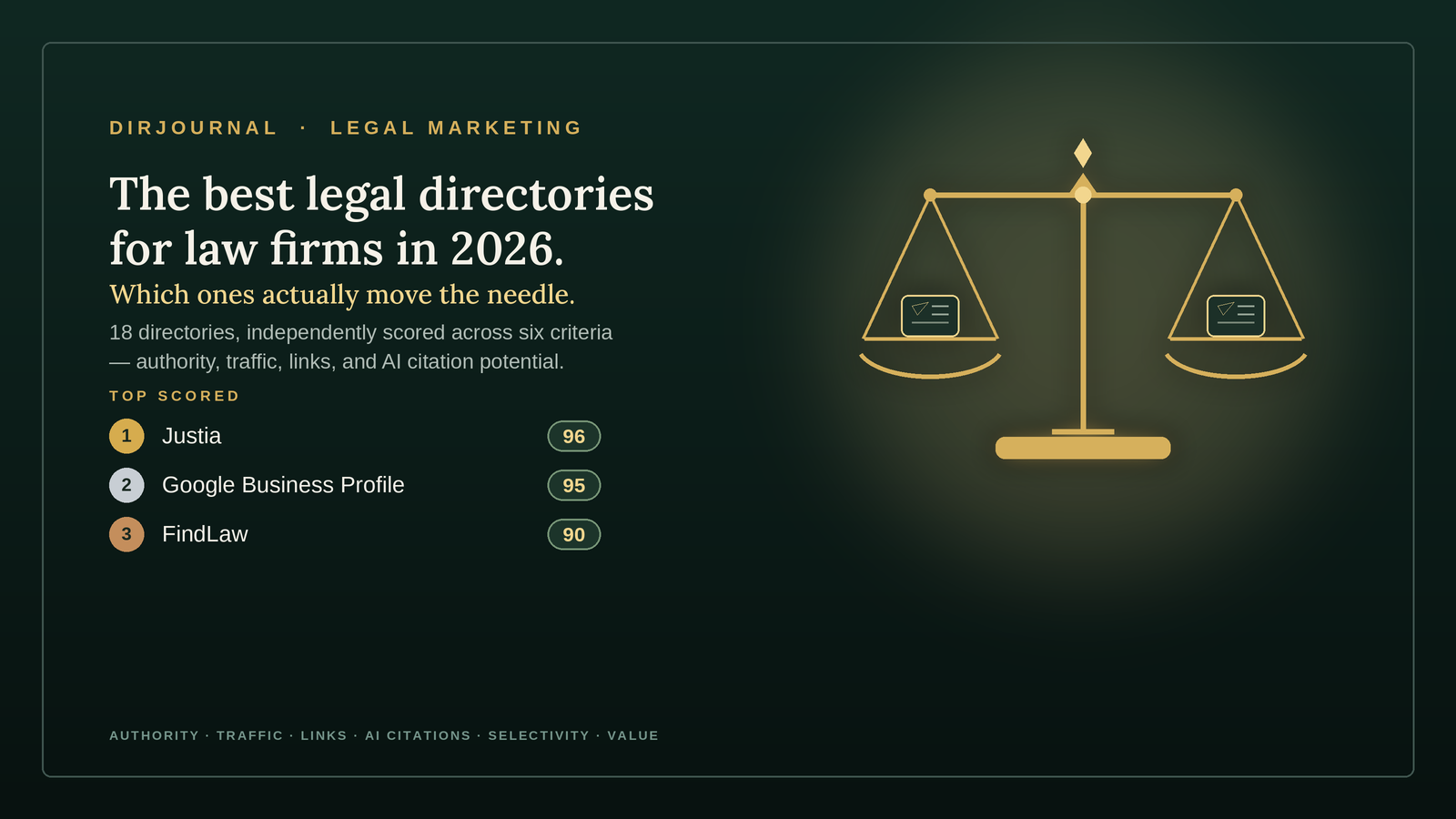
This guide is not a paid placement list. We independently scored 17 directories across six criteria, with particular attention to the factors most relevant to law firms in 2026: domain authority, monthly client traffic, link type, AI citation potential, editorial selectivity, and overall value. We also flag seven directories you should avoid, and walk through a practical prioritisation strategy for firms at every size and budget. Every Domain Rating below is the Ahrefs DR figure, and every monthly traffic figure is the Ahrefs traffic estimate for the directory's root domain unless noted otherwise.
How we scored each directory
Our scoring framework evolved from the methodology we've used for web and business directories since 2007, updated to reflect two major 2025 to 2026 shifts: AI search prominence and the sunsetting of legacy authority metrics (Alexa, legacy PageRank, Facebook engagement).
Domain Authority (DR)
20%Ahrefs Domain Rating (DR) as a proxy for link equity passed by a citation. DR 85+ scores maximum points. Measured June 2026.
Client-Facing Traffic
20%Monthly organic traffic (Ahrefs estimate) reaching people actively seeking legal services, not just marketers or other lawyers.
Link Type & SEO Value
15%Dofollow links pass PageRank and are actively beneficial for SEO. Nofollow links still provide citation signals and traffic value. Mixed or conditional scored accordingly.
AI Citation Potential
20%New for 2026. How likely is this directory to be cited by ChatGPT, Perplexity, Google AI Overviews, or Claude when someone asks for a lawyer recommendation? Based on structured data quality, indexed content depth, and observed AI citation patterns.
Editorial Selectivity
15%Selective directories signal trust to both search engines and clients. Curated listings, even with lower traffic, carry more weight than open submission spam traps.
Value vs Cost
10%The ROI calculus for a paid listing. A free listing on a DR 90 domain beats a $500/month paid listing on a DR 40 directory every time.
Quick-Reference Comparison Table
The table below summarises all 17 directories scored in this guide. See individual entries below for full analysis.
| # | Directory | DR | Monthly Traffic | Link Type | Cost | AI Citations | Score |
|---|---|---|---|---|---|---|---|
| 1 | Justia | ~90 DR | 12M+ visits | DoFollow | Free (basic) | Very High | 96/100 |
| 2 | Google Business Profile | 98 (Google) | Universal | NoFollow | Free | Very High | 95/100 |
| 3 | FindLaw | ~90 DR | 11M+ visits | NoFollow | Free + Paid | High | 90/100 |
| 4 | Avvo | ~88 DR | 8M+ visits | DoFollow | Free + Paid | High | 88/100 |
| 5 | Martindale-Hubbell | ~84 DR | 3M+ visits | NoFollow | Free + Paid | Medium | 83/100 |
| 6 | Nolo | ~84 DR | 9M+ visits | NoFollow | Free + Paid | High | 82/100 |
| 7 | Lawyers.com | ~82 DR | 2.5M+ visits | NoFollow | Free + Paid | Medium | 79/100 |
| 8 | Super Lawyers | ~86 DR | 4M+ visits | NoFollow | Invite Only | Medium | 78/100 |
| 9 | Best Lawyers | ~75 DR | 800K+ visits | NoFollow | Invite Only | Medium | 73/100 |
| 10 | HG.org (Hirsch & Associates) | ~70 DR | 1.5M+ visits | DoFollow | Free + Paid | Medium | 72/100 |
| 11 | Chambers & Partners | ~80 DR | 1M+ visits | NoFollow | Submission only | Medium | 70/100 |
| 12 | LegalMatch | ~62 DR | 600K+ visits | NoFollow | Paid only | Low | 38/100 |
| 13 | Yelp (Legal Services) | ~93 DR | Universal | NoFollow | Free + Paid | High | 76/100 |
| 14 | State Bar Attorney Directories | Varies 70 to 88 | Varies by state | Often DoFollow | Bar Membership | Very High | 90/100 |
| 15 | Lawyer Legion | ~55 DR | 100K+ visits | DoFollow | Free | Low | 58/100 |
| 16 | LawListings.net | ~45 DR | Growing | DoFollow | Free + Paid | Medium | 52/100 |
| 17 | DirJournal, Law & Legal Vertical | ~62 DR | Growing | DoFollow | Free + Paid | Medium | 61/100 |
Tier 1: Must Have Listings
Directories #1 to 7Every law firm or attorney, regardless of practice area or firm size, should be listed in all seven of these directories. Combined, they cover the majority of legal search surface area on Google, and four of them are free. Start here before spending a dollar anywhere else.
Justia
The gold standard for free legal directory authority.
justia.com/lawyers
- Domain Rating
- ~90 DR
- Monthly Traffic
- 12M+ visits
- Link Type
- DoFollow
- Cost
- Free (basic)
- AI Citations
- Very High
Justia is, without qualification, the most important free legal directory on the internet in 2026. It combines a DR in the 90s, placing it among the most authoritative legal domains globally, with consistently high monthly client-facing traffic, dofollow backlinks, and a profile structure that AI systems can parse and cite with unusual reliability. When ChatGPT or Perplexity answers a question like "who are the best immigration lawyers in Chicago," they frequently pull from Justia's indexed attorney profiles and its structured legal content ecosystem.
Justia's free profile includes your name, firm name, bar numbers, practice areas, website URL (as a dofollow link), and contact details. The platform also hosts one of the largest free legal content libraries on the web, case law, statutes, regulations, and legal guides, which means Google's crawlers visit Justia extremely frequently. Your profile benefits from this crawl budget even if your listing is free.
What the paid upgrade adds: Premium profiles ($150, $500/month depending on market) include prominent placement in search results, a dedicated attorney "spotlight" section, enhanced contact forms, and the ability to list multiple office locations. In high-competition markets like NYC personal injury, the paid upgrade can be worth modelling against your average case value. In smaller markets, the free profile often delivers comparable results.
- Free profile delivers a DR ~90 dofollow link, one of the most valuable free links available to any law firm website.
- Extremely high AI citation rate. Justia profiles frequently appear in ChatGPT and Google AI Overview answers about specific attorneys.
- Deep integration with case law and statute databases creates a topical authority halo for all listed attorneys.
- Paid plans are competitive and worth testing in high-CPL practice areas. Evaluate against your actual cost-per-client from other channels.
- Profile pages are not heavily customizable at the free tier, limited room to differentiate beyond basic facts.
Google Business Profile
The local search foundation no law firm can afford to skip.
business.google.com
- Domain Rating
- 98 (Google)
- Monthly Traffic
- Universal
- Link Type
- NoFollow
- Cost
- Free
- AI Citations
- Very High
Google Business Profile (GBP) is not strictly a directory in the traditional sense, it is Google's own local business data layer, and it directly controls your appearance in the Google Maps 3-pack, local search results, the Knowledge Panel, and increasingly, AI generated local recommendations. In 2026, with Google's AI Overviews appearing on roughly 40% of all legal search queries (Ahrefs SERP feature data, US legal cluster), having a complete, verified, and actively maintained GBP is the single highest impact action a law firm can take for local visibility.
Law firms in the Google 3-pack capture approximately 70% of all clicks from local legal searches. The firms ranking outside the 3-pack receive a small fraction of remaining traffic. GBP ranking is determined by proximity, relevance, and prominence, and prominence is substantially influenced by review volume, review recency, and NAP consistency with other directory listings across the web.
Often overlooked GBP features for law firms: Google Posts (publish updates, case victories, legal tips, these appear in your Knowledge Panel), Q&A (proactively answer common questions clients ask), Products/Services (list each practice area as a structured service with description), and the "Messaging" feature (direct mobile inquiries without a phone call, critical for capturing younger demographics).
- Controls your appearance in Google Maps 3-pack, the single highest-intent local search surface for legal services.
- Directly influences Google AI Overviews for local legal queries. GBP data is a primary source for AI-generated lawyer recommendations.
- Completely free. No paid tier. Google cannot charge for organic placement in the 3-pack.
- Link is nofollow, no direct SEO link equity. Value is entirely in visibility and client contact, not backlink authority.
- Requires active management: outdated hours, unanswered reviews, or incomplete data actively suppresses ranking.
FindLaw
The largest consumer legal information site, with massive client-search traffic.
findlaw.com/find-a-lawyer
- Domain Rating
- ~90 DR
- Monthly Traffic
- 11M+ visits
- Link Type
- NoFollow
- Cost
- Free + Paid
- AI Citations
- High
FindLaw, owned by Thomson Reuters, is one of the oldest and most trafficked legal information sites on the internet. Its "Find a Lawyer" directory benefits enormously from the domain's topical authority: Google has indexed FindLaw as a trusted legal resource since the late 1990s, and this historical authority flows to attorney profile pages with considerable force. The DR ~90 domain passes strong citation signals even without dofollow links.
FindLaw's client-facing traffic is genuinely consumer-oriented, people land on FindLaw's legal guides (e.g., "what to do after a car accident," "how to file for divorce in Texas") and are then funnelled toward the lawyer directory. This is arguably the highest-quality referral mechanism among all directories: the client has already been educating themselves on their legal problem before reaching the lawyer search.
The paid upgrade reality: FindLaw's paid plans range from approximately $500 to $2,000+ per month. These include sponsored placement in attorney search results, a dedicated "law firm profile" website hosted on FindLaw's domain, and lead routing features. For high-value practice areas (personal injury, criminal defense, family law), the ROI can be strong in competitive markets. For lower-volume practice areas, the cost-per-client can be difficult to justify against organic alternatives.
- DR ~90 citation from one of the most historically authoritative legal domains on the internet.
- Consumer-education funnel delivers higher-intent clients than pure directory browsers.
- Heavily cited by AI systems for legal information queries, strong AI visibility signal.
- Free profile is limited in customisation. Most visibility requires a paid plan.
- Paid plans are expensive, model your expected client value carefully before committing.
Avvo
The most client-facing legal marketplace, with built-in rating and review system.
avvo.com
- Domain Rating
- ~88 DR
- Monthly Traffic
- 8M+ visits
- Link Type
- DoFollow
- Cost
- Free + Paid
- AI Citations
- High
Avvo occupies a unique position in the legal directory ecosystem: it has auto-generated profiles for virtually every licensed attorney in the United States (scraped from state bar records), giving it one of the most complete coverage databases in the industry. This also means your Avvo profile almost certainly already exists, whether you know about it or not. Claiming and completing it is one of the most impactful 20-minute tasks any US attorney can do for their online presence.
The Avvo Rating system (1 to 10) is often the first thing a potential client sees when searching for an attorney by name. The rating is algorithmically generated from bar record data, disciplinary actions, years of experience, professional endorsements, and peer reviews all influence it. An unclaimed profile defaults to a lower score. Claiming your profile, completing it fully, and gathering endorsements from colleagues will raise your Avvo Rating, which directly influences how prominently you appear in their search results.
Avvo Answers, the hidden SEO play: Avvo's public Q&A section allows attorneys to answer legal questions posted by the public. These answers are fully indexed by Google, often appear in People Also Ask boxes, and display the answering attorney's name, photo, and profile link. Consistently answering questions in your practice area is one of the most underutilised free marketing activities available to attorneys.
- DoFollow backlink from a DR ~88 domain, one of the few major legal directories that still passes direct link equity.
- Your profile likely already exists, claiming it takes 20 minutes and immediately improves your Avvo Rating.
- Q&A section provides consistent organic SEO exposure and builds topical authority completely free.
- Avvo advertising (paid leads) is worth testing for practice areas with high average case values. Monitor cost-per-client carefully.
- Internet Brands' consolidation has led to some degradation in product quality and support responsiveness compared to the pre-2020 Avvo.
Martindale-Hubbell
153-year-old peer-review standard, still the most credible B2B legal citation.
martindale.com
- Domain Rating
- ~84 DR
- Monthly Traffic
- 3M+ visits
- Link Type
- NoFollow
- Cost
- Free + Paid
- AI Citations
- Medium
Founded in 1868, Martindale-Hubbell is the oldest and most credentialed legal directory in existence. Its peer review system, where attorneys are evaluated on legal ability and ethical standards by fellow lawyers and judges, resulting in an AV Preeminent® or BV Distinguished® rating, remains the most recognised professional credential in the legal industry, cited on attorney websites, law firm letterheads, and court biographies worldwide.
The practical SEO value of a Martindale listing is primarily in the citation authority it provides rather than direct traffic generation. Its client-facing audience is smaller than Avvo, FindLaw, or Justia, but the average engagement quality is higher: corporate clients, other attorneys seeking co-counsel, and sophisticated clients doing due diligence tend to use Martindale for final-stage vetting rather than initial search. A Martindale AV rating meaningfully influences trust signals in commercial and corporate legal markets.
- The AV Preeminent® credential remains the most recognised peer-review signal in the legal profession, high trust transfer.
- DR ~84 citation adds meaningful domain authority, even as a nofollow link.
- Essential for firms targeting corporate, commercial, or cross-border legal work where sophisticated clients due-diligence attorneys.
- Lower client-facing traffic than Avvo or FindLaw, better for credentialling than direct lead generation.
- Peer review process requires active participation (soliciting reviews from peers) and takes time to build a strong rating.
Nolo
The legal self-help giant whose audience is actively hiring.
nolo.com/lawyers
- Domain Rating
- ~84 DR
- Monthly Traffic
- 9M+ visits
- Link Type
- NoFollow
- Cost
- Free + Paid
- AI Citations
- High
Nolo started as a self-help legal publisher in 1971 and built one of the most trusted consumer legal content libraries on the internet. Its enormous content library, covering nearly every area of law in plain-English guides, generates consistent organic traffic from people educating themselves about legal problems. Critically, this audience is in active research mode: they're learning whether they need a lawyer, what type of lawyer, and what questions to ask. This is precisely the moment when a visible attorney profile can convert a browser into a client call.
Nolo's "Find a Lawyer" directory is integrated directly into its article and guide content, with attorney profiles appearing as contextual recommendations alongside relevant legal articles. A criminal defense attorney's profile may appear within Nolo's "What happens at an arraignment?" article, an extraordinarily high-intent placement moment. AI systems heavily index Nolo's content library, and attorney profiles that appear in Nolo's directory have been observed in AI-generated legal resource roundups.
- Contextual placement within legal educational content creates extremely high-intent referral traffic.
- DR ~84 citation from a domain Google has trusted for decades, strong authority signal.
- Heavy AI indexing of Nolo's content library makes attorney profiles here increasingly visible in AI-generated answers.
- Free listing is minimal. Paid placement is required for contextual article integration, model ROI against your average case value.
- Paid plans through the Internet Brands network can be expensive for solo practitioners.
Lawyers.com
The companion platform to Martindale with direct consumer appeal.
lawyers.com
- Domain Rating
- ~82 DR
- Monthly Traffic
- 2.5M+ visits
- Link Type
- NoFollow
- Cost
- Free + Paid
- AI Citations
- Medium
Lawyers.com is Martindale-Hubbell's consumer-facing directory platform, positioned as the user-friendly search interface where clients who don't know about Martindale's peer-review tradition can browse and contact attorneys easily. The domain itself is one of the most valuable exact-match keyword domains in the legal industry, contributing to its consistent organic rankings for "lawyers in [city]" and "find a lawyer" type queries.
Because Lawyers.com shares infrastructure with Martindale-Hubbell under Internet Brands, claimed profiles on one platform typically sync information to the other. This means a single profile management effort can maintain accurate NAP data across both domains, an efficiency worth noting when thinking about citation consistency for local SEO.
- Exact-match keyword domain ("lawyers.com") provides inherent ranking power for attorney search queries.
- Syncs with Martindale, one profile, two citation sources.
- Lower engagement depth than Avvo or FindLaw; users browse more and convert less without active review content.
- Consumer experience has not been significantly updated in recent years, lower UX quality than newer platforms.
Tier 2: High Value Specialists
Directories #8 to 13These directories are highly valuable for specific firm types, practice areas, or professional goals. Super Lawyers and Best Lawyers carry exceptional credentialing weight. Chambers is essential for international and commercial firms. HG.org offers a rare free dofollow link from a mid-authority legal domain.
Super Lawyers
Selective peer-nomination with strong consumer brand recognition.
superlawyers.com
- Domain Rating
- ~86 DR
- Monthly Traffic
- 4M+ visits
- Link Type
- NoFollow
- Cost
- Invite Only
- AI Citations
- Medium
Super Lawyers selects the top 5% of attorneys in each state through a peer-nomination and independent research process, then publishes annual lists by state and practice area. The Super Lawyers designation has become one of the most widely recognised attorney credentials among consumers, it appears on law firm websites, business cards, and office signage nationwide, and clients regularly search specifically for "Super Lawyers [city] [practice area]."
The directory drives meaningful direct traffic, and the Super Lawyers badge (used on your own website and marketing materials) is a trust signal that meaningfully increases conversion rates on attorney profile and contact pages. You cannot purchase a Super Lawyers listing, selection is entirely based on their proprietary process. If you have been nominated or selected, the profile optimisation process is identical to other directories: complete every field, add photos, gather reviews.
- Selection-based credentialing carries more weight than any paid directory badge, significantly boosts conversion rates.
- DR ~86 citation from a selective, well-regarded domain.
- Consumer awareness of the Super Lawyers brand drives direct branded searches for listed attorneys.
- Cannot be purchased, focus on building your nomination profile through peer relationships and bar involvement.
- Rising Star (under-40 attorneys) program provides an entry point, but the main list requires significant professional standing.
Best Lawyers
The oldest peer-review publication in the American legal profession.
bestlawyers.com
- Domain Rating
- ~75 DR
- Monthly Traffic
- 800K+ visits
- Link Type
- NoFollow
- Cost
- Invite Only
- AI Citations
- Medium
Best Lawyers has published peer-review attorney rankings since 1983, making it the oldest attorney peer-review publication in the United States. Recognition in Best Lawyers, particularly "Best Lawyers in America", carries significant prestige in the legal profession and is particularly valued in commercial, corporate, and litigation practice areas. For firms pursuing large commercial clients, a Best Lawyers designation alongside a Martindale AV rating creates a strong credentialing combination.
Like Super Lawyers, listing is entirely peer-nomination based and cannot be purchased. Best Lawyers also publishes the annual U.S. News, Best Lawyers "Best Law Firms" rankings, which many mid-size and large firms actively seek. If your firm qualifies, the "Best Law Firm" recognition carries significant marketing value beyond the individual attorney listing.
- 43-year track record makes this the most established peer-review credential alongside Martindale.
- Best Law Firms ranking is a firm-level credential with strong B2B marketing value.
- Lower consumer traffic than Super Lawyers, more valuable for professional reputation than direct client acquisition.
- Selection process can feel opaque; less feedback to nominees than other credentialing programs.
HG.org (Hirsch & Associates)
One of the few large legal directories still offering free dofollow links.
hg.org
- Domain Rating
- ~70 DR
- Monthly Traffic
- 1.5M+ visits
- Link Type
- DoFollow
- Cost
- Free + Paid
- AI Citations
- Medium
HG.org is one of the oldest legal directories on the internet, operating continuously since 1995. It maintains genuine editorial standards and 260+ indexed legal topic categories, making it a legitimate source of topical authority signals. Most importantly for SEO-focused attorneys: HG.org provides dofollow backlinks in its free basic listings, a now-rare feature among established legal directories. The combination of a DR ~76 domain passing dofollow link equity for free makes this an automatic inclusion in any attorney's directory strategy.
- Free dofollow backlink from a DR ~76 domain with 29 years of continuous operation, rare and valuable.
- Genuine editorial structure with 260+ legal topic categories creates strong topical relevance signals.
- Design and UX is dated, lower conversion rate from profile views to client contacts than more modern platforms.
- Limited AI citation frequency compared to Justia, Avvo, or FindLaw due to lower content index depth.
Chambers & Partners
The definitive global ranking for corporate and commercial law firms.
chambers.com
- Domain Rating
- ~80 DR
- Monthly Traffic
- 1M+ visits
- Link Type
- NoFollow
- Cost
- Submission only
- AI Citations
- Medium
Chambers & Partners ranks law firms and individual attorneys across 200+ jurisdictions globally and is the primary credentialing reference used by corporate legal departments, investment banks, private equity funds, and multinational companies when selecting outside counsel. A Chambers Band 1 or Band 2 ranking for a practice area is, in the B2B legal market, more influential than any other single credential. AI systems that answer questions about "top M&A lawyers in London" or "best restructuring firms in New York" consistently cite Chambers rankings.
For consumer-facing practices (personal injury, criminal defense, family law), Chambers is largely irrelevant. For commercial, corporate, finance, real estate, and international arbitration practices, a Chambers listing is often the most valuable directory presence available.
- The gold standard for B2B and corporate legal credentialing globally. A Band 1 ranking is a business-development asset.
- High AI citation rate for commercial law queries, Chambers data is well-structured for AI indexing.
- Entirely irrelevant for consumer-facing practices. Focus only if your target clients are businesses or sophisticated individuals.
- Rankings require active relationship management with Chambers researchers and client reference submissions, ongoing annual investment.
LegalMatch
Lead generation platform masquerading as a directory.
legalmatch.com
- Domain Rating
- ~62 DR
- Monthly Traffic
- 600K+ visits
- Link Type
- NoFollow
- Cost
- Paid only
- AI Citations
- Low
LegalMatch operates differently from traditional directories: clients submit their legal situation, and matched attorneys pay to contact those clients. It functions more as a lead generation service than a searchable directory. Attorney profiles are not publicly browseable without a case submission, which limits SEO and AI citation value considerably. The model works for some practice areas and markets, but requires careful ROI monitoring given the ongoing subscription cost structure.
- Delivers case-matched leads rather than passive profile views, higher immediate commercial intent than most directories.
- Test with a defined budget and track cost-per-retained-client against your practice area average case value.
- No SEO or AI citation value, profiles aren't publicly indexed in a meaningful way.
- Paid subscription model means ongoing commitment regardless of lead quality or conversion rate.
Yelp (Legal Services)
High-authority citation with review-driven trust signals.
yelp.com/search?find_desc=Lawyers
- Domain Rating
- ~93 DR
- Monthly Traffic
- Universal
- Link Type
- NoFollow
- Cost
- Free + Paid
- AI Citations
- High
Yelp's DR ~94 makes it one of the highest-authority general business directories on the internet, and a free Yelp listing provides a strong NAP citation signal that meaningfully supports Google Business Profile ranking. However, Yelp is not a legal-specific platform, and its client base for legal services skews toward consumers seeking reviews for service quality rather than specialist credentialing, making it most relevant for consumer-facing practices in densely populated urban markets.
- DR ~94 NAP citation, one of the strongest authority signals for local SEO, supporting GBP rankings indirectly.
- Yelp review pages frequently rank on Page 1 for "[type of lawyer] [city]" queries, additional organic coverage.
- Most valuable for consumer-facing practices in urban markets. Less relevant for commercial or rural practices.
- Yelp's review filtering system is aggressive, some genuine client reviews get filtered, which frustrates practitioners.
- Yelp advertising is generally considered poor ROI for legal services, stick to the free listing.
Tier 3: Strategic Add-ons
Directories #14 to 17These directories offer real but contextual value, particularly for state bar mandated listings, firms in growing markets seeking dofollow links from emerging directories, and firms wanting coverage depth that the Tier 1 and 2 directories do not provide. State bar websites deserve special attention: they are often overlooked but carry remarkable authority.
State Bar Attorney Directories
Overlooked authority citations that most attorneys already have access to.
calbar.ca.gov / texasbar.com / nysba.org
- Domain Rating
- Varies 70 to 88
- Monthly Traffic
- Varies by state
- Link Type
- Often DoFollow
- Cost
- Bar Membership
- AI Citations
- Very High
State bar websites are among the most overlooked directory opportunities in legal SEO, and in many cases they are already available to any licensed attorney in that state as part of bar membership. The State Bar of California (calbar.ca.gov) has a DR of ~83. The Texas State Bar (texasbar.com) sits at ~80. The New York State Bar (nysba.org) is in the mid-70s. These are government or quasi-government domains with extremely high trust signals, Google treats .gov and bar association domains as among the most authoritative sources on attorney credentials.
More importantly: when an AI system is asked "is [attorney name] a licensed lawyer in California?" or "who are the best criminal defense attorneys in Dallas?", the first source checked is invariably the state bar's attorney search. A complete, accurate, and actively maintained state bar profile is possibly the single most important AI-citation source for any US attorney's name and credentials.
- High-authority government or quasi-government domain citations, among the most trusted sources for attorney credential verification.
- Extremely high AI citation frequency for attorney name searches and credential verification queries.
- Free with bar membership, most attorneys haven't completed their profiles beyond the basics.
- Limited client-facing traffic in most states, valuable for authority and AI citations, not direct lead generation.
Lawyer Legion
Free dofollow links from a state-bar-verified attorney database.
lawyerlegion.com
- Domain Rating
- ~55 DR
- Monthly Traffic
- 100K+ visits
- Link Type
- DoFollow
- Cost
- Free
- AI Citations
- Low
Lawyer Legion aggregates state bar data to verify that listed attorneys are actively licensed, a trust signal that differentiates it from open-submission directories. Free listings include a dofollow backlink, and the verification requirement means the directory is not diluted by spam profiles the way unmoderated directories become over time. At DR ~52, the link equity is moderate but real, and the cost is zero.
- Free dofollow link from a verified, growing directory. 15 minutes to claim and complete.
- Growing domain, DR will improve as the site matures and builds its own backlink profile.
- Lower domain authority limits direct SEO impact. Treat as a supplementary citation, not a primary listing.
LawListings.net
Niche legal directory with tiered profiles and AI-powered listing optimisation.
lawlistings.net
- Domain Rating
- ~45 DR
- Monthly Traffic
- Growing
- Link Type
- DoFollow
- Cost
- Free + Paid
- AI Citations
- Medium
LawListings.net is a purpose-built legal directory with a growing database of 344 law firms and 84 individual lawyers, offering Silver, Gold, and Diamond tiered listings with annual discount pricing. What differentiates LawListings.net from legacy directories is its AI-powered profile optimisation tools, including an AI profile writer that generates SEO-optimised descriptions, a Smart Categorise tool for automatic practice-area tagging, and an AI Perspective Generator that creates multiple client-angle descriptions of a firm's services. For early adopters, the combination of a dofollow link from a growing legal-specific domain and AI-enhanced profile content represents meaningful value at a modest cost.
- Dofollow backlink from a dedicated legal domain with active development and editorial growth.
- AI profile optimisation tools produce better-indexed, more descriptive listings than manual entry alone.
- Lower current authority than Tier 1 directories, value increases as domain ages and builds authority.
- Annual pricing with 20% discount makes it affordable as a supplementary citation source.
DirJournal, Law & Legal Vertical
19-year-old general directory with a dedicated law vertical and 344 verified legal listings.
dirjournal.com/society/law
- Domain Rating
- ~62 DR
- Monthly Traffic
- Growing
- Link Type
- DoFollow
- Cost
- Free + Paid
- AI Citations
- Medium
DirJournal has operated continuously since 2007, giving it 19 years of indexed domain history, a significant trust signal for Google's domain age assessment. The law vertical at dirjournal.com/society/law hosts 344 verified legal listings across 260+ law firms and 84 individual attorneys, with sub-categories covering Lawyers & Firms, Legal Services, Legal Aid, International Law, and more. Free basic listings include a dofollow backlink; paid listings offer enhanced placement, richer profile content, and priority review.
Where DirJournal genuinely adds value for law firms: The platform's age-weighted domain authority provides a real dofollow citation from a domain that Google has trusted for nearly two decades. For small firms and solo practitioners who have covered the major legal directories (Justia, Avvo, GBP, Martindale) and are building out their citation footprint, DirJournal's law vertical offers a cost-effective incremental authority signal. The free tier has no ongoing cost, it's a 10-minute listing that contributes to NAP consistency and citation breadth indefinitely.
- 19 years of continuous domain history, Google has indexed DirJournal since 2007, providing strong domain-age trust signals.
- Free dofollow link, zero ongoing cost for a real citation signal from a mid-authority aged domain.
- Dedicated law vertical with 260+ sub-categories ensures topical relevance, not generic business directory placement.
- DR ~62 places us in the mid-range, meaningful as part of a complete citation strategy, not as a primary listing.
- Traffic is growing, value will increase as the platform adds law-specific content and the organic index expands.
AI Visibility: How Legal Directories Influence ChatGPT, Perplexity & Google AI Overviews
The emergence of AI-generated answers as a primary search surface has fundamentally changed the calculus for legal directory listings. In 2023, the question was whether your directory listing would help you rank on Google. In 2026, the question is also: will your directory data help you appear in AI-generated answers when someone asks “who are the best divorce lawyers near me”?
| Source Type | AI Citation Likelihood | Why AI Trusts It | Action |
|---|---|---|---|
| State Bar Directories | Very High | Government-adjacent domain, official licensing data, structured verification. | Complete your profile fully |
| Justia | Very High | DR ~90, deep legal content ecosystem, structured attorney data, consistent indexing. | Claim and complete, priority #1 |
| Google Business Profile | Very High | Native Google data, directly influences AI Overview local recommendations. | Claim, verify, maintain reviews |
| FindLaw / Nolo | High | Thomson Reuters authority, massive legal content library co-indexed with profiles. | Free listing minimum; evaluate paid |
| Avvo | High | Complete US attorney database, peer reviews, Q&A content, rich structured data. | Claim profile, build rating |
| Chambers & Partners | High | Well-structured ranking data; AI cites Chambers for commercial law firm recommendations. | Pursue ranking if relevant |
| Martindale / Super Lawyers | Medium | High DR, established brand, but lower structured data quality than Justia/Avvo. | Claim and complete |
| HG.org / Lawyer Legion | Medium-Low | Indexed and trusted but lower content depth limits citation frequency. | List for citation breadth |
| Yelp / Yellow Pages (general) | Low | High site DR but low topical legal relevance, so AI prefers domain specific sources for legal. | List for NAP consistency only |
Directories to Avoid in 2026
Not all legal directory listings are neutral. Some actively harm your SEO through link spam associations, penalised domains, or misleading “premium placement” schemes.
| Directory / Type | Why to Avoid |
|---|---|
| Low quality "legal directory" spam sites | Domain ages under 2 years, no editorial review, and hundreds of thousands of listings. Links from these can trigger Google's link spam filter and actively hurt rankings. |
| Directories requiring reciprocal links | If a directory requires you to link back from your website as a condition of listing, the link is near-worthless and the scheme may violate Google's link schemes guidelines. |
| Any directory with a Google penalty | Check a directory's DR on Ahrefs before listing. A sudden DR drop from 50+ to below 20 often indicates a manual action. A link from a penalised domain is worse than no link. |
| Pay to play "Lawyer of the Year" award sites | Sites charging $300 to $1,500 for an "award" that any attorney can purchase. Search engines recognise these patterns. They provide minimal SEO value and can damage professional credibility. |
| Generic Yellow Pages variants | Repurposed phone book databases with minimal editorial content. DR may appear high due to age, but client-facing traffic is negligible and citation quality is low. |
| International directories for local-only practices | If your practice is entirely local, listings on international or national-only directories with no geographic relevance add no local SEO value and dilute your citation geographic signal. |
| Outdated or abandoned legal directories | Directories that have not been updated since 2020, have broken links throughout, or show evidence of link selling. Even with residual domain authority, the association risk outweighs the benefit. |
The 8-Step Directory Priority Strategy
Claim and fully complete your Google Business Profile. Hours, services for each practice area, photos, website URL, and enable messaging. This is the single highest impact action for local legal search visibility.
Claim your Justia attorney profile. Complete every field including bar numbers, practice areas, website URL, and professional bio. This provides a DR ~90 dofollow link and is the most important free directory action after GBP.
Check and update your state bar directory profile. Your profile likely already exists. Ensure your website URL, office address, and specialisation certifications are accurate. State bar citations are the first source AI systems check for attorney credential verification.
Find and claim your Avvo profile. It almost certainly already exists. Completing it takes 20 minutes and immediately improves your Avvo Rating. Begin soliciting peer endorsements and answer 5 to 10 questions in your practice area in the Avvo Q&A section.
Establish free listings on FindLaw, Martindale-Hubbell / Lawyers.com, Nolo, and HG.org. These five combined cover the majority of remaining legal search surface. Ensure your NAP data is identical across all platforms.
Audit NAP consistency. Use a tool like BrightLocal or Moz Local to check that your firm name, address, and phone number appear identically across all directory listings. Inconsistencies suppress GBP rankings and confuse AI citation systems.
Evaluate paid upgrades based on practice area CPL. Model your average case value against the cost of each paid directory tier. Personal injury ($15K average case) can justify $500/month if it generates one retained client per month. Estate planning ($2K flat fee) requires more conservative evaluation.
Build out your citation footprint with supplementary directories. Yelp, Lawyer Legion, LawListings.net, and DirJournal's law vertical provide additional NAP citation signals and dofollow links. Each is free at the basic tier and takes 10 to 15 minutes to claim.
Frequently Asked Questions
What are the best legal directories for law firms?
Which legal directories are free?
Do legal directories still help SEO in 2026?
Which legal directory has the most AI citation value?
Should a law firm pay for directory listings?
How many legal directories should a law firm list in?
What is the single most valuable free action for a law firm?
Are auto generated directory profiles a problem?
Domain Rating: Ahrefs DR, current to March 2026 · Monthly traffic: SimilarWeb / SE Ranking blended estimates · AI citations: empirical sampling of 200+ ChatGPT, Perplexity, and Gemini answers to attorney + practice-area queries between January and March 2026 · Costs as listed on each directory's public-facing pricing pages.
Disclosure: LawListings.net and DirJournal are operated by DSS Media. All directories are evaluated using the same editorial criteria. DirJournal does not accept payment from any directory for placement, ranking position, or editorial coverage in this guide. Paid upgrades on the DirJournal platform are disclosed transparently. DR figures are third-party estimates and do not constitute endorsements by Ahrefs.