Independent. Human-Curated. Established 2007.
Corporate Finance vs. Business Finance – What's The Difference?
DirJournal Founder · 19+ years building directory and discovery products. Editorial-team verified.
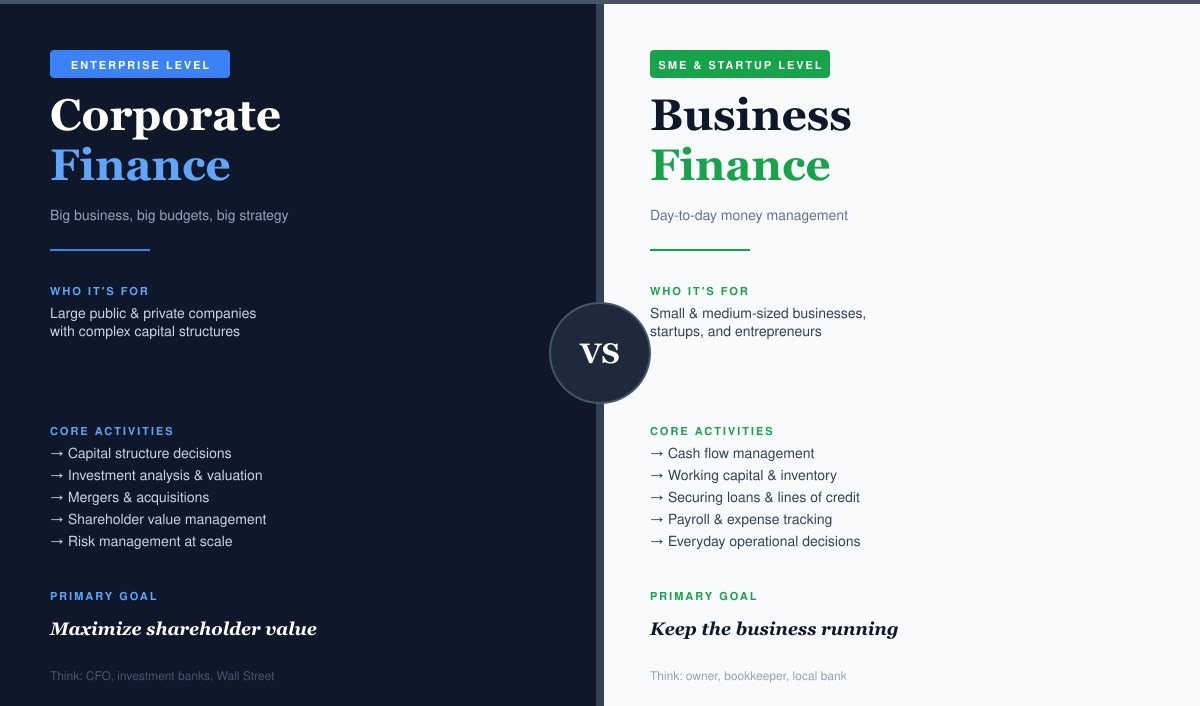
Corporate finance focuses on maximising shareholder value within large corporations — through capital structure decisions, investment analysis, and transactions like mergers and IPOs. Business finance is the broader discipline: it covers financial management across all types and sizes of business, including day-to-day cash flow, budgeting, working capital, and securing funding for operations. Every corporation uses business finance principles, but not every business operates under the rules of corporate finance.
Corporate Finance vs. Business Finance: the Core Difference
If corporations are businesses and some business are corporations, then shouldn't corporate finance and business finance be the same thing? Well, not really. Even though a corporation is technically a business, there's a different type of finance that applies to a corporation than say, a sole proprietorship. Confused, yet? Hang in there. A more thorough explanation is coming.
Corporate finance deals with the financial decisions that a corporation makes in its day to day operations. It focuses on using the capital the corporation currently has to make more money while simultaneously minimizing risks of certain decisions. The ultimate goal is to increase wealth of the corporation's shareholders.
Business finance has a focus on the financial decisions made in all types of business – including, but certainly not limited to, corporations. Business finance deals with the same underlying concept of raising capital for business use, but also incorporates capital management. Managing accounts receivable, payroll, inventory financing, and short-term credit lines all fall under the business finance umbrella.
At a Glance: Corporate Finance vs. Business Finance
The seven dimensions where the two disciplines diverge most clearly.
| Dimension | Corporate Finance | Business Finance |
|---|---|---|
| Primary Goal | Maximise shareholder value | Sustain & grow the business |
| Who It Applies To | Public & large private corporations | All business types & sizes |
| Key Activities | IPOs, M&A, capital structure, NPV analysis | Cash flow, budgeting, working capital, payroll |
| Time Horizon | Long-term strategic (3–10+ years) | Short & medium-term (daily to 3 years) |
| Capital Sources | Equity markets, bonds, institutional debt | Bank loans, overdrafts, retained earnings, grants |
| Risk Framework | Shareholder risk tolerance; board-level decisions | Owner/operator risk tolerance; operational focus |
| Key Metrics | EPS, WACC, ROE, NPV, share price | Cash flow, gross margin, working capital ratio |
IPOs and Going Public
Initial Public Offering, or IPO, is when the corporation makes its first sale of common shares on a public stock exchange. An IPO's primary goal is to make money for the corporation. As you may discover through a business directory, some choose to remain privately invested companies and never have stock that's traded on a public exchange market.
Investment Portfolios: Short-Term and Long-Term
Corporations often plan their investment portfolio in short-term and long-term increments. In the short-term, money markets are the primary investing market. Some common money market instruments are certificates of deposits, commercial papers, federal funds, municipal notes, and treasury bills. Capital markets are used for longer-term investing. The capital market includes the stock and bond markets.
Project Valuation and Capital Budgeting
In corporate finance, the company makes decisions about the projects that will be invested in. To determine which projects are profitable and which are not, the company goes through a valuation process to estimate the value of the project. Projects are assigned an NPV, or net present value, based on the expected cash flow from the project.
Projects also have a risk associated. These risks must also be evaluated to determine whether the project is a worthy investment. Projects with a high NPV and high risk might lose out to a project with a medium NPV and low risk. Remember, the primary goal of the corporation is to provide value for the shareholders. High risks will keep the company from achieving its goals. As such, projects with high risks (that can't be mitigated) will often be forfeited for more attractive projects.
Mergers and Acquisitions
Mergers and acquisitions are another part of corporate finance. Companies often have financial reasons for combining with another company. While it may be direct or indirect, ultimately all mergers and acquisitions are to affect the corporation's bottom line. When a company is merged or acquired it's usually done at market value. The "acquiring" firm has the hope that the result of the merger/acquisition will exceed the premium of the purchase. Merger and acquisition decisions are treated as other project decisions with a valuation and risk assessment being made prior to purchase.
One of the most common points of confusion is assuming that corporate finance is simply "finance for serious businesses" and business finance is "finance for small ones." That's not quite right. The distinction is structural, not a matter of scale or sophistication.
You are operating under business finance principles if you are: a sole trader or sole proprietor managing your own cash flow and tax; a partnership deciding how to split profits and fund growth; an SME owner managing working capital, payroll, and bank credit lines; or a startup founder raising seed capital and monitoring your burn rate. All of these situations — regardless of how ambitious or fast-growing the business is — involve business finance fundamentals: cash flow, budgeting, capital acquisition, and financial sustainability.
Corporate finance becomes relevant when: your business is structured as a corporation (C-Corp, plc, Ltd.) with shareholders; you are considering going public via an IPO; your board is evaluating a merger, acquisition, or divestiture; or you are structuring large-scale debt or equity raises that involve institutional investors. The presence of shareholders whose wealth must be actively managed is the clearest signal that corporate finance principles apply.
Which Should I Study? Corporate Finance vs. Business Finance Career Paths
A major search intent for this topic — students and professionals choosing between the two disciplines.
If you are considering a finance career or choosing between degree programmes, the distinction between corporate finance and business finance has real implications for what you study, where you work, and what you earn.
Corporate Finance Career
- Investment banking analyst/associate
- Corporate development manager
- M&A advisor
- Treasury analyst at a public company
- Capital markets specialist
- CFO at a large corporation
Business Finance Career
- Financial controller at an SME
- Business finance manager
- Commercial finance analyst
- Finance director at a private company
- Business banking relationship manager
- Startup CFO or head of finance