The Big Domain Glossary: Every Term You Need to Know (2026)
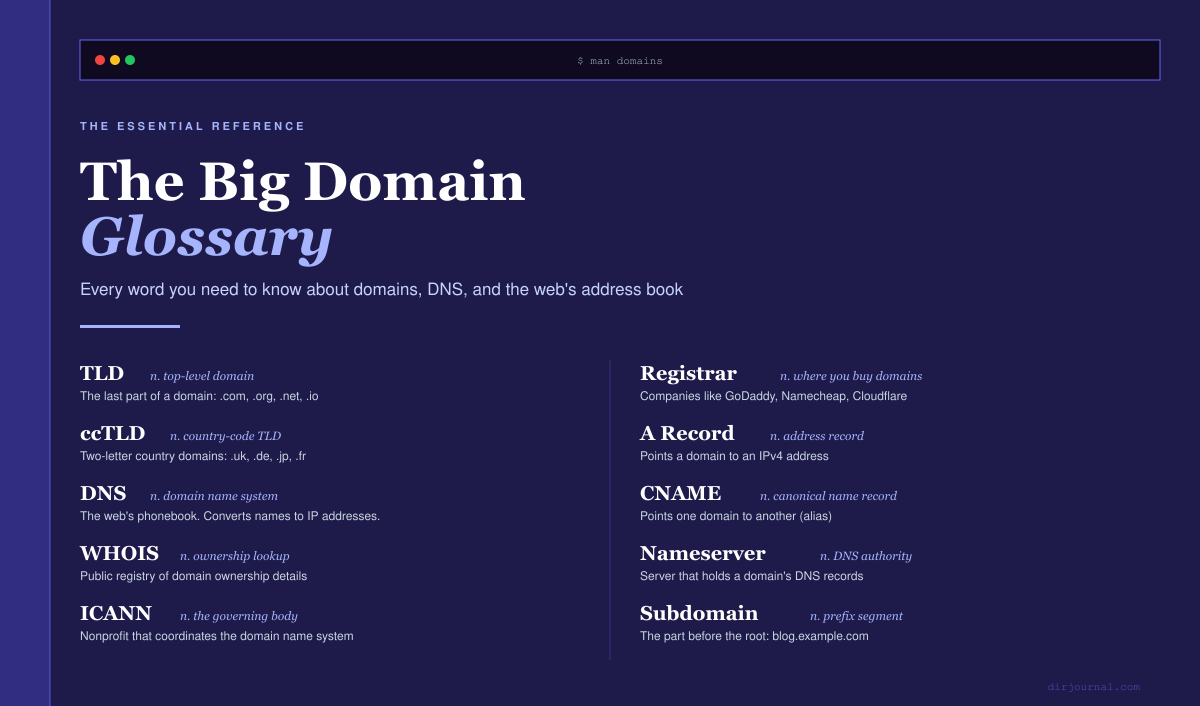
A domain name is the human-readable address of a website (e.g. dirjournal.com) that maps to an IP address via the Domain Name System (DNS). This glossary covers over 60 essential domain industry terms — from the basics (TLD, registrar, WHOIS) through to modern developments (Web3 domains, AI-driven appraisals, blockchain domains, GDPR-era privacy protection).
The Big Domain Glossary: Every Term You Need to Know
The terminology associated with domain names can be unfamiliar and occasionally confusing — especially as the industry has evolved significantly since the original version of this glossary was written. This updated 2026 edition adds Web3 and blockchain domains, AI-powered domain tools, GDPR-era privacy changes, new gTLD categories, and the current ICANN policy landscape.
A domain name is the human-readable address used to identify a website or other internet resource. It functions as a mnemonic for IP addresses — instead of typing 172.217.14.196, you type google.com. Domain names consist of a name (the second-level domain) and an extension (the top-level domain): in "dirjournal.com", "dirjournal" is the second-level domain and ".com" is the top-level domain.
An Internet Protocol address is the numerical label assigned to every device connected to a computer network. IPv4 addresses are 32-bit numbers expressed as four groups of digits (e.g. 192.168.1.1). IPv6 addresses are 128-bit, expressed in hexadecimal (e.g. 2001:0db8:85a3:0000:0000:8a2e:0370:7334), and were introduced to address IPv4 exhaustion. The Domain Name System (DNS) translates domain names into IP addresses so browsers can load websites.
The Domain Name System is the internet's phonebook — a globally distributed database that maps domain names to IP addresses. When you type a URL, your browser queries a DNS server to find the corresponding IP address. DNS is hierarchical: root servers → TLD servers → authoritative nameservers for each domain. DNS records include: A records (domain → IPv4), AAAA records (domain → IPv6), CNAME records (alias to another domain), MX records (email routing), TXT records (verification and policy data), and NS records (authoritative nameservers).
The suffix at the end of a domain name. TLDs are categorised as: gTLDs (generic TLDs: .com, .net, .org, .info, .biz), ccTLDs (country code TLDs: .uk, .de, .au, .ae), New gTLDs (introduced from 2013 onward: .app, .shop, .blog, .tech, .io, .ai and 1,200+ others), and sponsored TLDs (.gov for US government, .edu for US universities, .mil for US military). The .com TLD remains the most trusted and most valuable for commercial purposes, commanding premium resale prices over comparable .net or .org domains.
The portion of the domain name immediately to the left of the TLD. In "dirjournal.com", "dirjournal" is the SLD. This is the part you register and own. In country-specific structures like "company.co.uk", ".co" is the second level and "company" is the third level.
A domain that is a subset of a larger domain. In "blog.dirjournal.com", "blog" is the subdomain of "dirjournal.com". Subdomains are free to create if you own the parent domain and can be used to organise different sections of a site (shop.example.com, docs.example.com). Search engines typically treat subdomains as separate entities from the root domain for SEO purposes, though this is nuanced.
An organisation accredited by ICANN (or a national authority for ccTLDs) to register domain names on behalf of individuals and organisations. Major registrars include GoDaddy, Namecheap, Google Domains (now part of Squarespace), Cloudflare Registrar, and Name.com. Registrars compete on price, renewal rates, interface quality, and bundled services. Registrar price ≠ renewal price — many offer cheap first-year registration with higher renewal fees. Always check the renewal rate before registering.
The organisation that manages the master database of a TLD. Not to be confused with a registrar — the registry is the wholesaler, registrars are the retailers. Verisign operates the .com and .net registries. The Public Interest Registry operates .org. Each ccTLD has its own national registry. Registries set the wholesale price and rules for their TLD; registrars then sell to the public at retail prices.
The Internet Corporation for Assigned Names and Numbers is the non-profit organisation responsible for coordinating the global internet's naming and numbering systems. ICANN accredits registrars, oversees the root zone (the master list of all TLDs), manages the WHOIS system, and runs dispute resolution processes (UDRP). ICANN's policy decisions — including the introduction of new gTLDs and WHOIS privacy rules — significantly affect the domain industry. Based in Los Angeles, ICANN operates under a multi-stakeholder governance model.
A public database that historically showed the registration details (name, address, email, phone) of every domain owner. WHOIS was significantly changed by GDPR in 2018 — European registrants' personal data is now redacted by default, replaced by a privacy-masked contact. Most major registrars now offer WHOIS privacy protection (often free) that replaces your personal contact details with proxy information. Despite GDPR-era privacy, WHOIS still shows registration date, expiry date, registrar, and nameservers — useful for domain research.
Servers that store the DNS records for a domain and respond to DNS queries about it. When you register a domain, you point it at nameservers (usually provided by your web host or DNS provider) that then direct traffic to the correct IP address for your website, email server, etc. Changing nameservers redirects all traffic from a domain — a critical step when migrating a website to a new host. Nameserver changes propagate globally in 24–48 hours (DNS propagation).
The process of acquiring the right to use a domain name for a specified period (typically 1–10 years). Domains are not owned outright — they are licensed from the registry via a registrar for a recurring fee. If you fail to renew, the domain expires and becomes available for others to register. Setting auto-renewal is strongly recommended for any domain you rely on.
When a domain registration expires, it does not immediately become available. Most registries have a grace period (typically 30 days) during which the original owner can renew. This is followed by a Redemption Grace Period (another 30 days) during which renewal is possible but at a significantly higher cost ($80–$200+). After that, the domain enters a pending delete phase before becoming publicly available. Expired domains with significant backlinks are actively monitored and snapped up by drop-catchers within seconds of release.
Moving a domain registration from one registrar to another. Requires an EPP/auth code (a security code from the current registrar), disabling of transfer locks, and a WHOIS email confirmation. Transfers are prohibited for 60 days after initial registration or a previous transfer (ICANN policy). Transfers do not affect nameservers or website content — they only change who manages the registration.
A unique security code required to authorise the transfer of a domain between registrars. Sometimes called an auth code, transfer code, or authorisation key. The current registrar generates this code — request it before initiating a transfer. Without the correct EPP code, a transfer cannot proceed.
A security setting that prevents unauthorised transfer of a domain to another registrar. Recommended to keep enabled unless actively transferring. Also called the Registrar Lock. A domain can also have a Registry Lock (more robust, requiring manual intervention by the registry to change) used for high-value or critical domains.
A domain with high inherent value due to its characteristics: short length, exact-match keywords, generic commercial terms, or memorable quality. Premium domains are either sold by registries at elevated registration prices or traded in the secondary market. The most expensive domain sales include Cars.com ($872M), Insurance.com ($35.6M), Voice.com ($30M), and Sex.com ($13M). Premium .com domains are typically priced in the thousands to millions; their primary value comes from direct type-in traffic and SEO authority.
A domain whose name exactly matches a high-value keyword or search query (e.g. cheaphotels.com, personalinjurylawyer.com). EMDs historically received a significant SEO boost in Google's algorithm. Google's 2012 "EMD update" significantly reduced this advantage for low-quality sites, but high-quality EMDs still carry SEO value through brandability, backlink anchor text, and click-through rates. EMDs remain highly valued in domain investment markets.
A domain created as a unique brand name rather than a keyword description — typically short, memorable, easy to pronounce and spell, and without dictionary meaning (e.g. Stripe, Shopify, Zapier, Canva). Brandable domains have become increasingly preferred over EMDs as brand-building has become a stronger long-term SEO and business strategy than keyword matching.
Two-letter domain extensions assigned to specific countries or territories: .uk (United Kingdom), .de (Germany), .au (Australia), .ae (United Arab Emirates), .ca (Canada). Some ccTLDs have become widely used for non-geographic purposes: .io (originally British Indian Ocean Territory) is ubiquitous among tech startups; .ai (Anguilla) has become extremely popular given the AI industry boom; .co (Colombia) is commonly used as a .com alternative.
ICANN began releasing new generic TLDs in 2013–2014, expanding from the original handful (.com, .net, .org, .info, .biz) to over 1,500 options including .app, .shop, .blog, .tech, .store, .online, .digital, .agency, .studio, and hundreds more. Adoption has been mixed — .io, .app, .dev, and .ai have achieved genuine traction; many others see minimal usage. Google has confirmed that new gTLDs are treated equally to .com in search rankings, but .com continues to command the highest commercial trust and premium resale value.
A new category of domain that operates on blockchain networks rather than traditional DNS. The most prominent systems are Ethereum Name Service (ENS) using .eth extensions and Unstoppable Domains using extensions like .crypto, .wallet, .nft, and .blockchain. Web3 domains are stored as NFTs in a crypto wallet — no registrar, no renewal fees, true ownership. Primary use cases in 2026: receiving cryptocurrency payments (your .eth name can replace a 42-character wallet address), identity in Web3 applications, and censorship-resistant websites. Limitation: Web3 domains do not work in standard browsers without a special extension or resolver — they are not accessible via ordinary DNS.
AI has significantly changed how domains are researched, appraised, and purchased. AI domain name generators (GoDaddy's domain generator, Namelix, Lean Domain Search) now suggest hundreds of brandable options in seconds based on industry and style preferences. AI-powered appraisal tools estimate domain value based on keyword analysis, comparable sales, traffic data, and backlink profiles. In 2026, AI-assisted domain brokerage — where AI identifies potentially valuable expired domains and routes acquisition offers — is an active area of development among domain investors.
The General Data Protection Regulation (GDPR), implemented in the EU in 2018, fundamentally changed WHOIS. Personal data of European registrants is now redacted from public WHOIS by default. Most major registrars globally followed suit, offering free WHOIS privacy protection that replaces personal contact details with proxy information. This is now standard practice — all new domain registrations should enable WHOIS privacy unless there is a specific reason for public contact information (some organisations choose to display contact details for transparency).
Pointing a registered but undeveloped domain to a parking page — typically a page showing pay-per-click advertisements relevant to the domain's keywords. Domain parking generates passive revenue from type-in traffic on valuable domains. Revenue depends on traffic volume and keyword CPC values. Major parking services include Sedo, Bodis, and ParkingCrew. Parking is most viable for high-value generic keyword domains; most parked domains generate negligible income.
The practice of attempting to register an expired domain the moment it becomes publicly available. High-value expired domains are monitored by automated systems (drop-catchers) that submit registration requests in the milliseconds after a domain enters the available pool. Services like SnapNames, DropCatch, and GoDaddy Auctions facilitate drop-catching and backorder systems. An expired domain with significant backlinks can be extremely valuable for SEO purposes — a major driver of the domain aftermarket.
ICANN's mandatory dispute resolution process for domain name conflicts — primarily used against cybersquatting (registering a domain that infringes a trademark with bad faith intent to profit). UDRP decisions can result in domain transfer or cancellation. The process is faster and cheaper than litigation. Complainants must prove: (1) the domain is identical or confusingly similar to their trademark, (2) the respondent has no legitimate rights, and (3) the domain was registered and is being used in bad faith. UDRP is not appropriate for good-faith registration conflicts — those require other dispute mechanisms or litigation.
A digital certificate that authenticates a website's identity and enables encrypted HTTPS connections. SSL (Secure Sockets Layer) has been superseded by TLS (Transport Layer Security) but the term SSL is still commonly used. All websites should use HTTPS — Google has used it as a ranking signal since 2014, browsers display security warnings on HTTP sites, and user data submitted via forms on HTTP sites is transmitted unencrypted. Let's Encrypt, launched in 2016, provides free SSL certificates and has dramatically accelerated HTTPS adoption globally. Most hosting providers now include free SSL with all plans.
A registry manages the master database of all domains in a TLD (e.g. Verisign runs .com). A registrar is accredited by the registry to sell domain registrations to the public (e.g. GoDaddy, Namecheap). The registry is the wholesaler; the registrar is the retailer you interact with. Registrars compete on price and services; the underlying registry infrastructure is the same regardless of which registrar you use.
Web3 domains (like .eth from Ethereum Name Service or .crypto from Unstoppable Domains) are blockchain-based identifiers stored as NFTs in a crypto wallet. They can be used to receive cryptocurrency payments and access decentralised applications. They are not accessible via standard browsers without additional configuration. In 2026 they are useful for crypto users and Web3 enthusiasts but have limited mainstream utility. Standard .com domains remain far more commercially valuable.
Yes, for virtually all personal and small business domain registrations. WHOIS privacy replaces your personal contact details (name, address, email, phone) with proxy information in the public WHOIS database, protecting against spam, unsolicited sales calls, and identity data harvesting. Most registrars now include it free. The only reason not to enable it is if your organisation requires public contact visibility for transparency — which applies to very few registrants.
Frequently Asked Questions
What is a domain name in simple terms?
What is the difference between a domain registrar and registry?
What are Web3 domains and are they worth buying?
Is WHOIS privacy worth enabling?
Related Resources
Looking for verified service providers? Browse our directory categories below — all human-audited and trusted by decision-makers since 2007.