How to Write a White Paper
Key Takeaways: Writing a White Paper
- 1A white paper is a persuasive "Problem/Solution" tool, not a sales brochure.
- 2Successful B2B white papers build Lifetime Domain Equity by positioning your brand as the authority.
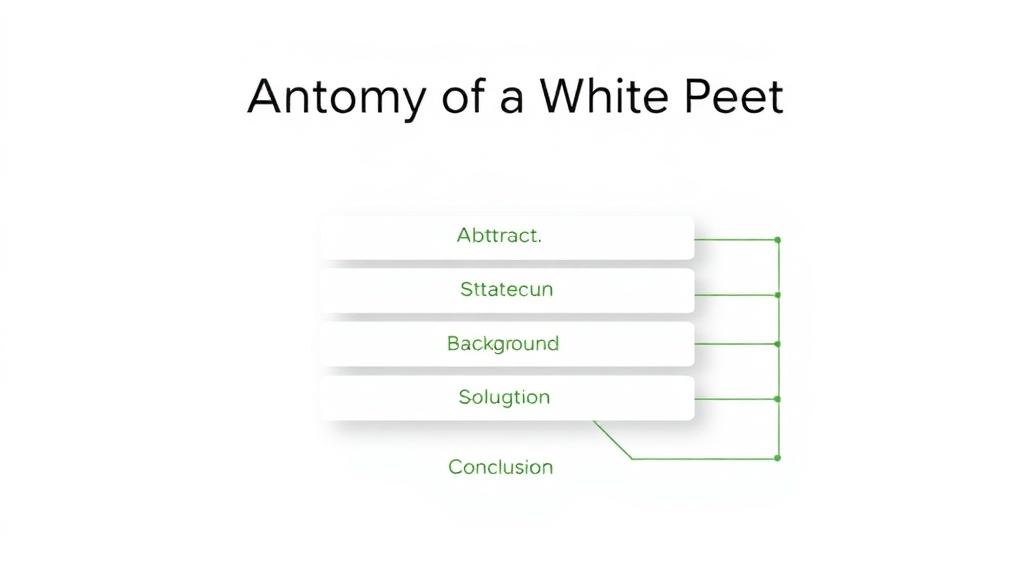
- 3Structure follows: Abstract → Problem → Background → Solution → Conclusion.
- 4Distribution strategy matters as much as writing quality — gate it for lead generation.
Consider learning how to write a white paper if you're looking to improve your content marketing efforts. White papers, like other long-form content marketing pieces such as case studies and e-books, have the potential to influence people not through flashy sales copy but through informative content. Simply put, you open people up to your marketing message by first giving them content they actually want to read.
White Paper vs. E-Book: At a Glance
| White Paper | E-Book |
|---|---|
| Persuasive, data-driven argument | Educational, narrative-driven content |
| Formal, authoritative tone | Conversational, accessible tone |
| 6–20 pages, text-heavy | 20–100+ pages, visually rich |
| B2B decision-makers & C-suite | Broader audience, early-stage leads |
| Best for lead generation & thought leadership | Best for brand awareness & education |
If you've heard of white paper writing as a marketing tactic already, you probably already know white papers can be excellent tools to drive leads and sales. But what are white papers -- and how do you write one? While white papers can seem complicated, they don't have to be. This article will teach you the basics of how to write a white paper of your own.
Note: There are some differences of opinion in the white paper writing community regarding things like abstracts, best lengths, and rates if you choose to outsource your writing. My opinions are based on years of experience in writing marketing white papers for small businesses, so that is the perspective this article is coming from. Please don't think that there's only one "right" way to format or write a white paper.
Let's get started:
Key Concept: What Is a White Paper?
In short, a white paper is a report. That's it. Nothing fancy there. Like other business freebies, they're designed to do two primary things: educate and persuade. Here's what I mean. Let's say your company released a new software package, and you want to increase sales to corporate clients (who will use the software company-wide). You aren't targeting end consumers. You're targeting executive-lev
What's in a White Paper?
So you know your white paper has to educate someone about your product or service, and it has to convince them to buy from you. How does it do that? Let's oversimplify.
When you write a white paper, here's what it should say to the reader:
White Paper: "You have a problem, whether you know it yet or not -- a big problem for your business. Here's what that problem is and proof that it affects businesses like yours."
Reader: "Oh no. You're right. That is a problem."
White Paper: "That problem might even be tied to other, smaller problems. Uh oh, you'd better find a solution, and fast."
Reader: "Wow! I didn't realize all of that. Okay. Quick. Give me a solution."
White Paper: "You're in luck. Here's an idea that could make all of your problems go away. Let me describe the basic solution for you without shoving a marketing message down your throat yet to help you understand it better."
Reader: "Great. I think I understand, and I agree -- that sounds like it might work and be really good for my business. Any specific recommendations on who to hire?"
White Paper: "Um, yeah. Me! Here's why my company or my product meets your needs."
Reader: "Sign me up!"
Okay. That's obviously not quite what's going through a reader's head, but it shows you the intended train of thought when moving from one section to the next of the basic white paper outline.
Elements of a White Paper
Here's what that outline looks like:
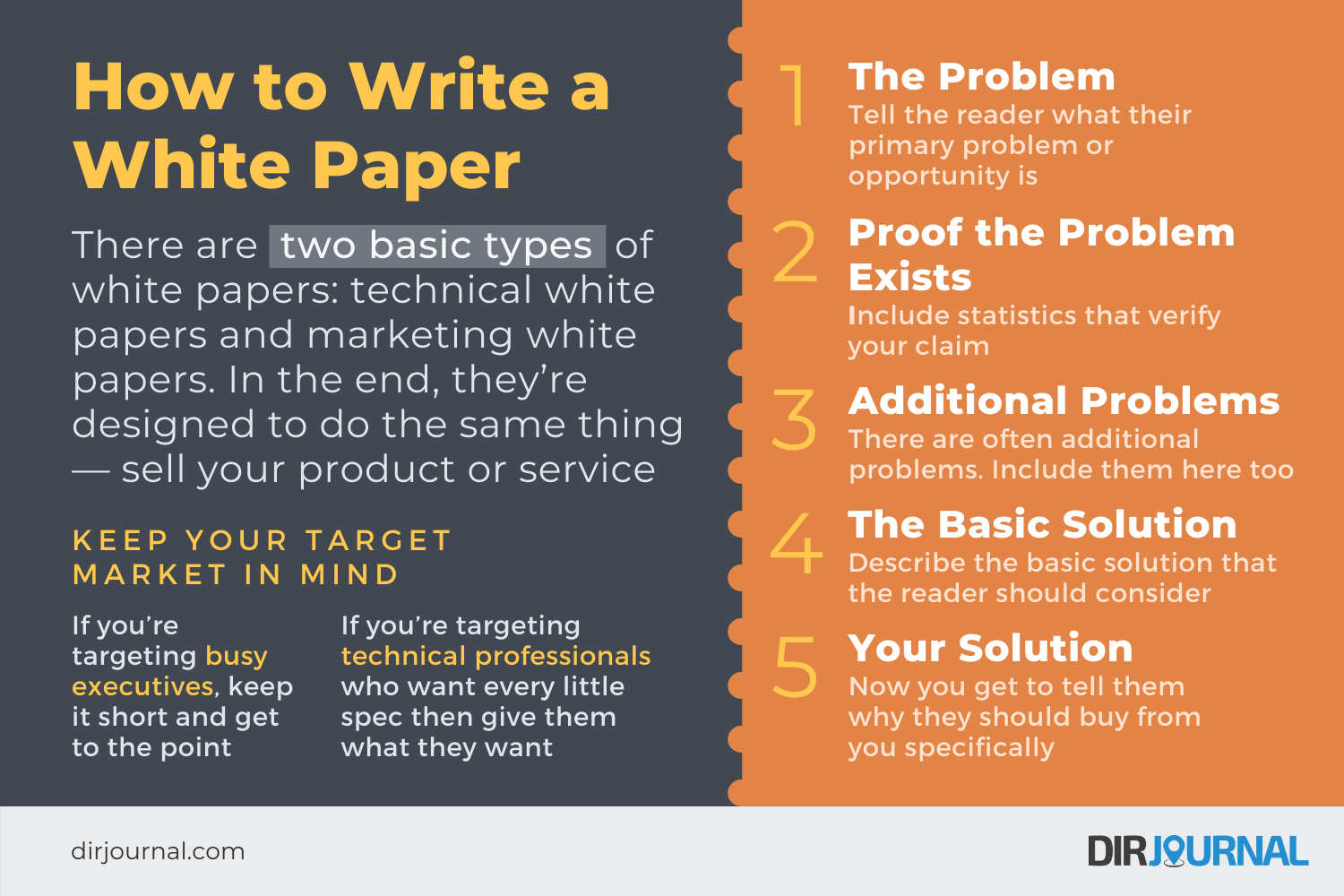
- The Problem (or Opportunity)
- Proof the Problem Exists
- Additional Problems
- The Basic Solution
White papers can include more than those five elements, but these are the most important, and the ones that should be included in any white paper you write. You might also choose to include a title page, abstract, illustrations (like charts and graphs), sidebars, a separate benefits section (instead of including benefits in your general solution), guidelines on how to choose a provider for the solution (before pitching yourself), and more. Since you're probably learning how to write a white paper for the first time though, let's focus on keeping it as simple as possible.
Sections and What to Include
Now let's look at what should be included in each of those sections when you write white papers.
- The Problem -- This is the introduction to your white paper. It will tell the reader what their primary problem or opportunity is. This may be something holding back their own business, or an opportunity to drastically increase sales or productivity, for example. Your introduction shouldn't be more than a page long. You want to get the problem across quickly in order to grab the reader's attention.
- Proof the Problem Exists -- You say there's a problem for the reader. So what? Why should they believe you? After exposing them to the primary problem, you need to back it up with market research. This is where you'll include statistics that verify your claim.
Formatting and Titling
Now that you know the basics of how to write the white paper's content, how should it look? While I'm not sure if you'll consider it fortunate or unfortunate, there's no right way to format a white paper! Some white paper writers like to use a single format for all of their clients. Others adapt from one to the next. I often let the supplementary material decide.
For example, if there will be a lot of charts and graphs, I'll go with a full page format to allow more room for the graphics. If it will have few graphics and I'd rather use pull quotes for visual interest, I might go with a two-column format where quotes and small charts go in a sidebar area, keeping the main body text free-flowing.
Title Pages and Abstracts
You'll also have to decide whether or not you want to include a title page and abstract (that is, a short summary of the white paper content). Here's the rule I go by: If I include a title page, I include an abstract. If I go right into the content on the first page, then I leave the abstract out. Why? Because if I'm going to put an extra page between my reader and my main problem paragraph, then I want to give them the gist up front -- a reason to open it. Sometimes a title and sub-title will be enough, but not in every case.
A title page isn't necessary, although many companies include them. What I suggest is that you choose whichever format you're most comfortable with, but try to keep things consistent with white papers released through your company moving forward. Just make sure that if you don't include a title page, your company name, logo, and contact information are clearly visible on the first page.
Speaking of titles, here's a rule I follow and suggest: Forget about catchy and cutesy. The white paper title does have to get attention, but it should more importantly tell the reader what's coming. Because of that, I believe it should always include a mention of the basic problem and the target market. You need to scream "Hey, this white paper is for you!" Save the fluff for consumer marketing if you must; not B2B.
Length
How long should your white paper be? Again, there is no right answer. It might be five pages. It might be 50 pages. I've found that most of my clients prefer white papers in the 5-10 page range. However, the more technical the material, the more information might have to be included.
So there's nothing wrong with a longer white paper. Just keep your target market in mind. Ask yourself, "Will they read this?" If you're targeting busy executives, keep it short and get to the point. If you're targeting technical professionals who want every little spec and detail, then give them what they want.
Hiring a White Paper Writer
If you're not comfortable with the idea of writing white papers yourself yet, you might opt to hire a business writer. Some writers specialize in writing nothing but white papers. Other business writers and copywriters write white papers in addition to other types of copy (such as e-books, press releases, email marketing campaign copy, brochure copy, etc.).
If you already have a business writer working for you, I would suggest seeing if they're capable of writing a white paper first. If they're already intimately familiar with your company, products, and target market, they'll be well-equipped to handle your project for you.
Just know that white paper writing won't come cheap (if the writer is well-qualified and experienced). It's not uncommon to pay more than $1.00 per word for a white paper, sometimes quite significantly more. Expect at least a low-to-mid four-figure budget if you want to hire someone experienced. As with all things white paper related, there's no "right" price to pay. That'll vary significantly based on specialty, location, experience, and other credentials.
Learn to Write White Papers
If you want to learn how to write a white paper of your own, it's a great idea to take some time to search the Web and read a few white papers. Look at some in your niche, and look at some outside of it. You'll find many different formats, lengths, and styles, and looking at samples will be one of the best ways for you to decide what you do and don't like when it comes to writing white papers.
Do you have some favorite white paper examples to share? Link to them in the comments and offer your own tips on how readers can learn how to write white papers for their businesses.
Frequently Asked Questions
What is a white paper?
What is the difference between a white paper and an e-book?
What should a white paper include?
How long should a white paper be?
How much does it cost to hire someone to write a white paper?
Should a white paper have a catchy title?
Do white papers still generate leads in 2026?
Related Resources
Looking for verified service providers? Browse our directory categories below — all human-audited and trusted by decision-makers since 2007.