Independent. Human-Curated. Established 2007.
Most Dangerous Animals in the World (2026)
DirJournal Contributing Author. Editorial-team verified.
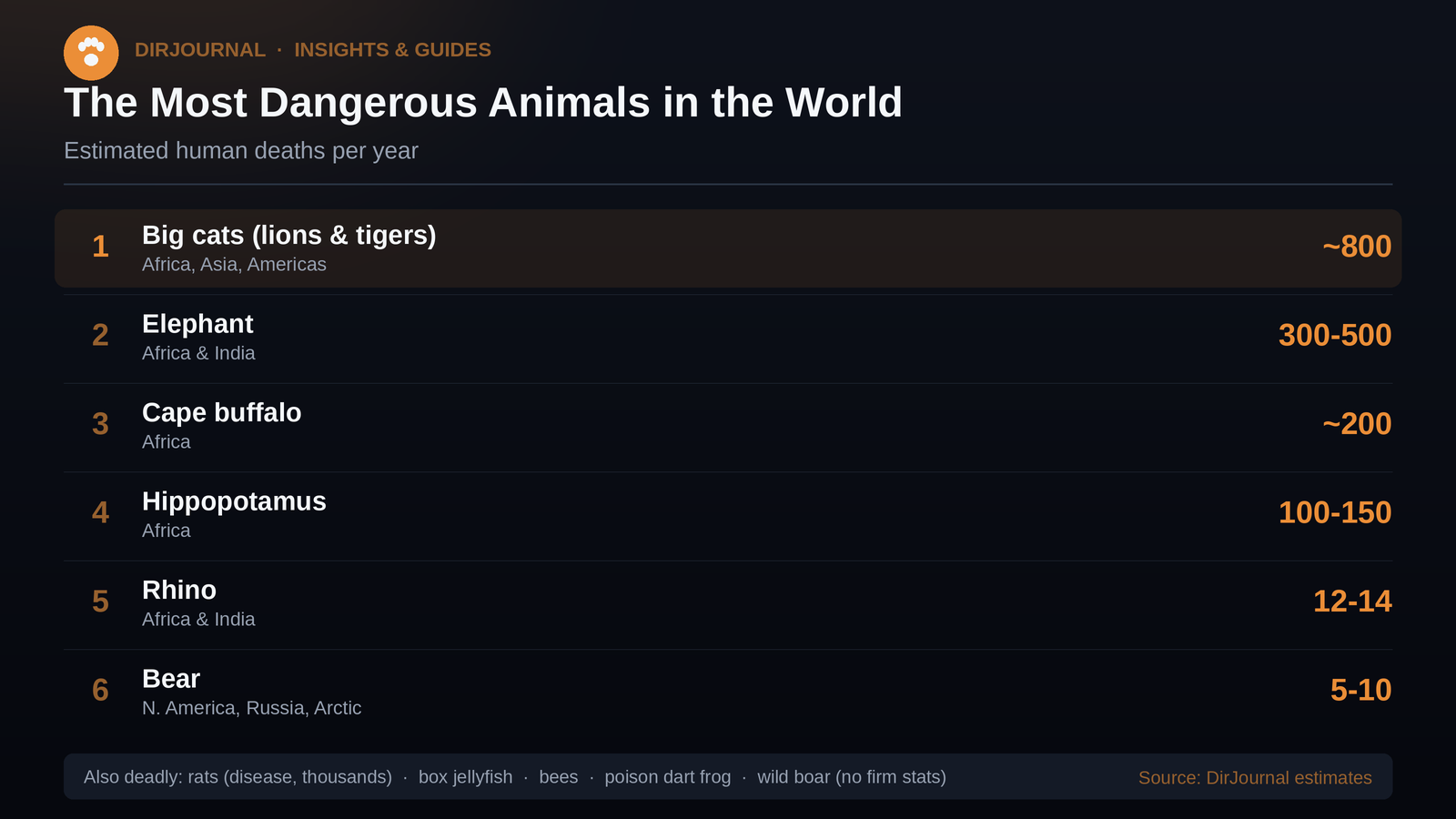
By annual human deaths, the mosquito is the world's most dangerous animal — responsible for over 725,000 deaths per year through diseases including malaria, dengue fever, Zika, and yellow fever. Humans are second (~475,000 deaths through violence). The most dangerous large predator is the hippopotamus, responsible for an estimated 500 deaths annually. Most animals on this list kill through venom, disease transmission, or territorial aggression — not predation.
Most Dangerous Animals in the World (2026)
Before we get into the full list, a note on how "dangerous" is defined here. We rank by annual human deaths caused — the most reliable measure of actual danger to people. This metric means the list looks very different from what most people expect. The largest or most fearsome-looking animals are rarely the deadliest. The tiniest creatures — mosquitoes, tsetse flies, freshwater snails — kill far more people than lions, sharks, and crocodiles combined.
| Rank | Animal | Est. Annual Human Deaths | Primary Cause |
|---|---|---|---|
| 1 | 🦟 Mosquito | 725,000+ | Malaria, dengue, Zika, yellow fever |
| 2 | 👤 Humans | ~475,000 | Homicide and warfare |
| 3 | 🐍 Snakes | ~138,000 | Venomous bites |
| 4 | 🐕 Dogs | ~59,000 | Rabies transmission |
| 5 | 🪱 Tsetse Fly | ~10,000 | Sleeping sickness |
| 6 | 🦛 Hippopotamus | ~500 | Territorial attacks |
| 7 | 🐊 Crocodile | ~1,000 | Predation |
| 8 | 🐘 Elephant | ~500 | Trampling, charging |
| 9 | 🦁 Lion | ~200 | Predation |
| 10 | 🦈 Shark | ~5–10 | Predation |
The mosquito kills more humans than any other creature on Earth — by an enormous margin. Mosquitoes transmit malaria (which killed approximately 619,000 people in 2021 according to the WHO, mostly children under 5 in sub-Saharan Africa), dengue fever (affecting 400 million people annually with around 40,000 deaths), Zika virus, yellow fever, West Nile virus, chikungunya, and lymphatic filariasis. Combined, mosquito-borne diseases account for over 725,000 deaths per year globally.
Only female mosquitoes bite — they require blood protein to produce eggs. They detect hosts through body heat, CO₂ in exhaled breath, and specific body odour compounds. Roughly 3,500 species of mosquito exist; fewer than 100 transmit diseases dangerous to humans. The Anopheles genus transmits malaria; Aedes aegypti transmits dengue, Zika, and yellow fever.
The box jellyfish encompasses approximately 50 species, most of which will not kill a healthy adult. The exception is Chironex fleckeri, found primarily in Australian coastal waters and parts of Southeast Asia, which can kill a human in as little as two to five minutes after a severe sting. Its tentacles — which can reach 3 metres in length — contain millions of nematocysts that fire venom on contact, causing cardiovascular failure, paralysis, and excruciating pain simultaneously.
Box jellyfish kill an estimated 20–40 people annually in the Philippines alone. In Australia, Chironex fleckeri kills at least one to two people per year, though Irukandji syndrome — caused by a smaller box jellyfish species — may cause additional deaths attributed to heart failure. Vinegar is the standard first aid for box jellyfish stings — it deactivates unfired nematocysts. Fresh water should never be used as it triggers additional firing.
Snakebite is one of the world's most neglected public health crises. According to the WHO, venomous snakes kill approximately 138,000 people per year and cause permanent disability — amputations, blindness, and chronic pain — in an estimated 400,000 more. The vast majority of deaths and injuries occur in South Asia (India, Bangladesh, Nepal), sub-Saharan Africa, and Southeast Asia, where agricultural workers are bitten in fields and antivenom is unavailable or unaffordable.
The most dangerous snakes by human deaths include the Indian saw-scaled viper (Echis carinatus), Russell's viper, the Indian cobra, and various species of krait. By venom potency, the inland taipan of Australia has the most toxic venom of any land snake — but causes very few deaths due to its remote habitat and non-aggressive temperament. In 2019, the WHO added snakebite to its list of neglected tropical diseases and set a target of halving global deaths by 2030.
Despite being herbivores, hippopotamuses are widely considered the most dangerous large animal in Africa, responsible for an estimated 500 deaths per year. They are highly territorial, extremely aggressive when approached on land (they must return to water regularly to keep their skin moist), and capable of running at 30 km/h — faster than most humans. Their jaws can open 150° and exert a bite force of approximately 8,100 N. Most fatal incidents involve hippos capsizing boats on African rivers or attacking people who inadvertently come between a hippo and water.
2026 Update: Emerging Animal Threats
Tick-borne diseases — rising threat in temperate zones. As global temperatures rise, tick habitats have expanded significantly into previously unaffected regions of North America, Europe, and East Asia. Lyme disease, spread by Ixodes ticks, now affects an estimated 476,000 people annually in the US alone. Tick-borne encephalitis, Crimean-Congo haemorrhagic fever, and SFTS virus (primarily in China and Korea) are also expanding their ranges. Ticks are becoming an increasingly significant threat beyond tropical regions.
Freshwater snails — the overlooked killer. Schistosoma flatworms, transmitted through freshwater snails, cause schistosomiasis — a parasitic disease affecting over 250 million people in tropical regions and killing an estimated 200,000 per year. The snail is the intermediate host; the parasite penetrates human skin during water contact. This makes freshwater snails responsible for more deaths than most large predators combined, yet they rarely appear on mainstream "dangerous animals" lists.