Independent. Human-Curated. Established 2007.
Sample Questionnaires for Training Needs Analyses
DirJournal Contributing Author. Editorial-team verified.
Key Takeaways: Training Needs Analysis
- 1Training is a 5-step strategic investment: Assess → Design → Develop → Deliver → Evaluate (ADDIE).
- 2The goal is to close the "Gap" between actual and desired employee performance.
- 3Use three levels of analysis: organizational, task/role, and individual.
- 4ROI-positive training programs start with data, not assumptions.
Earlier, we posted an article about how to conduct a training needs analysis (TNA). Many readers of that article expressed interest in sample questionnaires for an analysis of the sort described.
There is no single “one size fits all” questionnaire that can serve this purpose. Company requirements vary too widely, and any analysis of an employee base must be tailored to that specific group and the unique attributes of their work. That said, it is possible to share with our readers examples of the kinds of things that assessment instruments ask, with the understanding that these must of course be customized for the particular workplace being analyzed.
Sample Surveys
The previous article mentioned several components that may be chosen as elements of a TNA. These approaches included observation, interviews, surveys, job description analysis, difficulty-of-task analysis, problem-solving conferences, identification of motivating personality factors, and analysis of organizational policies.
The 4-Step Problem Solving Process
Three Levels of Training Needs Analysis
| Level | Focus | Key Questions |
|---|---|---|
| Organizational | Strategic goals & culture | Where is the company headed? |
| Task / Role | Job-specific competencies | What skills does each role require? |
| Individual | Employee performance gaps | Who needs upskilling and in what? |
For the sake of providing a useful example in this limited space, we will focus on surveys. The reasons for this are threefold. First, no matter how a TNA is constructed, at some point it must entail direct input from the individuals who are candidates for training. Surveys accomplish this handily, and are perhaps the most frequently used tool in such analyses.
Second, a survey has arguably the broadest reach of any TNA methodology applied throughout an organization, so it is a high-value tool that offers a lot of “bang for the buck.” Finally, once a survey is created, any interviews which are conducted can use that form as a starting point for more open-ended oral interviews. In this manner the survey does double duty, supporting more than one TNA technique.
Defining Survey Scope
Before using any sample surveys – or most critically, when creating surveys from scratch – it is important to be clear on precisely what the survey is intended to analyze. This in turn shapes what questions are invented, or what and how existing questions are customized.
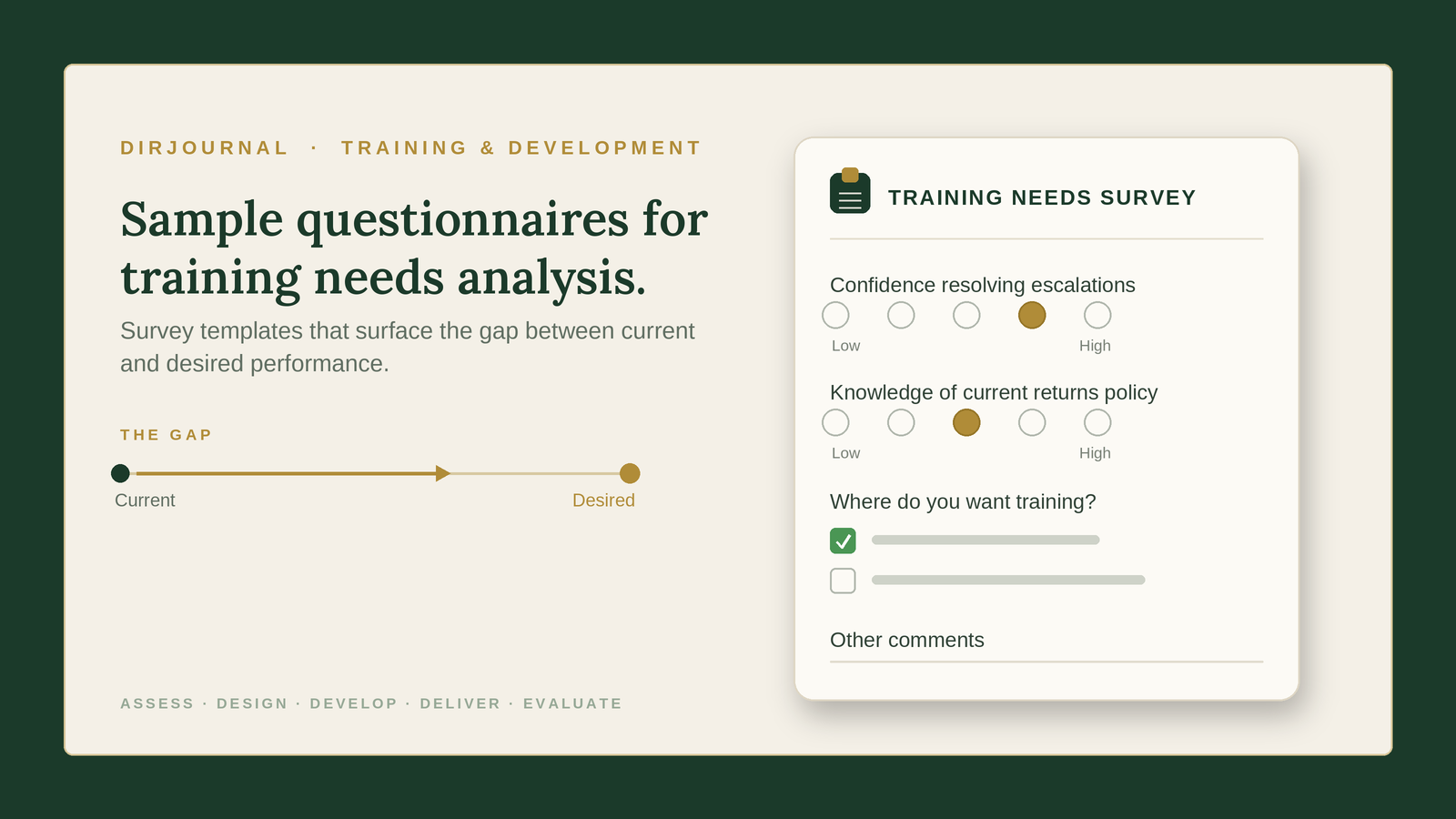
The best way to achieve this is to first create a meta-list of the areas of inquiry the survey should explore. For example, let's assume we want to assess the training needs of our customer service staff. Even before looking at any pre-written surveys, we consider what we know of customer service operations and the nature of our business, and do a little brainstorming about topic areas to be addressed. Perhaps we determine the employee survey should probe people's knowledge of returns policies, their ability to deal with unsatisfied customers, and their judgment about when to escalate a problem to a higher tier of support.
Once this scope is defined, we might then expect to come up with a survey in three sections, with detailed questions in each of these subject areas.
We keep this in mind when evaluating existing surveys against our needs, or when creating questions for our own original assessment instrument. This ensures that the survey we use will be truly relevant to our requirements.
Training Needs Analysis Survey Samples
A well-done TNA survey can be lengthy. Rather than reproduce them here, the following links include a variety of examples in their entirety. A link to a sample survey does not indicate endorsement of any associated products or services at that link.
IT Training: A Windows Office Suite self-assessment for computer users.
General Needs Assessment, Managerial and Office Skills
Common Business Needs: Equal Opportunites, Sales, Health & Safety, more. Several samples online.
Skills Self-Assessment – portion of a larger TNA survey series.
Join the DirJournal newsletter
Weekly insights on directories, listings, SEO, and how businesses get found online.
No spam. Unsubscribe anytime.
Found this useful?
Share this article
Related Resources
Looking for verified service providers? Browse our directory categories below — all human-audited and trusted by decision-makers since 2007.