Independent. Human-Curated. Established 2007.
Claude vs ChatGPT vs Perplexity: How Each AI Engine Answers Buyer Questions Differently
DirJournal Founder · 19+ years building directory and discovery products. Editorial-team verified.
Key Topics in This Guide
- 1The Numbers at a Glance — covered in detail below
- 2How Each Engine Formats Responses — covered in detail below
- 3Which Engine Trusts Which Directories — covered in detail below
- 4How Each Engine Handles Different Question Types — covered in detail below
- 5The Vertical Lens — covered in detail below
- 6The Refusal Gap — covered in detail below
- 7What This Means for Business Owners — covered in detail below
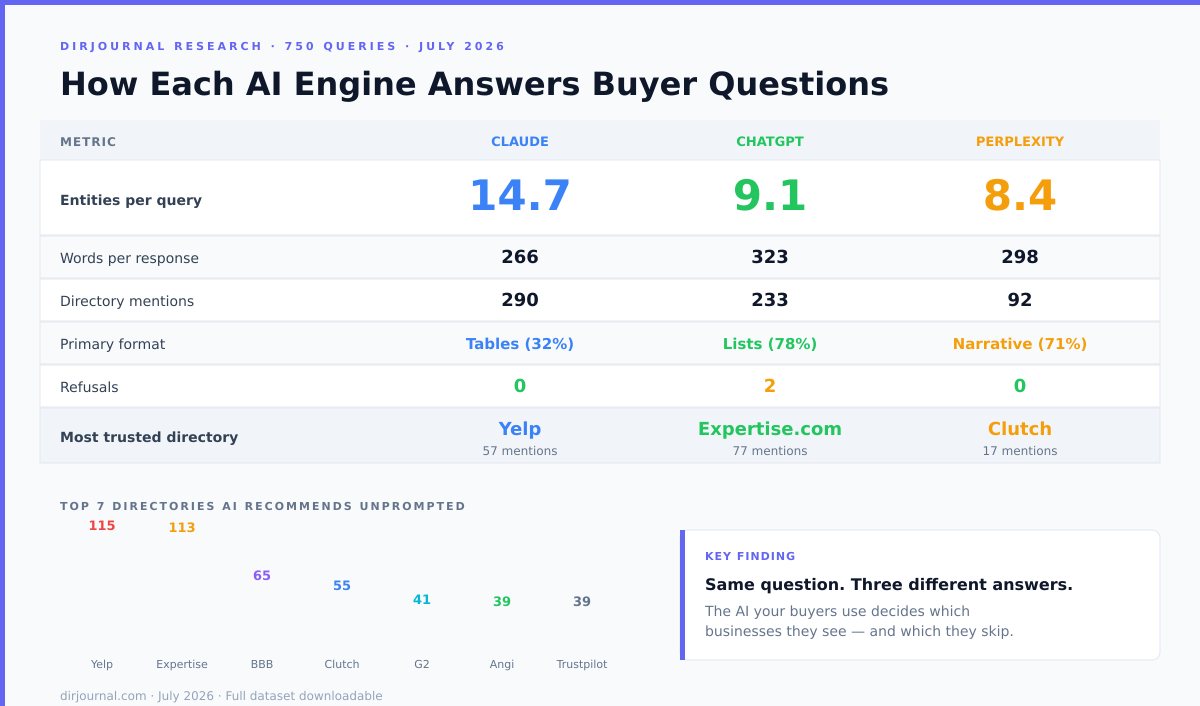
Claude writes comparison tables. ChatGPT writes numbered lists. Perplexity writes narratives with source links.
Same question, three completely different answers. We know this because we ran 750 identical queries across all three engines and parsed every response for format, entity counts, directory citations, and refusal patterns. This is the engine-level breakdown from our AI Citation Study.
The Numbers at a Glance
| Metric | Claude | ChatGPT | Perplexity |
|---|---|---|---|
| Avg entities per query | 14.7 | 9.1 | 8.4 |
| Avg word count | 266 | 323 | 298 |
| Directory mentions (total) | 290 | 233 | 92 |
| Refusals | 0 | 2 | 0 |
| Primary format | Tables (32%) | Numbered lists (78%) | Narrative (71%) |
Claude names the most businesses (14.7 per response) in the fewest words (266). ChatGPT writes the longest responses (323 words) while naming fewer businesses (9.1). Perplexity falls in between on both counts.
How Each Engine Formats Responses
Format differences aren't cosmetic. They change what buyers see and how they evaluate providers.
Claude: the table builder. 32% of Claude's responses contained markdown comparison tables. When asked "compare the leading providers," Claude defaults to structured columns: company name, specialisation, pricing tier, notable clients. This is the most scannable format for decision-making. The remaining 65% were detailed narratives with embedded context, and only 2% were simple numbered lists.
ChatGPT: the list maker. 78% of ChatGPT's responses were numbered lists. "1. Company A... 2. Company B... 3. Company C..." with a sentence or two per entry. Zero comparison tables across 250 queries. ChatGPT never formats provider comparisons as tables. This means buyers using ChatGPT see a flat ranked list without side-by-side comparison data.
Perplexity: the narrator. 71% of Perplexity's responses were flowing narratives that weave provider names into context. 26% contained tables. Perplexity's distinct advantage is source attribution: it links to the pages it pulled data from. The other two engines don't.
Which Engine Trusts Which Directories
Each engine has a different "trust stack" for directories it recommends.
| Directory | Claude | ChatGPT | Perplexity |
|---|---|---|---|
| Yelp | 57 | 47 | 11 |
| Expertise.com | 21 | 77 | 15 |
| BBB | 36 | 13 | 16 |
| Clutch | 32 | 6 | 17 |
| G2 | 32 | 5 | 4 |
| Angi | 15 | 23 | 1 |
| Trustpilot | 16 | 14 | 9 |
Claude distributes trust broadly. Four directories scored 32+ mentions each (Yelp, BBB, Clutch, G2). Claude treats multiple directories as valid trust signals rather than depending on one source.
ChatGPT concentrates trust. Expertise.com at 77 mentions accounts for 33% of all ChatGPT directory citations. It is, by a wide margin, ChatGPT's default authority for verifying business providers. Yelp comes second at 47, Angi third at 23. Everything else is in single digits.
Perplexity leans B2B. Clutch (17) and BBB (16) lead. Yelp scored only 11 mentions. Perplexity's user base skews toward researchers and B2B buyers, and its directory preferences reflect that.
How Each Engine Handles Different Question Types
We used five query templates. Each engine responded differently to each type.
Entity extraction ("List 5 prominent providers"). ChatGPT produced the most entities on this template. It follows instructions literally: you ask for 5, it gives 5, cleanly formatted as a numbered list. Claude often returned more than 5, adding context and caveats. Perplexity generated the fewest entities, sometimes discussing the category rather than naming specific businesses.
Buyer comparison ("Compare the leading providers"). Claude excelled here. It generated comparison tables with columns for specialisation, pricing, and clients. ChatGPT returned numbered lists without side-by-side structure. If your buyers ask AI to compare vendors, the format they receive depends entirely on which engine they use.
Scenario-based ("I run a 50-person firm, who should I evaluate?"). ChatGPT dominated this template with 10.3 entities per response. The scenario framing activated ChatGPT's recommendation mode. Claude averaged 4.7 entities with more qualifying context. Perplexity produced only 0.9, often redirecting to general advice.
Organic verification ("How would you verify this provider?"). This template produced the most directory mentions across all engines. Claude cited directories 1.4 times per response on this template. ChatGPT cited 0.9 times. The verification question is where AI engines reveal their trust hierarchy. Yelp dominated this template with 55 mentions across all engines.
Location-specific ("Name the top-rated provider in [city]"). ChatGPT outperformed at 5.9 entities per response. Claude produced 1.6. Perplexity produced 0.1. Local queries are where ChatGPT's training data advantage is most visible: it names specific local businesses that the other two engines can't.
The Vertical Lens
Each engine's performance shifts depending on the industry.
| Vertical | Claude (entities) | ChatGPT | Perplexity |
|---|---|---|---|
| Tech & SaaS | 2.6 | 6.9 | 0.5 |
| Traditional B2B | 1.4 | 6.8 | 0.4 |
| Professional Services | 1.8 | 6.4 | 0.5 |
| Health & Wellness | 2.4 | 5.3 | 0.3 |
| Local & Home Services | 1.9 | 5.4 | 0.2 |
ChatGPT leads entity naming in every vertical. But the gap between verticals is revealing. ChatGPT names 6.9 entities for Tech & SaaS but only 5.3 for Healthcare. AI engines know tech companies better than healthcare providers, regardless of which engine you use.
Perplexity underperformed on raw entity counts everywhere. Its value is in source attribution, not entity volume. When Perplexity names a provider, it tells you where the data came from. The other engines don't.
The Refusal Gap
Claude and Perplexity refused zero queries out of 250 each. ChatGPT refused 2 (0.8%). All refusals were for healthcare-adjacent queries where ChatGPT declined to name specific medical providers.
This matters for healthcare and legal verticals. If your business operates in a regulated industry, the engine your buyers use affects whether they receive specific provider names or generic "consult a professional" advice.
What This Means for Business Owners
The AI engine your buyers use determines three things about your business visibility.
Format. If your buyers use ChatGPT, they see a numbered list. Your position in that list matters. If they use Claude, they see a comparison table. Your differentiation across columns matters. If they use Perplexity, they see a narrative. Your presence in the cited sources matters.
Directory priority. If your buyers use ChatGPT, invest in Expertise.com (it accounts for 33% of ChatGPT's directory recommendations). If they use Claude, spread across Yelp, BBB, Clutch, and G2. If they use Perplexity, Clutch and BBB carry the most weight.
Query type matters. Scenario-based queries ("I run a company like X, who should I evaluate?") produce the richest results with the most named businesses. Buyers who frame their questions as scenarios get better answers than those who ask generic questions. Teach your customers to prompt better.
Full data from this analysis is available in the AI Citation Study CSV download. For a directory-by-directory comparison, see Yelp vs Expertise.com: The Two Directories AI Engines Trust Most.
Frequently Asked Questions
Which AI engine names the most businesses when asked?
Which AI engine is best for comparing business providers?
Which AI engine cites the most directories?
Join the DirJournal newsletter
Weekly insights on directories, listings, SEO, and how businesses get found online.
No spam. Unsubscribe anytime.
Found this useful?
Share this article
Recommended for You
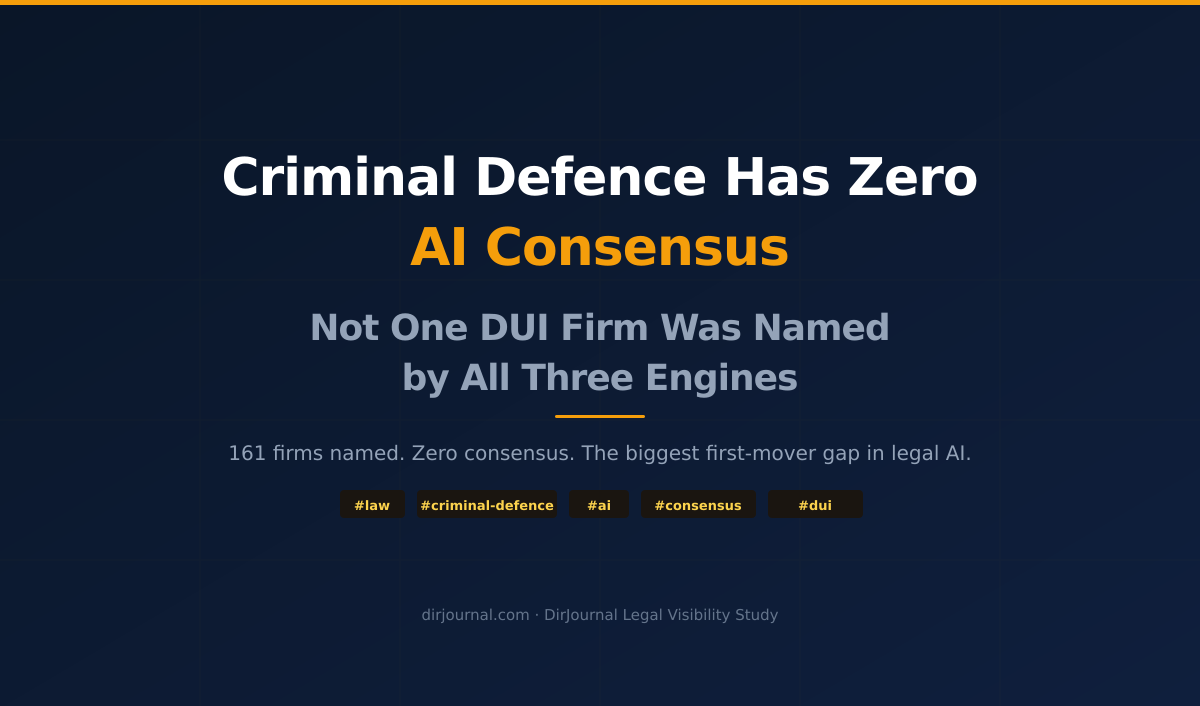
Criminal Defense Has Zero AI Consensus. Not One DUI Firm Was Named by All Three Engines.
183 criminal defense firms named across 60 queries. Zero named by all three engines. The only legal…
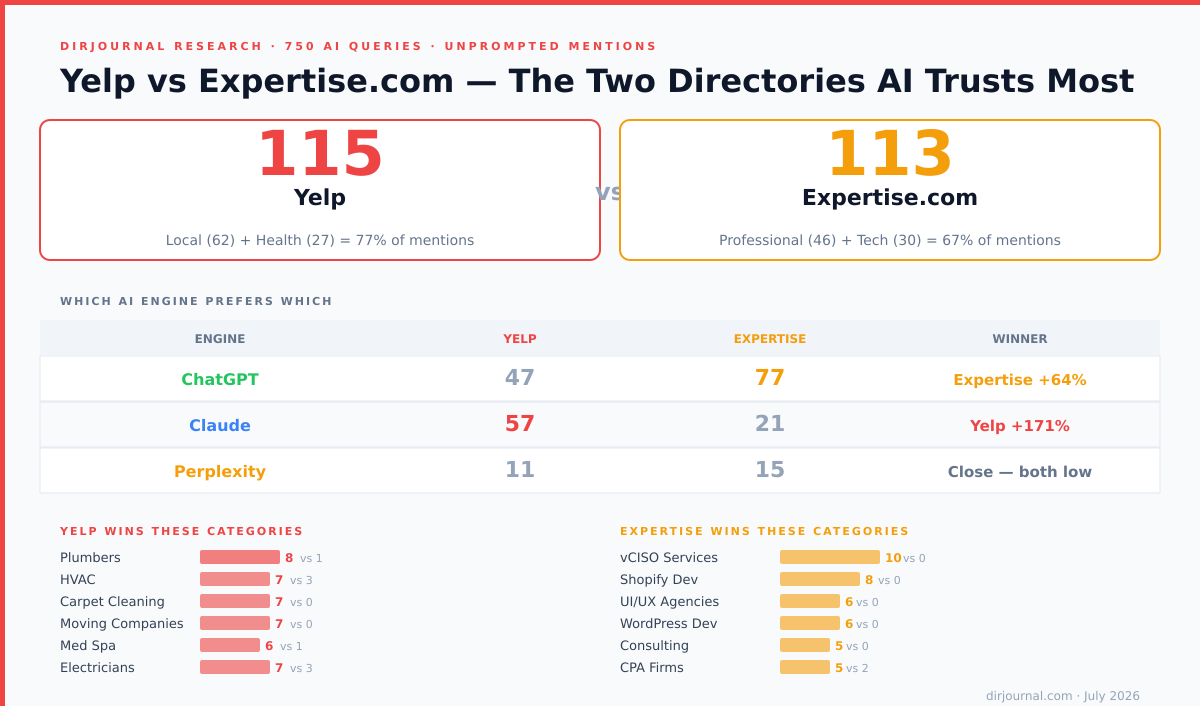
Yelp vs Expertise.com: The Two Directories AI Engines Trust Most
Yelp got 115 AI mentions across 750 queries. Expertise.com got 113. They're nearly tied overall but…
Best Personal Injury Lawyers in Miami: Ranked by AI Citation Data
We asked Claude, ChatGPT, and Perplexity to name Miami personal injury lawyers. Steinger Greene &…
Related Resources
Looking for verified service providers? Browse our directory categories below — all human-audited and trusted by decision-makers since 2007.