Independent. Human-Curated. Established 2007.
The Deepfake Dilemma: Why Verified Identity is the Only Currency Left in B2B
DirJournal Editorial Team. Verified against directory standards and primary sources.
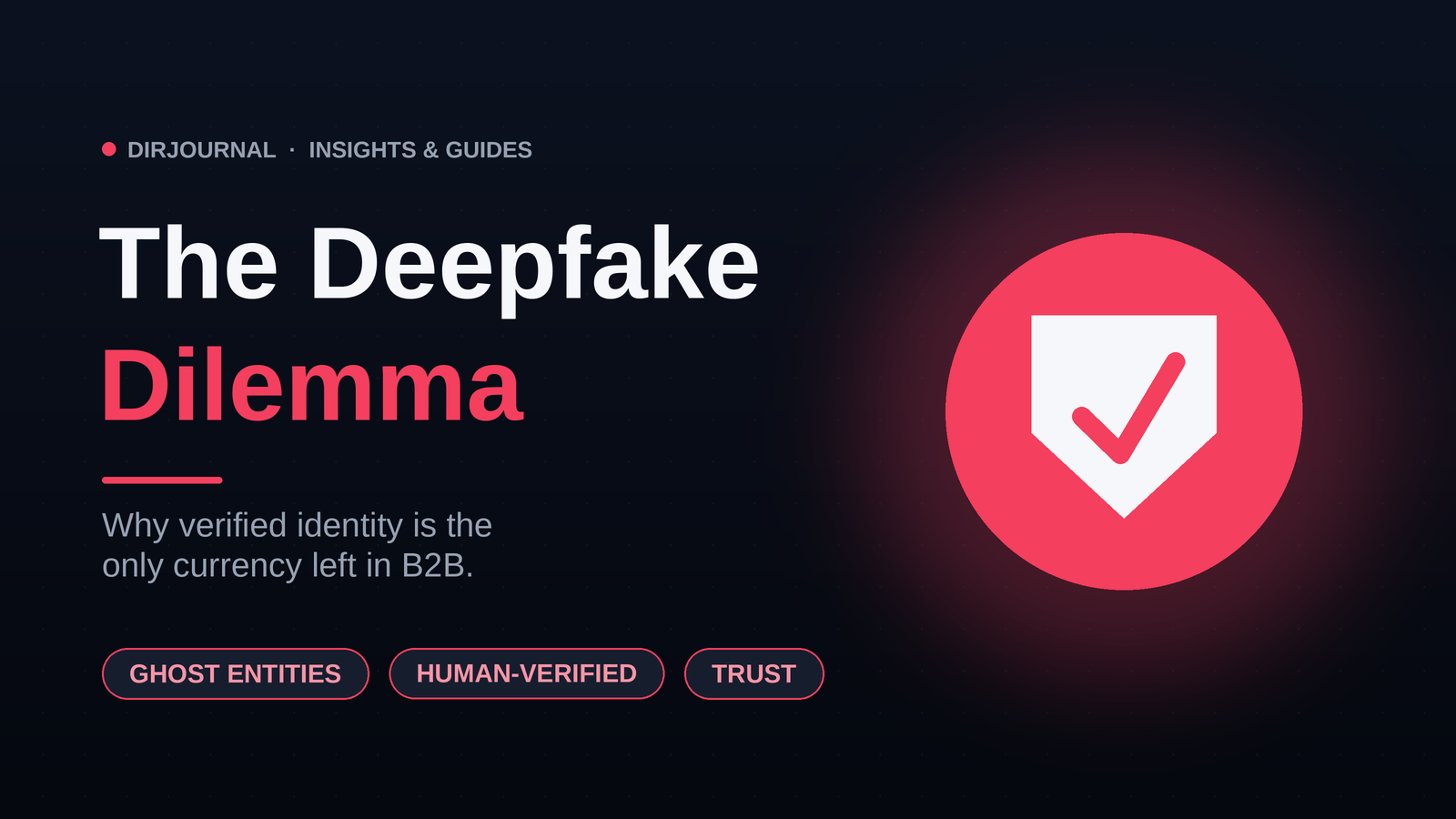
In 2026, a convincing fake agency — complete with an AI-generated website, fabricated LinkedIn profiles, synthetic headshots, and invented case studies — can be created in under ten minutes. Standard search engines cannot distinguish these Ghost Entities from legitimate firms. The only reliable filter is institutional verification: a human editor, on a domain with years of continuous operation, who has physically confirmed the business exists. That verification is now a competitive asset, not a formality.
The Deepfake Dilemma: Why Verified Identity is the Only Currency Left in B2B
We have officially entered the era of the Synthetic Corporation.
In 2026, it takes less than ten minutes to spin up a fully automated agency. With a few clicks and freely available AI tools, a bad actor can generate a professional website indistinguishable from a legitimate firm's, thousands of synthetic LinkedIn profiles complete with career histories and endorsements, AI-generated headshots that pass reverse image search, and a portfolio of fabricated case studies with realistic metrics and plausible client names.
To a standard search engine, these Ghost Entities look identical to hard-working, legitimate firms that have spent years building genuine expertise and client relationships.
For businesses seeking high-stakes partners in cybersecurity, fintech, or AI implementation, the unverified internet has become a minefield. When the "expert" on the other side of a video call might be a real-time deepfake and the "portfolio" might be entirely fabricated, the due diligence question is no longer "Are they good at what they do?" It is "Do they actually exist?"
The answer to that question isn't more technology. It's pedigree.
For years, the digital marketing industry relied on "trust signals" that were, in retrospect, always gameable: backlinks, keyword density, social shares, review counts. These signals worked when generating them required genuine human effort. In the age of Agentic AI, that assumption no longer holds. Bots can build backlinks to other bots. AI agents can generate social proof in closed loops. Fake review networks have scaled from cottage industry to industrial operation.
The result is a trust crisis that is reshaping how the most sophisticated discovery systems — the AI engines that are rapidly replacing traditional search for high-stakes queries — approach the verification problem.
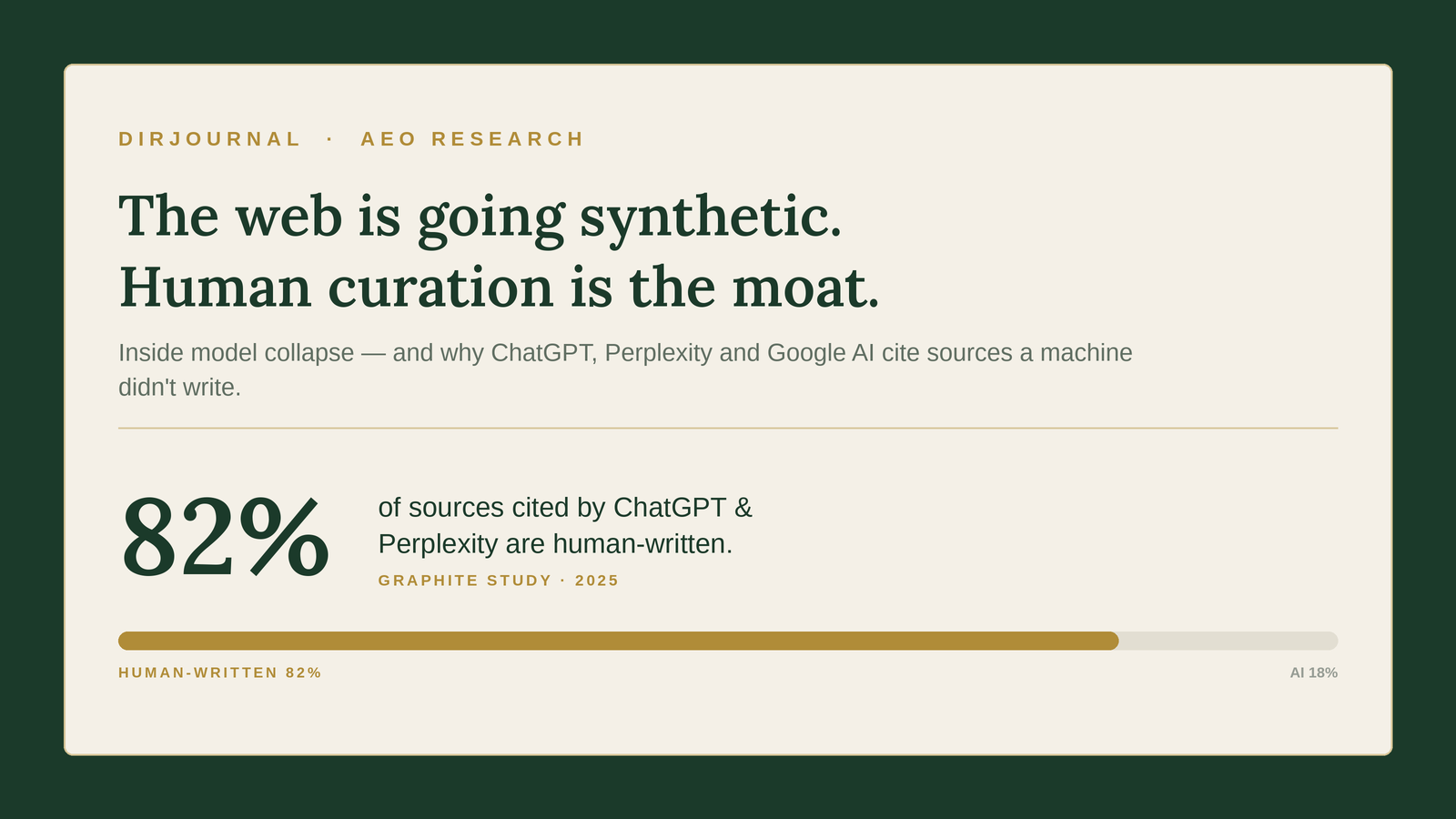
Generative search engines like Perplexity and ChatGPT Search are actively shifting their source weighting away from "crawling the open web" and toward what can be called Trusted Data Enclaves: sources with demonstrable historical continuity, human editorial oversight, and institutional standing that pre-dates the AI content explosion. An AI agent's primary goal when answering a B2B recommendation query in 2026 is to avoid recommending a scam. To achieve that, it looks for an institutional vouch — a third-party authority whose own credibility is on the line for every entity it endorses.
| Trust Signal | Pre-2024 Weight | 2026 Weight | Why It Changed |
|---|---|---|---|
| Backlink volume | High | Low | AI link farms operate at scale |
| Social proof / reviews | High | Medium-Low | Synthetic review networks widespread |
| Website quality / design | Medium | Very Low | AI generates convincing sites in minutes |
| Domain age | Medium | High | Cannot be faked — age is immutable |
| Human-verified institutional listing | Low | Very High | Scarce signal in AI-saturated environment |
| Consistent historical data footprint | Low | Very High | Pre-AI-explosion consistency is unfakeable |
The Human-In-The-Loop Premium
DirJournal has been indexing businesses since 2007 — through the social media explosion, the mobile revolution, the content marketing era, and now the AI transformation. One truth has remained constant across all of those shifts: machines cannot verify the physical reality of a business as well as a human editor can.
While many directory and indexing platforms have moved to fully automated intake — accepting self-reported data with no editorial review — DirJournal has doubled down on manual verification for its core categories. The reason is strategic rather than sentimental: human verification is now a scarce signal, and scarce signals carry premium weight in information environments flooded with synthetic content.
When a business carries DirJournal's Human-Verified status, it signals three specific facts to the global entity graph that a synthetically generated profile cannot replicate:
What Human Verification Signals to AI Engines
Verification as Competitive Advantage
For agencies and consultants operating in high-stakes categories, being verified is no longer about the aesthetics of a trust badge on a footer. It is a direct input into Answer Engine Optimisation — the practice of ensuring that when AI engines construct their answers, your entity appears in them.
Consider the query an enterprise procurement team now routinely runs before engaging a specialist firm: "Which AI ethics governance consultants in the US are actually verified?" The AI processing that query filters out the vast majority of the web. It does not have the compute budget to evaluate every self-reported claim on every agency website. It looks for shortcuts — institutional filters that allow it to construct a trustworthy shortlist efficiently.
A verified listing on a human-reviewed institutional directory is exactly that shortcut. The AI defers to the human editorial judgement already embedded in the directory's verification process, and surfaces verified entities over unverified ones. The procurement team sees a list of firms they can actually trust. Your firm is on that list. The synthetic agencies are not.
Why Your Founding Date is Now a Shield
In a world where synthetic content can be generated instantly, the one thing that cannot be manufactured is the past. A founding date is immutable. A domain that has continuously operated since before the AI content explosion cannot be retrospectively faked. Historical consistency — the same business name, address, service description, and contact information appearing across institutional sources over years — is a form of proof that AI agents weight heavily precisely because it cannot be gamed.
This is why DirJournal's own founding date — 2007 — is not just a piece of heritage. It is a trust anchor. When a newly established legitimate business gets listed on DirJournal, it tethers itself to 19 years of continuous, indexed, editorially maintained authority. The AI engine sees: this new entity has been vouched for by a source that has been consistently trustworthy since before the modern social web existed. That tethering is the fastest available path to institutional credibility for a business that cannot yet have its own long history.
The Wild West era of the unverified web is not ending — it is bifurcating. The open web will continue to exist, increasingly synthetic, increasingly difficult to trust at face value. Alongside it, a parallel ecosystem of curated, verified, institutionally anchored data sources is becoming the substrate on which high-stakes B2B decisions are made.
Enterprise procurement teams, institutional investors, and the AI agents they increasingly rely on are retreating into these curated ecosystems. They are not searching the open web for cybersecurity partners or AI governance consultants — they are querying trusted institutional directories and the AI engines trained on them.
DirJournal's focus on high-stakes verticals — cybersecurity, AI implementation, fintech compliance, legal services, longevity medicine — is a deliberate bet on this bifurcation. In categories where the cost of engaging a fraudulent or incompetent partner is severe, the demand for institutional verification is highest. That is where the Human-Verified signal carries the most weight, and where being part of the curated ecosystem delivers the most tangible competitive advantage.
When the Deepfake Dilemma arrives in full force in your industry — and in most high-stakes B2B categories, it already has — the only question is whether your business is already standing on the verified side of the line.