Independent. Human-Curated. Established 2007.
Global Warming’s Six Americas: It's Not About Deniers Anymore
DirJournal Contributing Author. Editorial-team verified.
Key Topics in This Guide
- 1Global Warming's Six Americas — covered in detail below
- 21 - Alarmed — covered in detail below
- 32 - Concerned — covered in detail below
- 43 - Cautious — covered in detail below
- 54 - Disengaged — covered in detail below
- 65 - Doubtful — covered in detail below
- 76 - Dismissive — covered in detail below
- 8Dramatically Shifting Attitudes on the Climate Crisis — covered in detail below
- 9Different Climate Knowledge Levels — covered in detail below
- 10How to Tailor Global Warming Message Strategies — covered in detail below
- 11The Bottom Line — covered in detail below
[caption id="attachment_35458" align="aligncenter" width="1000"]
Since the very beginning of the debate about climate change, we've been able to see a binary division between ‘believers’ and ‘deniers’.
Between those who fear for the planet’s future, and those who disparage science.
Between politicians who push the shift towards renewable energies – and those who bring snowballs into Congress to disprove global warming.
But in the face of the complexity of climate change, this dichotomy is no longer sufficient.
Instead, it is necessary to move beyond simple distinctions and acknowledge the multi-layered attitudes of Americans towards climate change.
Why?
To tailor communication strategies.
The climate crisis is real, that much is certain. And we need to take action. However, to take such action, it's essential to have broad support in the population.
It't all too easy to just label people that express doubt as straight-up climate deniers. If we simply dismiss them, however, we cannot hope to win them over. Yet it's essential to gather as much support as possible.
Ultimately, the future of the fight against climate change is in collective action. This can only be achieved with effective communication.
And the cardinal rule of effective communication is this: Know Your Audience!
That is why the Yale Program on Climate Change Communication ran large-scale surveys to identify patterns audiences reactions to climate news.
Interviewing almost 14.000 Americans, they examined respondents’ common attitudes, risk perceptions, belief systems, motivations, values and policy preferences.
The outcome of this effort is ‘Global Warming’s Six Americas‘. An outline of six distinct types of audience that show starkly different levels of engagement with the climate crisis.
Here is what you need to know about the Six Americas of climate change - and how tailoring communication strategies to each of them could help save us all.
Global Warming's Six Americas
Global Warming’s Six Americas audience types do not just differ in whether they believe climate change is happening.
In addition, people have widely differing opinions on who will suffer the consequences - and when.
Here is the run-down on the essential characteristics of each group, based on the original survey (which the Yale project has since repeated several times).
If you’re wondering which of the Six Americas you belong to, the survey is also available as an online quiz for the curious.
[caption id="attachment_35457" align="aligncenter" width="644"]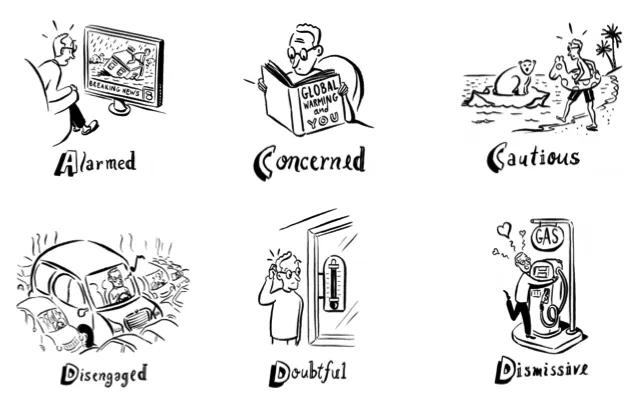
[caption id="attachment_yale_trends_2025" align="aligncenter" width="1024"]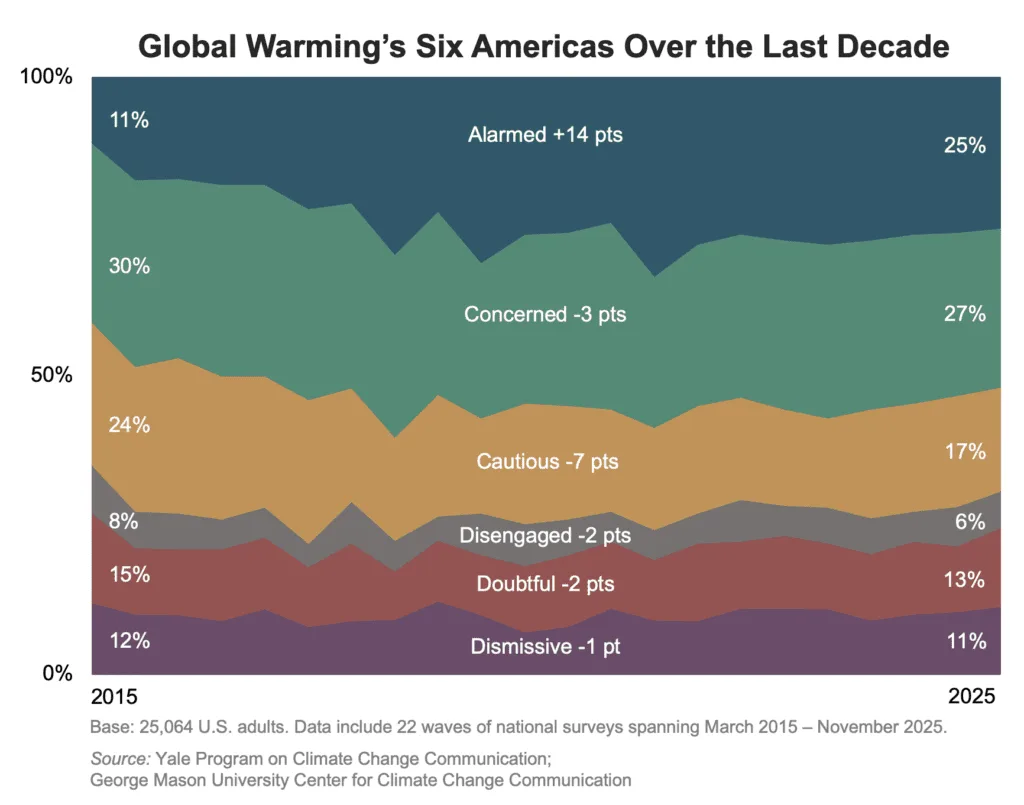
1 - Alarmed
First, members of the ‘alarmed’ group are certain that global warming is happening.
They see themselves as well-informed about the scientific basis of climate change. What’s more, the topic has a considerable prominence in their lives.
Importantly, they also see climate change both as a threat to future generations, and as something that is happening right now.
2 - Concerned
While the ‘concerned’ also believe that climate change is real, the issue is less important to them.
They worry about the impacts of climate change. Still, it is not a topic that figures prominently in their everyday lives.
Above all, they also see it less as a personal threat, and more as a problem for future generations. Most believe that climate change would start to negatively impact the US in the next 10 years.
3 - Cautious
The ‘cautious’ think that climate change is happening but are not entirely convinced. They are open to having their minds changed - in either direction.
Most members of this group see themselves as not very well-informed about climate change. About half of them think that human activities are causing it.
Like the ‘concerned’, the ‘cautious’ see climate change not as a personal threat, but as something that is going to impact future generations. They think things will get critical in around 35 years.
4 - Disengaged
Members of the ‘disengaged’ group are not sure global warming is happening. And don’t think about the issue a lot.
Crucially, this group is most likely to have their minds changed.
At the moment, just 30% of them believe human activities cause climate change. Most don’t know whether it will harm them or future generations. When asked, they estimate that it may affect the US in 30 years.
5 - Doubtful
Those who belong to the ‘doubtful’ group don’t know if climate change is happening. Either way, they don’t think it’s personally relevant to them.
They are not worried about it, don’t engage with the topic, and think that there is considerable scientific disagreement.
Consequently, most believe that the US will only start to feel impacts in around 100 years - if at all.
6 - Dismissive
Finally, the ‘dismissive’ group is the opposite end of the spectrum from the ‘alarmed’. Members of this group expressly don’t believe that climate change is happening.
Unlike the ‘disengaged’ and the ‘doubtful’, they engage with the topic frequently and believe themselves to be well-informed.
They either believe that there is no such thing as global warming, or that it is a natural process and not caused by human activities.
As a result, they believe that climate change won’t harm them, future generations, or the US as a whole.
Members of this group are the least likely to have their minds changed on the subject.
Dramatically Shifting Attitudes on the Climate Crisis
The first survey identifying Global Warming's Six Americas was published in 2009. Since then, researchers have repeated it several times.
The latest survey has found some startling trends and shifts in the general population’s attitude to climate change.
The most striking result was that the ‘alarmed’ group now makes up more than a quarter of the population (26%), spiking to over 30% in some years. In 2009, only 11% of the US population felt ‘alarmed’ about climate change, while 34% counted as ‘concerned’. With another 27% ‘concerned’, these two groups now make up over half the American population.
During the same five-year period, there has been a reduction of people who were merely ‘cautious’ (-7%), ‘disengaged’ (-1%) or ‘doubtful’ (-3%). Even the ‘dismissive’ group, the most resistant to a change of mind, shrank by 3%.
The reasons for these trends are fairly obvious. Since the first survey, a series of climate-related disasters has struck both globally and at home in the US.
Natural disasters amplified by climate change have caused massive economic damage for the US.
And they appear to be accelerating. In 2021, the National Oceanic and Atmospheric Administration (NOAA) listed 14 climate disaster events with losses exceeding $1 billion - each. 2022 had 18 billion-dollar events, and 2023 is likely to finish with at least 25. These events ranged from the California floods from January to March, several hailstorms, hurricane Idalia, and the August firestorm that devastated Hawaii.
For next year, the numbers will likely be even higher.
In the face of such physical evidence, many people have had to re-evaluate the urgency of the climate change situation – and how strongly they feel it personally affects them.
Different Climate Knowledge Levels
In defining Global Warming's Six Americas, researchers also tried to assess the accuracy of participants’ knowledge on the science behind climate change. To do so, they asked in-depth questions about the climate system and crisis to gauge the climate literacy of participants.
The results show massive room for improvement through education.
Overall, just below half (49%) of the members of the ‘alarmed’ group scored a passing grade (A, B, or C) on their climate literacy.
Among the ‘concerned’ group, this was the case for only 33% of people.
Similarly, in the ‘cautious’ and the ‘doubtful’ group, the levels were comparable at 16% and 17% of respondents passing respectively.
Pass rates in the ‘disengaged’ and ‘dismissive’ groups were worst, tallying in at just 5% and 4% respectively.
These results starkly show that among the American public, there is a need for more information about climate change. Even among those who view the issue as critical and consider themselves well-informed.
Without a solid basis of scientific information, it is nearly impossible to engage audiences and generate action.
How to Tailor Global Warming Message Strategies
Based on the Six Americas of climate change, the Yale Program on Climate Change Communication issued a publication on how to best tailor message strategies to each group.
In this publication, researchers describe the informational needs, media use, and key demographic characteristics of each of the Six Americas.
For instance, a message aimed at members of the ‘alarmed’ group no longer needs to to focus on the basic scientific facts. Instead, it should address the primary information needs of this group: They want to know what action they can take to reduce the impacts of climate change. This can range from information on which products are sustainable to strategies to reduce their travel carbon footprint.
On the other hand, 70% of members of the ‘cautious’ group pay little or no attention to global warming information. That means messages geared towards them must operate through different channels and convey basic scientific information, for example by striking more emotional notes.
Consequently, the Yale group has also worked to find the most effective climate messages.
The Bottom Line
The planet cannot be saved by a subset of the population. Instead, there has to be wide-spread support for climate action.
To engender this support, climate change communication is vital.
And to tailor communication, we must acknowledge that people are different. They have diverse psychological, cultural, and political reasons for taking action - or not, as the case may be.
Yale’s Six Americas classification can offer a vital contribution to this.
The audience types the researchers identified help boost the efficiency of climate change communication - by making it easier to develop messages that resonate.
At the end of the day, the fate of the world rests on the choices of 7.8 billion people - and counting. It’s time to convince each one of them to take action.
Join the DirJournal newsletter
Weekly insights on directories, listings, SEO, and how businesses get found online.
No spam. Unsubscribe anytime.
Found this useful?
Share this article
Related Resources
Looking for verified service providers? Browse our directory categories below — all human-audited and trusted by decision-makers since 2007.