Independent. Human-Curated. Established 2007.
The World's Strongest Militaries: Top 10 Armies Ranked
DirJournal Editorial Team. Verified against directory standards and primary sources.
The United States ranks first in the 2026 Global Firepower index, with a PowerIndex score of 0.0741, ahead of Russia and China. The top ten are the United States, Russia, China, India, South Korea, France, Japan, the United Kingdom, Türkiye and Italy. This is a ranking of conventional military capability across the armed forces, rather than land armies alone.
Who Has the Strongest Military in the World?
GFP's US inventory lists 13,032 military aircraft and 11 aircraft carriers. SIPRI estimates US military expenditure at $954 billion in 2025, the highest national total and 33% of worldwide spending.
How the Ranking Works (Updated November 2026)
The order follows Global Firepower's published ranking. GFP assesses 145 countries using more than 60 factors, including equipment inventories, finances and logistics. It also considers geography and applies bonuses and penalties within its formula.
A lower PowerIndex, abbreviated PwrIndx, indicates a stronger assessed conventional capability; 0.0000 is the theoretical perfect score. GFP added internet coverage as a percentage of population in 2026. Its formula can change between editions, so a country moving down does not by itself prove that its armed forces have become weaker.
Nuclear arsenals are separate from this conventional ranking. The nuclear comparison uses SIPRI's January 2026 estimates, while the spending comparison uses SIPRI's calendar-year 2025 expenditure data. National budget announcements cover different periods and accounting categories, so they are labelled separately.
The ranking is an annual snapshot, not a prediction of who would win a particular war. Equipment in an inventory may be undergoing maintenance or awaiting crews; the ability to supply and employ it matters as much as the count.
The Top 10 Armies in the World (2026)
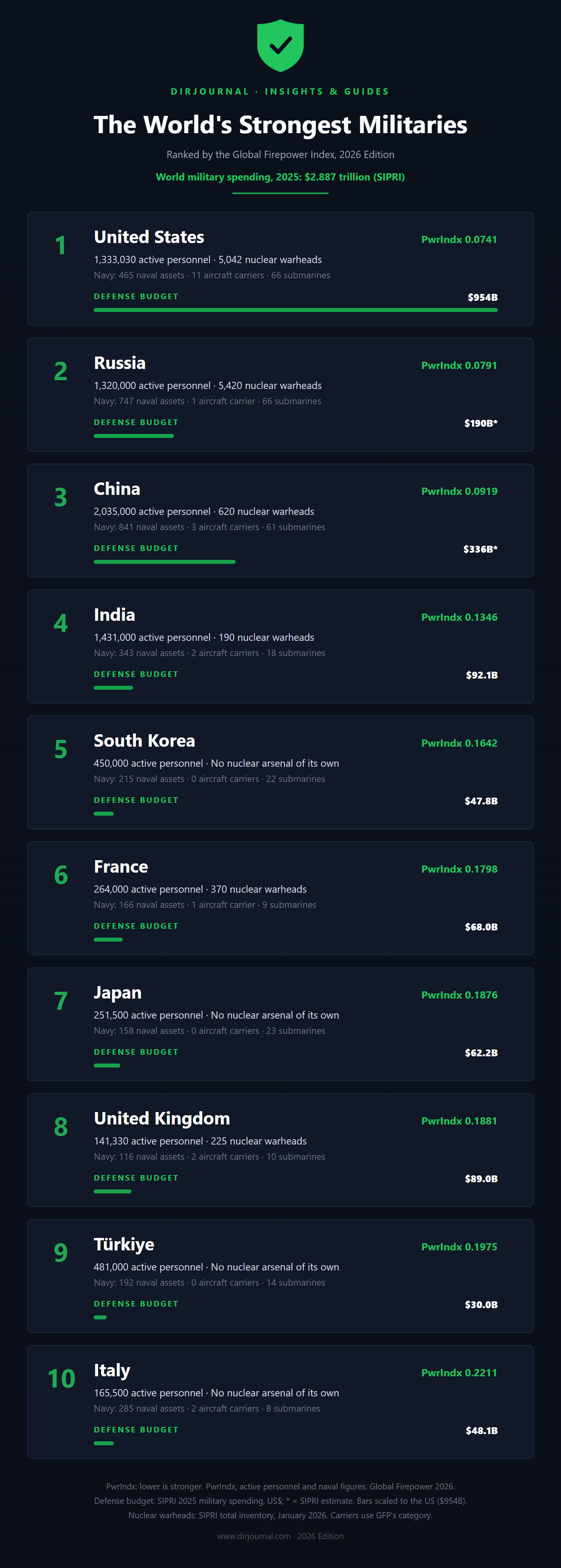
| Rank | Country | GFP PwrIndx | Active military personnel: GFP 2026 | Military spending in 2025: SIPRI, US$bn | Own nuclear arsenal |
|---|---|---|---|---|---|
| 1 | United States | 0.0741 | 1,333,030 | 954 | Yes |
| 2 | Russia | 0.0791 | 1,320,000 | 190* | Yes |
| 3 | China | 0.0919 | 2,035,000 | 336* | Yes |
| 4 | India | 0.1346 | 1,431,000 | 92.1 | Yes |
| 5 | South Korea | 0.1642 | 450,000 | 47.8 | No |
| 6 | France | 0.1798 | 264,000 | 68.0 | Yes |
| 7 | Japan | 0.1876 | 251,500 | 62.2 | No |
| 8 | United Kingdom | 0.1881 | 141,330 | 89.0 | Yes |
| 9 | Türkiye | 0.1975 | 481,000 | 30.0 | No |
| 10 | Italy | 0.2211 | 165,500 | 48.1 | No |
Sources: GFP rankings and the country profiles linked below; SIPRI military expenditure, Table 1; SIPRI nuclear forces, Table 8A.1. An asterisk marks a spending figure that SIPRI explicitly identifies as an estimate. Personnel figures cover active members across the armed forces and are GFP's estimates.
#1. United States
The US inventory in GFP 2026 includes 1,791 fighters, 66 submarines and 11 aircraft carriers. Its total of 13,032 aircraft covers fixed-wing aircraft and helicopters across all services.
The US military's financial lead remains substantial. SIPRI puts its 2025 expenditure at about 2.8 times China's, although US spending fell 7.5% in real terms that year; SIPRI links the decline primarily to the absence of new financial military assistance appropriations for Ukraine.
The Congressional Research Service's April 2026 report records $839.2 billion in the main FY2026 Department of Defense appropriations act. That act covers only part of national defence funding, so its total should not be substituted for SIPRI's broader spending measure.
#2. Russia
GFP's Russia profile records 1.32 million active personnel and 2 million reservists, alongside 5,630 tanks and 4,237 aircraft.
SIPRI's March 2026 budget study estimated planned Russian military expenditure at 14.9 trillion roubles, or 6.3% of GDP, and warned that the budget could be amended.
A September 28 decree ordered an authorised force of 1.55 million active servicemen, Reuters reported. An authorised establishment is a staffing target, not proof that every position has been filled.
#3. China
China's GFP profile lists 2,035,000 active personnel, 3,529 aircraft and 841 naval assets. China has the largest active military personnel total in GFP, while ranking third in its overall conventional index.
China's Ministry of National Defense confirms that its third aircraft carrier, Fujian, entered service on November 5, 2025. The ship uses electromagnetic catapults and has a full-load displacement above 80,000 tonnes.
GFP's broad naval asset count also includes auxiliary vessels.
#4. India
India ranks fourth, with 1,431,000 active personnel, 2,183 aircraft and two aircraft carriers in GFP's 2026 inventory.
India's Ministry of Defence announced a ₹7.85 lakh crore allocation for FY2026–27, 15.19% above the previous year's budget estimates. The ministry said the allocation also addressed procurement needs arising after Operation Sindoor.
On September 25, 2025, India signed a contract for 97 Tejas Mk1A aircraft, including 68 fighters and 29 twin-seaters. The ministry's year-end review puts the contract above ₹62,370 crore excluding taxes, with deliveries scheduled to start in 2027–28.
#5. South Korea
South Korea's GFP figures show 450,000 active personnel and 3.1 million reservists. Its inventory includes 1,540 aircraft and 1,831 tanks.
The first production KF-21 Boramae was delivered to the air force on September 22, 2026, according to the joint DAPA and air force announcement.
#6. France
France ranks sixth, ahead of Japan and the United Kingdom. GFP records 264,000 active personnel, 974 aircraft and one aircraft carrier, while France also maintains its own nuclear deterrent.
France's Ministry of the Armed Forces used a €57.1 billion defence budget for 2026 as the baseline in its April 2026 military programming update. The ministry's budget presentation identifies that figure as the Defence mission excluding pensions.
Dassault places the Rafale F5-associated combat drone in the post-2030 timeframe.
#7. Japan
Japan's GFP inventory includes 1,429 aircraft and 23 submarines. Japan moves ahead of the UK in the 2026 ranking.
Japan's Ministry of Defense budget document gives FY2026 defence-related expenditure of ¥9.0353 trillion when the specified base-realignment and related costs are included, a 3.8% increase. The same document records the establishment of the Joint Operations Command in March 2025.
Japan's government says its broader defence and complementary spending reached the level associated with its 2% target in FY2025. That measure differs from SIPRI's estimate of military expenditure at 1.4% of GDP in calendar year 2025.
#8. United Kingdom
The United Kingdom ranks eighth, with 141,330 active personnel and two aircraft carriers in GFP's dataset.
The 2025 Strategic Defence Review commitments include a future fleet of up to 12 SSN-AUKUS attack submarines and £15 billion for the sovereign nuclear warhead programme during the Parliament. The submarines are planned to replace the Astute class from the late 2030s.
The UK Ministry of Defence reported 127,060 full-time trained personnel across the naval and air services plus trade-trained Army personnel on July 1, 2026; this is a narrower category than total military personnel.
#9. Türkiye
Türkiye's GFP profile records 481,000 active personnel, 1,101 aircraft and 14 submarines. Its active personnel estimate is the second largest among NATO members after the United States.
On October 27, 2025, the UK government announced Türkiye's purchase of 20 Typhoon aircraft in a deal worth up to £8 billion. The first delivery is expected in 2030.
#10. Italy
Italy remains tenth, with 165,500 active personnel and 714 aircraft in GFP's 2026 dataset. It was also tenth in 2025, according to GFP's historical ranking; it did not replace Pakistan in this year's top ten.
GFP lists two Italian aircraft carriers and eight submarines. Italy's defence ministry records a combat flag presentation for Trieste on October 26, 2025.
Largest Militaries by Active Personnel
China leads GFP's active personnel table with 2,035,000, followed by India with 1,431,000 and the United States with 1,333,030. The figures count the active armed forces across services, rather than land armies alone.
Among the ten countries in this article, the personnel comparison is:
| Country | Active personnel | Reserve personnel |
|---|---|---|
| China | 2,035,000 | 510,000 |
| India | 1,431,000 | 1,000,000 |
| United States | 1,333,030 | 799,500 |
| Russia | 1,320,000 | 2,000,000 |
| Türkiye | 481,000 | 380,000 |
| South Korea | 450,000 | 3,100,000 |
| France | 264,000 | 43,444 |
| Japan | 251,500 | 56,000 |
| Italy | 165,500 | 18,300 |
| United Kingdom | 141,330 | 31,940 |
Source: GFP 2026 country profiles. This table covers the overall top ten only; it is not a global top-ten personnel ranking.
Highest Defense Budgets
SIPRI estimates that world military expenditure reached $2.887 trillion in 2025, up 2.9% in real terms.
| Spending rank | Country | 2025 spending, US$bn | Real change from 2024 | Share of GDP |
|---|---|---|---|---|
| 1 | United States | 954 | −7.5% | 3.1% |
| 2 | China | 336* | +7.4% | 1.7%* |
| 3 | Russia | 190* | +5.9% | 7.5%* |
| 4 | Germany | 114 | +24% | 2.3% |
| 5 | India | 92.1 | +8.9% | 2.3% |
| 6 | United Kingdom | 89.0 | −2.0% | 2.4% |
| 7 | Ukraine | 84.1* | +20% | 40%* |
| 8 | Saudi Arabia | 83.2* | +1.4% | 6.5%* |
| 9 | France | 68.0 | +1.5% | 2.0% |
| 10 | Japan | 62.2 | +9.7% | 1.4% |
| 11 | Israel | 48.3 | −4.9% | 7.8% |
| 12 | Italy | 48.1 | +20% | 1.9% |
| 13 | South Korea | 47.8 | +2.6% | 2.6% |
| 14 | Poland | 46.8 | +23% | 4.5% |
| 15 | Spain | 40.2 | +50% | 2.1% |
Source: SIPRI, Table 1. Dollar amounts use current prices and exchange rates; percentage changes are in real terms. Asterisks reproduce SIPRI's explicit estimate markers.
The US did not spend more than the next ten countries combined in 2025. Adding SIPRI's published figures for spending ranks 2–11 gives approximately $1,166.9 billion, compared with $954 billion for the US; this is a calculation from rounded source figures.
Biggest Nuclear Arsenals and Largest Navies
Nuclear Arsenals: January 2026
SIPRI's January 2026 estimates put the world's nuclear inventory at 12,187 warheads across nine states. Of these, 9,745 were in military stockpiles and 4,012 were deployed with operational forces.
| Country | Deployed warheads | Stored warheads | Military stockpile | Total inventory |
|---|---|---|---|---|
| Russia | 1,796 | 2,604 | 4,400 | 5,420 |
| United States | 1,770 | 1,930 | 3,700 | 5,042 |
| China | 34 | 586 | 620 | 620 |
| France | 280 | 10 | 290 | 370 |
| United Kingdom | 120 | 105 | 225 | 225 |
| India | 12 | 178 | 190 | 190 |
| Pakistan | None listed | 170 | 170 | 170 |
| Israel | None listed | 90 | 90 | 90 |
| North Korea | None listed | 60 | 60 | 60 |
| Total | 4,012 | 5,733 | 9,745 | 12,187 |
Source: SIPRI Yearbook 2026, Table 8A.1. “None listed” represents SIPRI's dash in the deployed category.
Military stockpiles include deployed and stored weapons. Total inventories also include retired warheads awaiting dismantlement: 1,342 for the US, 1,020 for Russia and 80 for France.
SIPRI's estimate of China's stockpile rose from 600 in January 2025 to 620 in January 2026.
GFP's China profile lists 841 naval assets, the largest total in its ranking, but the category includes auxiliary vessels.
| Country | Total naval assets | Aircraft carriers: GFP category | Submarines |
|---|---|---|---|
| China | 841 | 3 | 61 |
| Russia | 747 | 1 | 66 |
| United States | 465 | 11 | 66 |
| India | 343 | 2 | 18 |
| Italy | 285 | 2 | 8 |
| South Korea | 215 | 0 | 22 |
| Türkiye | 192 | 0 | 14 |
| France | 166 | 1 | 9 |
| Japan | 158 | 0 | 23 |
| United Kingdom | 116 | 2 | 10 |
Source: GFP 2026 country profiles. The table compares the ten countries ranked above, not the world's ten largest navies; GFP classifies helicopter carriers separately.
The US profile gives aggregate fleet tonnage of about 8.27 million tonnes, compared with about 3.19 million for China. That reverses the hull-count order and illustrates why fleet composition matters.
Largest Air Forces
The United States has the largest total military aircraft inventory in GFP 2026. The figures include helicopters and aircraft from all services, and exclude uncrewed aerial vehicles.
| Country | Total military aircraft | Fighters/interceptors |
|---|---|---|
| United States | 13,032 | 1,791 |
| Russia | 4,237 | 861 |
| China | 3,529 | 1,443 |
| India | 2,183 | 476 |
| South Korea | 1,540 | 242 |
Source: GFP 2026 profiles for the US, Russia, China, India and South Korea. Total aircraft includes support and training platforms.
United States vs China
The US leads China in GFP's overall ranking and aircraft inventory. China has more active personnel and more naval assets by GFP's broad hull definition.
| Measure | United States | China |
|---|---|---|
| GFP 2026 rank | 1 | 3 |
| Active personnel: GFP | 1,333,030 | 2,035,000 |
| Total military aircraft: GFP | 13,032 | 3,529 |
| Naval assets: GFP | 465 | 841 |
| Aircraft carriers: GFP | 11 | 3 |
| Military expenditure, 2025: SIPRI | $954bn | $336bn estimated |
Sources: US GFP profile, China GFP profile and SIPRI.
The figures do not settle the outcome of a conflict near Taiwan or elsewhere. Geography and access to bases affect how much of a country's force can reach a particular theatre and remain supplied there.
China vs Russia
Russia ranks second and China third in GFP 2026.
| Measure | China | Russia |
|---|---|---|
| Active personnel: GFP 2026 | 2,035,000 | 1,320,000 |
| Total military aircraft: GFP 2026 | 3,529 | 4,237 |
| Naval assets: GFP 2026 | 841 | 747 |
| Military expenditure, 2025: SIPRI | $336bn estimated | $190bn estimated |
| Nuclear military stockpile, January 2026: SIPRI | 620 | 4,400 |
Sources: China and Russia GFP profiles; SIPRI spending and nuclear estimates.
Russia's larger nuclear stockpile belongs in a separate strategic comparison.
Military Rankings 11–20
GFP's next ten countries include Germany and Pakistan, both of which moved two places between the 2025 and 2026 editions.
| Rank | Country | GFP PwrIndx |
|---|---|---|
| 11 | Brazil | 0.2374 |
| 12 | Germany | 0.2463 |
| 13 | Indonesia | 0.2582 |
| 14 | Pakistan | 0.2626 |
| 15 | Israel | 0.2707 |
| 16 | Iran | 0.3199 |
| 17 | Australia | 0.3208 |
| 18 | Spain | 0.3247 |
| 19 | Egypt | 0.3651 |
| 20 | Ukraine | 0.3691 |
Source: GFP 2026. Poland is 21st, Taiwan 22nd and Saudi Arabia 25th.
Notable Movers: What Changed in 2026?
GFP's historical rankings establish the changes below.
| Country | 2025 rank | 2026 rank | Change |
|---|---|---|---|
| France | 7 | 6 | Up 1 |
| Japan | 8 | 7 | Up 1 |
| United Kingdom | 6 | 8 | Down 2 |
| Germany | 14 | 12 | Up 2 |
| Pakistan | 12 | 14 | Down 2 |
| Australia | 18 | 17 | Up 1 |
| Spain | 17 | 18 | Down 1 |
| Saudi Arabia | 24 | 25 | Down 1 |
| Italy | 10 | 10 | Unchanged |
Germany's rise sits alongside a large spending increase: SIPRI puts its 2025 expenditure at $114 billion, up 24% in real terms.
Pakistan was ninth in 2024, twelfth in 2025 and fourteenth in 2026. Ukraine remained twentieth from 2025 to 2026; SIPRI estimates that its military expenditure reached 40% of GDP in 2025.
The 2026 Conflicts and the Limits of an Annual Ranking
The Pentagon dates the start of Operation Epic Fury against Iran to February 28, 2026. The Council on Foreign Relations' September 11 overview describes US and Israeli attacks followed by a Pakistan-mediated ceasefire and a June memorandum, with further strikes and no durable settlement.
The US also conducted Operation Absolute Resolve in Venezuela on January 3, 2026. The Pentagon's account describes the capture of Nicolás Maduro and Cilia Flores in an operation combining military and law-enforcement personnel.
These events occurred after, or around the preparation of, the annual ranking.
NATO's 5% Defence Spending Commitment
At the 2025 Hague summit, NATO members committed to investing 5% of GDP annually by 2035. The commitment combines at least 3.5% for core defence requirements with up to 1.5% for broader defence- and security-related spending, with a review in 2029.
In its July 7, 2026 update, NATO expected five allies to meet the 3.5% core guideline during 2026. NATO's definitions also differ from SIPRI's.
Frequently Asked Questions
Which country has the strongest military in 2026?
Is China's military stronger than Russia's?
Which country has the largest army by active personnel?
Which country spends the most on its military?
Which countries have nuclear weapons, and how many?
Where does Pakistan rank in military strength?
Where does Germany rank in military strength?
Where does Ukraine rank in military strength?
How many aircraft carriers does each major military have?
Is the military ranking based on nuclear weapons?
Why did the UK fall from sixth to eighth?
Does the US spend more than the next ten militaries combined?
Join the DirJournal newsletter
Weekly insights on directories, listings, SEO, and how businesses get found online.
No spam. Unsubscribe anytime.
Found this useful?
Share this article
Recommended for You

Best SEO Companies: 15 Agencies Ranked by Specialization, Case Studies, and AI Citation Data
Victorious is our top pick for companies that want a search-only specialist. OuterBox leads for…

The Ultimate List of Free Business Directories (Ranked by AI & SEO Value)
60+ free business directories ranked by AI citations, not just DA. Trustpilot gets 1.35M AI…

Best Digital Marketing Agencies: 15 Agencies Ranked by Specialization and Client Results
15 digital marketing agencies compared by specialization, pricing, client results, and AI…
Related Resources
Looking for verified service providers? Browse our directory categories below — all human-audited and trusted by decision-makers since 2007.