Independent. Human-Curated. Established 2007.
What Everyone Gets Wrong About Talking to AI (And the Mistakes That Keep Costing People Money, Time, and Sometimes Their Careers)
DirJournal Founder · 19+ years building directory and discovery products. Editorial-team verified.
Key Topics in This Guide
- 1The Single Biggest Misconception: AI is Not a Memory System — covered in detail below
- 2Why Long Threads Get Worse, Not Better (the "Lost in the Middle" Problem) — covered in detail below
- 3Context Retention Compared: Claude vs. ChatGPT vs. Gemini — covered in detail below
- 4The Hallucination Problem is Worse Than People Think — covered in detail below
- 5Where the Public Goes Wrong With AI in Personal Life — covered in detail below
- 6Where Professionals Get It Wrong (Especially When Building Software) — covered in detail below
- 7How to Maintain Context in Long Development Conversations — covered in detail below
- 8Tips to Stop Repeating Yourself — covered in detail below
- 9Common Pitfalls When Building Sites With AI Tools — covered in detail below
- 10A Simple Reality Check Before You Trust AI Output — covered in detail below
- 11The Mental Model That Actually Works — covered in detail below
A few months back I was deep into a website rebuild, working through a single Claude thread that had been running for the better part of three weeks. I had convinced myself this was the smart way to do it. The longer the chat, I figured, the more "context" the model would have on the project. By week three it would basically be a teammate. It wasn't. Around the time the thread crossed a certain length I cannot pinpoint, the assistant started forgetting decisions we had locked in days earlier. It rewrote files using outdated column names. It cheerfully suggested I "add" a feature that already existed in the codebase, then a few prompts later wiped half the implementation while "cleaning up." When I pushed back, it apologized and confidently broke something else.
That mega-thread cost me close to a day of debugging. It also taught me something important about every AI tool people are using right now: the public mental model of how these things work is not just wrong, it is wrong in ways that have produced sanctioned attorneys, malware-infected codebases, and at least one man who replaced his table salt with a pesticide on ChatGPT's advice and ended up in a hospital bed.
This post is the long version of what I wish someone had handed me two years ago. It pulls together what Anthropic, OpenAI, and Google have published, what academic researchers have actually measured, and what I have learned the hard way running multiple production sites built with AI assistance. If you only read one piece on this topic, I want it to be this one.
The Single Biggest Misconception: AI is Not a Memory System
The thing most people imagine when they chat with Claude or ChatGPT or Gemini is something like a smart colleague who is gradually getting to know them. That mental model is the source of about 80 percent of the trouble.
What you are actually talking to is a stateless prediction engine. Every time you hit send, the model receives the entire visible conversation, runs it through a probability machine, and outputs the most plausible next chunk of text. It has no inner life between messages. It does not "think about your project" when you walk away. It does not get to know you, unless a specific memory feature is turned on, in which case it gets to know a tiny summary of you, not the real you.
Three implications fall out of this, and almost every misunderstanding people have can be traced to ignoring at least one:
- If something isn't in the current prompt or active context, it does not exist for the model.
- The model does not verify, fact-check, or "know" anything. It produces statistically likely text.
- Confidence in the output has no relationship to accuracy. The tone is the same whether the answer is correct or completely fabricated.
That last point is the dangerous one. Humans are wired to trust confident speakers. AI is, by default, a confident speaker.
Why Long Threads Get Worse, Not Better (the "Lost in the Middle" Problem)
Here is the part that surprised me the most when I started reading the research. The whole industry has spent two years bragging about context windows. Claude went to 1M tokens. GPT-5.5 went to 1M tokens. Gemini 3.1 Pro is at 1M tokens. The implication, sold loud and often, was that you could now feed in entire codebases or novels and the model would handle them gracefully.
The reality is more complicated. A landmark Stanford and University of Washington paper introduced what they called the "lost in the middle" effect. When you place key information in the middle of a long context, model accuracy drops sharply, even on models specifically built for long-context tasks. The performance curve is U-shaped: information at the beginning and end of the context gets remembered well, and the stuff in the middle gets fuzzy. Follow-up research from Snorkel AI confirmed the same pattern in GPT-4 and Claude 3 Opus.
Independent benchmarking from Elvex found that models often only retain reliable accuracy across about 60 to 70 percent of their advertised context window before performance starts breaking down. Claude has historically held up better than its competitors here, with less than 5 percent accuracy degradation across its full 200K range, but no model is immune.
There is also a phenomenon I learned to call "context poisoning." If the AI hallucinates a fact early in a thread and you don't catch it, that hallucination becomes part of its working "truth" for the rest of the conversation. Every subsequent answer builds on that false foundation. The error compounds. By the time you notice, half your conversation is built on something the model invented in message four.
The takeaway is counterintuitive but important: a clean five-message thread is almost always smarter than a sprawling fifty-message thread. More context is not more intelligence. It is often less.
Context Retention Compared: Claude vs. ChatGPT vs. Gemini
Here is a side-by-side that reflects where each tool actually sits in early 2026, drawn from each company's published specs and independent benchmarks.
| Capability | Claude (Opus 4.7) | ChatGPT (GPT-5.5) | Gemini (3.1 Pro) |
|---|---|---|---|
| Maximum context window | 1M tokens | 1M tokens | 1M tokens |
| Effective context (real-world) | Strongest sustained accuracy across full range | Strong on tasks ≤ 128K, degrades faster on long inputs | Largest by raw size, but uneven mid-context recall |
| Persistent memory between sessions | Yes (opt-in, summary based) | Yes (Memory feature, tracks preferences) | Yes (in Gemini Advanced, scoped) |
| Built-in web search | No (separate tool when enabled) | Yes (default for current questions) | Yes (deeply integrated with Google Search) |
| Coding context retention | Best in class for agentic coding workflows | Strong general coding, weaker on multi-file consistency | Fast and broad, occasionally inconsistent on tricky logic |
| Tendency to admit "I don't know" | Highest | Moderate | Lowest |
| Hallucination rate (commercial averages) | Low | Low | Moderate |
Two notes on this. First, all three companies update their models every few months and the gaps narrow constantly. By the time you read this, GPT-5.6 or Gemini 3.2 may have shifted things again. Second, raw context size is the least interesting number on this table. What matters is how reliably the model uses the context you give it. On that front, none of these tools deserve blind trust.
The Hallucination Problem is Worse Than People Think
Most people understand "AI hallucinates" as an abstract risk. Let me give you three concrete examples that should change how you think about it.
Example 1: Slopsquatting. Researchers at the University of Texas at San Antonio, Oklahoma, and Virginia Tech tested 16 large language models across 576,000 code samples in a 2025 USENIX Security study. Open-source models invented non-existent package names 21.7 percent of the time. Even commercial models like GPT-4 hallucinated packages in 5.2 percent of cases. They identified more than 205,000 unique fictional package names. Attackers have been registering these names on npm and PyPI and uploading malware under them. One hallucinated package called huggingface-cli was downloaded over 30,000 times in three months before anyone noticed it was fake. A security researcher who registered the hallucinated react-codeshift watched it spread into 237 GitHub repositories before he locked it down.
If you build websites using AI tools and copy-paste install commands without checking, you are part of this attack surface.
Example 2: Fabricated case law. The legal field has had a brutal two years on this front. The original Mata v. Avianca case in 2023 saw attorney Steven Schwartz fined $5,000 for filing a brief with cases that did not exist. It was supposed to be a one-time embarrassment. It wasn't. By 2025, Morgan & Morgan, the largest plaintiffs firm in the U.S. by headcount, was sanctioned $5,000 after one of its lawyers cited eight non-existent cases generated by AI. A California state court fined two law firms $31,000 in another AI-generated citation case. A researcher at HEC Paris, Damien Charlotin, has built a public database tracking these incidents. As of late 2025 it logged 486 cases worldwide.
A Stanford RegLab analysis found that some AI tools generate hallucinations in roughly one out of every three legal queries. One in three.
Example 3: Medical misinformation that lands people in hospitals. A case study published in the Annals of Internal Medicine documented an older man who asked ChatGPT how to cut sodium from his diet. The model recommended replacing his table salt with bromide salts. Bromide salts were used as a sedative around 1900. They are now found primarily in pesticides and pool cleaners. The man was hospitalized with bromide poisoning. He had assumed, reasonably, that an AI giving health advice would not direct him to consume something used to clean swimming pools.
These are not edge cases. They are the predictable output of a system that produces plausible-sounding text without ever checking whether it is real.
Where the Public Goes Wrong With AI in Personal Life
I split this into personal and professional because the misuse patterns look different.
On the personal side, the most common mistakes I see:
- Treating AI medical answers as a final verdict instead of a starting point for talking to an actual doctor
- Using it for legal interpretation and acting on the answer without ever speaking to a lawyer
- Asking for stock picks, crypto plays, or "should I buy this house" advice and weighing it as expert opinion
- Pasting personal information, financial details, or family medical history into chat tools without checking the platform's data policy
- Using AI as a therapist during a real mental health crisis without recognizing how badly that can go
- Believing the first answer on a contested topic instead of probing or cross-checking
- Assuming the AI is "the same" between conversations or even between days, when models update silently
- Sharing screenshots of chats as if the AI's confident phrasing equals authority
The fundamental error is treating the AI as a credentialed source. It has no credentials. It has no liability. It has no professional review board. When it gets something wrong, no one is on the hook except you.
Where Professionals Get It Wrong (Especially When Building Software)
This is where I have made most of my own mistakes, and it is also where the stakes can run highest.
- Pasting client data, NDAs, internal financials, or proprietary code into consumer-grade AI tools without checking what happens to that data
- Letting AI-generated code go straight to production without a real review
- Quoting AI-generated statistics, legal cases, or expert opinions in published work without verifying them (this is the failure mode that ended a few journalism careers in 2024 and 2025)
- Assuming the model "knows" the codebase, the brand voice, or the client context just because you mentioned it once five days ago
- Skipping documentation because "we can ask AI again later," then losing critical decisions when that thread goes cold
- Running entire multi-week builds inside a single thread until the model collapses under its own weight
- Treating speed of output as a proxy for quality of output
- Deploying code with hallucinated package names and inviting malware into the repo
- Burning hours arguing with the model when starting a fresh thread would have solved the problem in five minutes
If you take one practical thing from this whole article, take this: the moment a thread starts feeling slow, contradictory, or forgetful, you have already lost. Start a new one.
How to Maintain Context in Long Development Conversations
This is the part of the post I wish someone had written when I started building with AI tools. Below is the actual playbook I use now after enough painful lessons.
1. Treat threads as workspaces, not archives. Every thread is for a specific scoped task. When the task ends, the thread ends. Summarize the outcome somewhere outside the chat (a Notion doc, a README, a commit message) and start fresh for the next task.
2. Build a project context file and paste it at the start of every new thread. Mine includes the stack, the database schema, the naming conventions, the directories I never touch, and the decisions we have already made. Three to five hundred words is usually enough. If you use Claude Code, Cursor, or similar tools, this lives in a CLAUDE.md or rules file. If you are in plain chat, it goes in the first message.
3. Use compaction. When a thread gets long but you genuinely need to keep going, ask the model to summarize the conversation into a structured snapshot covering decisions made, current state, open questions, and next steps. Anthropic uses this approach internally in Claude Code. Copy the summary into a fresh thread and continue from there. You lose almost nothing, and you reset the attention budget.
4. Re-state non-negotiables every time. If your project has a column that gets confused with another column, or a function that should never be modified, or a coding pattern you require, repeat it. The model is not stubborn. It just does not retain priorities the way a human would.
5. Paste the actual code or schema rather than describing it. I see people writing things like "you remember our user table, right?" The model does not. Paste the schema. Paste the function. Paste the file. Concrete tokens beat vague references every time.
6. Lower the temperature when it matters. If your AI tool exposes a temperature or "creativity" setting, turn it down for code, configuration, or anything where precision counts. Lower temperatures produce fewer creative leaps and fewer fabricated package names.
7. Verify packages, citations, and APIs before you trust them. Any time the model recommends a library or a function, check that it actually exists. Run npm view <package> or pip show <package> before installing. For citations, click through. This step takes seconds. Skipping it has ended careers.
Tips to Stop Repeating Yourself
One frustration that drives people to long mega-threads in the first place is the friction of re-explaining context every time. Here is how I cut that down without giving up the benefits of fresh threads.
| Tactic | What it solves | How to set it up |
|---|---|---|
| Project context file | Repeating stack, conventions, schema | Maintain a 300–500 word doc; paste at start of any new thread |
| Custom instructions or system prompt | Repeating tone, role, constraints | Use the Custom Instructions feature in ChatGPT or Project setup in Claude |
| Memory feature | Cross-session preferences (your name, role, goals) | Turn on Memory in ChatGPT or Claude; review what it stores periodically |
| Saved prompt templates | Repeating task structure | Keep a library of prompts in Notion, a text file, or a snippets manager |
| Project folders | Re-uploading the same reference docs | ChatGPT Projects, Claude Projects, and Gemini Gems all support this |
| External knowledge base | Reusing institutional context | RAG setup with your own docs (advanced; for teams or heavy users) |
The pattern across all of these is the same. Anything you find yourself typing twice, externalize. The AI does not get tired of reading your context file. You get tired of typing it.
Common Pitfalls When Building Sites With AI Tools
I run multiple sites and have built or rebuilt several of them with heavy AI assistance. Here are the specific traps that catch people, especially non-technical founders trying to ship quickly.
- Treating "it works on the page" as "it works." Code that renders correctly can still have broken auth, leaked API keys, missing input validation, or a database query that loads 30,000 rows on every request. Always test like a hostile user.
- Letting the AI design the architecture. AI is good at writing a function. It is bad at deciding whether you should use Postgres or a message queue or how your auth should be structured. Architectural decisions made by an AI tend to look fine and age badly.
- Trusting the AI's read of your codebase. If you paste five files into a thread, the AI is reasoning about those five files. It does not know about the other ninety. It will confidently suggest changes that break things in places you didn't paste.
- Not pinning dependencies. If the AI recommends a package, pin the exact version after you verify the package is real. Floating versions plus AI suggestions plus auto-installers is how malware lands in production.
- Skipping the security review because "it's a small site." The bromide-salt logic applies to code too. The AI is not checking whether your contact form is rate-limited, whether your admin route requires auth, or whether your file uploads are sanitized. You are.
- Believing the AI's diagnosis when something breaks. The model often misdiagnoses errors with great confidence. If your build is failing, read the actual error log yourself before asking the AI what went wrong. Otherwise you and the AI will go three rounds chasing a problem that doesn't exist.
- Vibe coding past your skill level on anything that handles real money or real data. AI lets you build things you could not build alone. It does not let you maintain them, debug them under load, or recover them when they fail. If you ship it, you own it.
A Simple Reality Check Before You Trust AI Output
I keep this list pinned above my desk, more or less:
- Did the AI actually search for this, or is it pulling from training data?
- Could the model's knowledge cutoff make this answer stale?
- Does this involve a real person, organization, citation, or library that I should verify independently?
- If it gave me a citation, does the citation exist?
- Would I act on this if a confident stranger said it at a coffee shop?
- If this is wrong, what does it cost me — and is that cost reversible?
The last question is the one that has saved me the most. If the cost of being wrong is "I have to rewrite this paragraph," ship and move on. If the cost is "I get sued, fired, hospitalized, or hacked," verify everything.
The Mental Model That Actually Works
After two years of using these tools daily, here is the framing that has held up for me. AI is a brilliant, fast, well-read intern with no memory between days, no skin in the game, a tendency to please, and an inability to tell when it is making things up. You can get extraordinary work out of an intern like that, but only if you supervise, verify, and structure the work into clean assignments.
It is not a colleague. It is not an expert. It is not an oracle. And it is not, despite what the marketing implies, getting to know you and your project. It is a stateless prediction machine that will happily tell you whatever sounds plausible, in the same confident tone, whether the answer is brilliant or completely made up.
Use it for what it is good at. First drafts, scaffolding, brainstorming, learning, summarizing, translating, restructuring, debugging hints, and exploring options you would never have thought of alone. Verify what matters. Document outside the chat. Keep your threads short, your context files current, and your skepticism intact.
The people getting the most out of AI right now are not the ones who trust it the most. They are the ones who understand exactly where it breaks.
Join the DirJournal newsletter
Weekly insights on directories, listings, SEO, and how businesses get found online.
No spam. Unsubscribe anytime.
Found this useful?
Share this article
Recommended for You
Keyword Research in the AI Search Era: What You Think You Know vs. What You Might Uncover
Keyword research in 2026 is no longer about finding terms to rank for. It is about understanding…
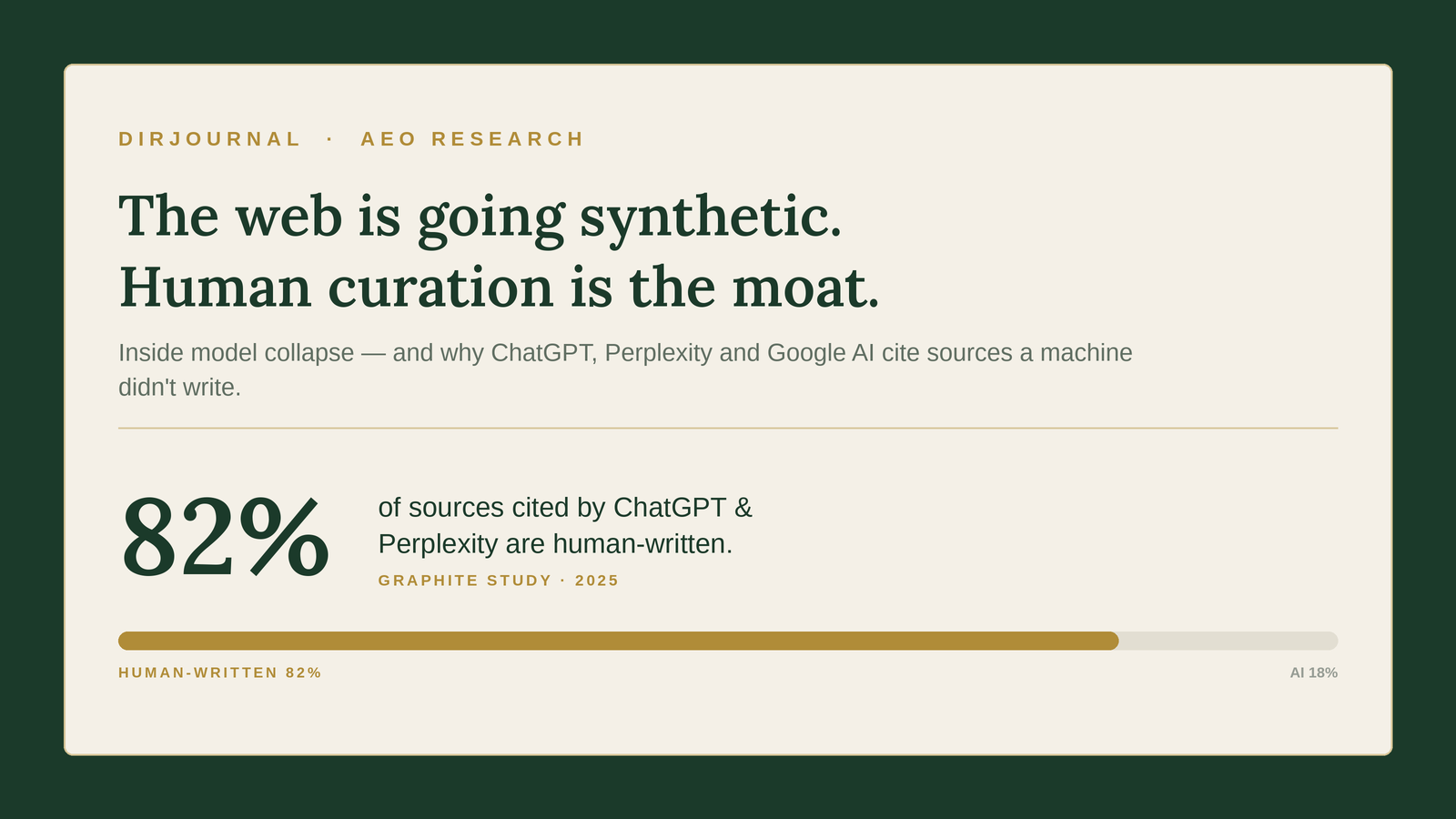
The Role of Human-Curated Directories in LLM Training Data
Why answer engines like ChatGPT, Perplexity, and Google AI Overviews disproportionately cite…
The 8 Data Points Every Business Listing Needs in 2026 (Or AI Will Skip You)
For nearly two decades, link accumulation drove directory authority. In 2026 that playbook is…
Related Resources
Looking for verified service providers? Browse our directory categories below — all human-audited and trusted by decision-makers since 2007.