Independent. Human-Curated. Established 2007.
How to Build Links in 2026: 15 Strategies That Actually Work
DirJournal Founder · 19+ years building directory and discovery products. Editorial-team verified.
Key Takeaways
- Link building in 2026 is about earning, not building. Google's algorithms are sophisticated enough to detect manufactured link patterns. The strategies that work are the ones that create genuinely link-worthy content or provide real value to other site owners.
- Digital PR has become the #1 scalable link building strategy. Creating data-driven studies, surveys, and original research that journalists cite naturally generates high-authority links at scale — without outreach that feels like spam.
- Directory links still matter — but only from quality directories. A listing on DirJournal, BOTW, or Jasmine Directory carries real SEO weight. A link from a random auto-approve directory does nothing or hurts.
- The best links come from being genuinely useful. Free tools, calculators, templates, and original data attract links naturally because people reference useful resources. This is the hardest strategy to execute but the most sustainable.
Backlinks remain one of Google's top three ranking factors in 2026. That hasn't changed. What has changed is how you get them. The era of mass email outreach, PBNs (private blog networks), and link exchanges is over — not because Google says so in blog posts, but because the algorithms genuinely detect and discount these patterns now.
What works today: creating things worth linking to, building relationships with people who link, and making it easy for authoritative sites to reference your work. This guide covers 15 strategies ranked by three factors: effectiveness (how much ranking impact), difficulty (time and skill required), and cost (budget needed).
All 15 Strategies at a Glance
Ranked by overall effectiveness for most businesses.
| # | Strategy | Effectiveness | Difficulty | Cost | Time to Results |
|---|---|---|---|---|---|
| 1 | Original Research & Data Studies | ★★★★★ | High | $-$$ | 2-6 months |
| 2 | Digital PR & Journalist Outreach | ★★★★★ | High | $-$$ | 1-3 months |
| 3 | Free Tools & Calculators | ★★★★★ | High | $$ | 3-12 months |
| 4 | HARO / Connectively Responses | ★★★★ | Medium | Free | 2-8 weeks |
| 5 | Guest Posting (Strategic) | ★★★★ | Medium | $-$ | 1-3 months |
| 6 | Broken Link Building | ★★★ | Medium | $ | 1-2 months |
| 7 | Resource Page Link Building | ★★★ | Low-Medium | $ | 2-6 weeks |
| 8 | Business Directory Listings | ★★★ | Low | $-$ | Immediate |
| 9 | Skyscraper Technique 2.0 | ★★★ | High | $ | 2-4 months |
| 10 | Unlinked Brand Mentions | ★★★ | Low | Free-$ | 1-4 weeks |
| 11 | Podcast Appearances | ★★★ | Medium | Free | 1-3 months |
| 12 | Competitor Backlink Replication | ★★ | Medium | $ | 2-4 months |
| 13 | Content Syndication | ★★ | Low | Free-$ | 1-4 weeks |
| 14 | Community Participation | ★★ | Low | Free | 1-6 months |
| 15 | Infographics & Visual Assets | ★★ | Medium | $ | 1-3 months |
Tier 1: High-Impact Strategies (Worth the Investment)
1. Original Research & Data Studies
Why it's #1: Nothing attracts links more consistently than original data. When you publish research that doesn't exist elsewhere — a survey of 1,000 marketers, an analysis of 50,000 websites, a study of industry trends with real numbers — journalists, bloggers, and content creators link to it because they have no alternative source.
How to execute:
- Survey your customers or audience (use Typeform or Google Forms)
- Analyze publicly available data in a new way (government data, public APIs, app store data)
- Scrape and aggregate data that's scattered across many sources into one definitive resource
- Run experiments and publish the results (A/B tests, market tests, benchmarks)
Real example: Backlinko's "We Analyzed 11.8 Million Google Search Results" study has earned 37,000+ backlinks from 8,000+ domains. The study cost roughly $10,000-15,000 in data analysis time and has been generating links continuously since 2020.
2. Digital PR & Journalist Outreach
Why it works: Journalists need expert sources and data for their articles. If you can provide newsworthy data, expert commentary, or unique angles on trending stories, you earn links from the highest-authority sites on the internet — news outlets, industry publications, and major blogs.
How to execute:
- Monitor trending stories in your industry using Google Trends, Twitter/X, and news aggregators
- Prepare data-backed commentary BEFORE journalists need it (reactive PR)
- Create newsworthy assets — reports, indexes, rankings, predictions
- Build journalist relationships through Connectively (formerly HARO), Qwoted, and direct Twitter outreach
- Send personalized pitches — never mass-email journalists with generic templates
3. Free Tools & Calculators
Why it works: Useful tools earn links passively because people reference tools they actually use. A mortgage calculator, an SEO audit tool, a salary comparison widget — these become link magnets because they solve a problem that text content can't.
Real example: Ahrefs' free backlink checker earns thousands of links because every "how to check backlinks" article links to it as the recommended tool. DirJournal's own Webmaster Tools (DNS Lookup, Domain Check, Response Headers) serve the same function — free utilities that people reference and link to.
Tier 2: Reliable Strategies (Consistent Results)
4. HARO / Connectively Responses
The approach: Sign up at Connectively (free). Three times daily, you receive journalist queries seeking expert sources. Respond with genuinely helpful, concise expertise. When your response is used, you get a link from the publication.
Success rate: Expect 5-15% of your responses to result in published links. The key is responding quickly (within 2-3 hours of the query), being genuinely helpful (not promotional), and including credentials that establish your authority.
Typical results: 30 days of consistent responses (3-5 per day) = 8-15 published links from sites like Forbes, Business Insider, HubSpot, and niche industry publications.
5. Guest Posting (Strategic, Not Spammy)
The right way: Write genuinely valuable content for high-authority sites in your niche. One exceptional article on a DR 70+ site is worth more than 50 articles on low-quality "guest post farms." Target sites where your audience already reads.
The wrong way: Mass-emailing sites with "I'd love to write for your blog" templates. Paying $50 for a guest post on a site that accepts everyone. Writing thin 500-word articles stuffed with links. These practices are detectable and counterproductive.
How to find opportunities: Search for "[your topic] + write for us" or "[your topic] + contributor guidelines." Better yet, find sites that have published guest content before (check author bios for "guest contributor") and pitch specific, unique angles.
6. Broken Link Building
The approach: Find broken links on authoritative pages in your niche. Create content that could replace the dead resource. Email the site owner: "Hey, I noticed [link] on your [page] is broken. I recently published [similar resource] that could work as a replacement."
Tools: Ahrefs' Broken Link Checker, Check My Links (Chrome extension), Screaming Frog.
Success rate: 5-15% of outreach emails result in a link placement. The key is finding truly relevant broken links where your content is a natural replacement — not forcing a match.
7. Resource Page Link Building
The approach: Find resource pages and "best of" lists in your niche that link to similar content. Reach out and suggest your resource as an addition.
Search operators: "useful resources" + [your topic], "recommended tools" + [your topic], intitle:"resources" + [your topic]
8. Business Directory Listings
Still relevant in 2026: Quality business directories provide foundational backlinks that establish your business's legitimacy and improve local SEO. The key word is "quality" — auto-approve, spam-filled directories are worthless.
Recommended directories (see our full guide: Best Web Directories for SEO):
- DirJournal — Human-verified, 19-year domain authority, 55,000+ referring domains
- Best of the Web (BOTW) — Operating since 1994, DR 73
- Jasmine Directory — US/EU registered, human-edited, DR 58
- Google Business Profile — Essential for local SEO
- LinkedIn Company Page — High authority business profile
Found this useful?
Share this article
Recommended for You
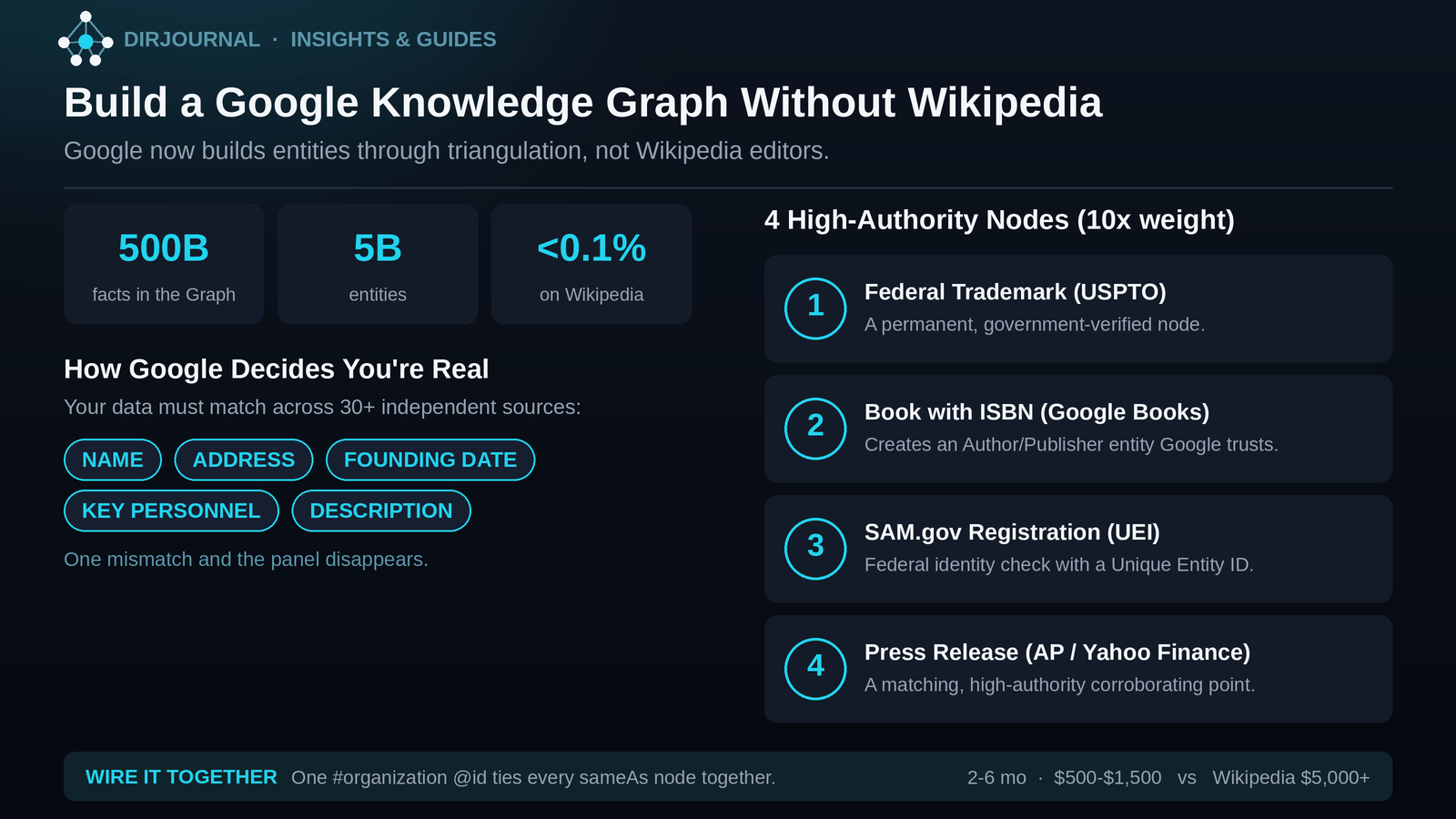
How to Build a Google Knowledge Graph Without Wikipedia
You do not need a Wikipedia page to get a Google Knowledge Panel. Here is the technical and legal pl
The Ultimate List of SEO Resources & Tools (2026)
Multilingual SEO: How to Rank in Multiple Languages and Countries
Multilingual SEO is the practice of structuring and optimizing a website so search engines and AI en
Deep Dive Resources
Related topics consolidated into this guide:
- The Best Business Directories for SEO in 2026
Related Resources
Looking for verified service providers? Browse our directory categories below — all human-audited and trusted by decision-makers since 2007.
Tier 3: Supporting Strategies (Supplementary Value)
9-15: Quick Overviews
9. Skyscraper Technique 2.0: Find the best-ranking content for your target keyword. Create something 10x better (not just longer — more useful, more current, better designed). Then outreach to sites linking to the inferior original. The 2.0 version: add original data, interactive elements, or a unique angle that the original completely lacks.
10. Unlinked Brand Mentions: Use Ahrefs' Content Explorer or Google Alerts to find pages that mention your brand but don't link to you. Email the author: "Thanks for mentioning us! Would you mind adding a link so readers can find us easily?" Success rate: 20-40% — the highest of any outreach method because they already know you.
11. Podcast Appearances: Appear as a guest on podcasts in your industry. Show notes typically include links to guests. More importantly, podcasts build relationships with hosts who may link to you from their sites, social media, and future content.
12. Competitor Backlink Replication: Use Ahrefs' Link Intersect tool to find sites that link to multiple competitors but not to you. These sites are clearly interested in your topic — they're the warmest outreach prospects.
13. Content Syndication: Republish your best content on Medium, LinkedIn Articles, or industry publications with a canonical link back to the original. This doesn't build traditional backlinks but increases exposure and can lead to organic links from people who discover your content through the syndicated version.
14. Community Participation: Genuine participation in Reddit, Quora, Stack Overflow, and industry forums — answering questions, sharing expertise, and linking to your content ONLY when it's the best answer. Never spam. Build reputation first, link second.
15. Infographics & Visual Assets: Create data visualizations, process diagrams, or infographics that others embed on their sites (with a link back to you). The effectiveness has declined from its 2015 peak but still works for genuinely useful visual data.
Link Building Practices to Avoid in 2026
These will either waste your money or actively harm your rankings.
- Buying links from link sellers — Google's SpamBrain algorithm specifically targets purchased links. The sellers who claim their links are "undetectable" are wrong. The risk-to-reward ratio is terrible.
- Private Blog Networks (PBNs) — Entire PBN networks get deindexed regularly. Every site that linked to you through the PBN becomes a penalty risk.
- Mass link exchanges — "I'll link to you if you link to me" at scale is a detectable pattern. Occasional, natural reciprocal links between genuinely related sites are fine. Systematic exchanges are not.
- Comment spam / forum spam — NoFollow links from comments have zero SEO value. Spam comments damage your brand reputation.
- Auto-approve directory submissions — If a directory accepts every submission without review, it has no quality signal. These links are ignored or discounted by Google.
- Fiverr / cheap link building services — "500 backlinks for $5" means 500 links from worthless sites. These packages frequently trigger manual penalties.