Independent. Human-Curated. Established 2007.
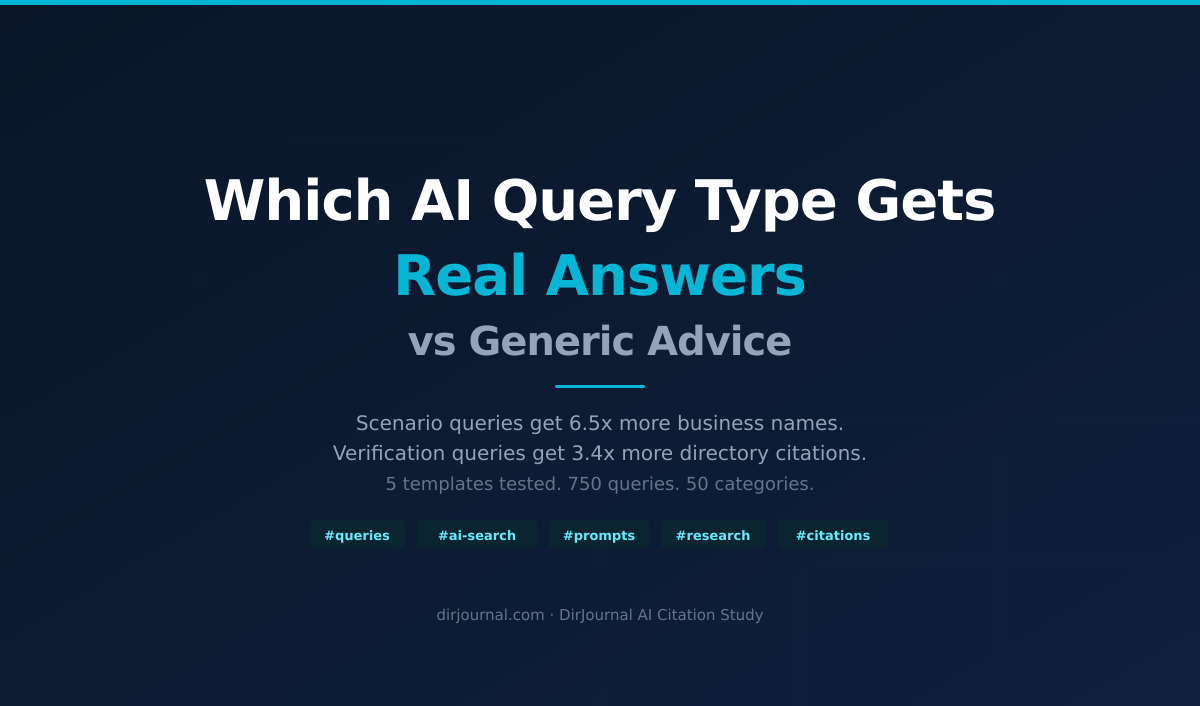
Which AI Query Type Gets Real Answers vs Generic Advice
DirJournal Founder · 19+ years building directory and discovery products. Editorial-team verified.
Key Topics in This Guide
- 1The Five Templates Ranked — covered in detail below
- 2Scenario Queries: the Unlock — covered in detail below
- 3Verification Queries: the Directory Finder — covered in detail below
- 4Comparison Queries: Tables, Not Names — covered in detail below
- 5Location Queries: ChatGPT's Strength — covered in detail below
- 6Entity Extraction: Simple but Risky — covered in detail below
- 7How to Use This — covered in detail below
Ask AI "list 5 plumbers" and you might get a refusal. Ask "I manage a 20-unit apartment building with a burst pipe at 2am, which emergency plumbers should I call?" and you get names, phone numbers, and reviews.
Same category. Same AI engine. Completely different output. The way you frame a question determines whether AI gives you real business recommendations or generic advice.
We tested 5 query types across all 750 queries in our AI Citation Study. Here's what each produced.
The Five Templates Ranked
| Template | Avg entities | Avg directories | Best for |
|---|---|---|---|
| T3: Scenario-Based | 4.0 | 0.41 | Getting specific business names |
| T4: Verification | 2.9 | 1.11 | Getting directory recommendations |
| T5: Location-Specific | 1.9 | 0.67 | Getting local business names |
| T1: Entity Extraction | 1.3 | 0.63 | Quick lists (but high refusal rate) |
| T2: Buyer Comparison | 0.6 | 0.33 | Getting structured comparison tables |
Scenario-based queries produced 6.5x more business names than comparison queries. Verification queries produced 3.4x more directory citations than any other template.
Scenario Queries: the Unlock
Template: "I run a {business type} with {X employees} in {location}. Which {category} providers should I evaluate for {specific need}?"
This template averaged 4.0 entities per response. ChatGPT went furthest: 10.3 entities per scenario query, naming specific businesses with pricing context and client references.
Why it works: specificity activates the AI's recommendation mode. When you describe your situation (business size, location, budget, specific need), the AI has enough context to make concrete suggestions. Vague questions trigger caution mode.
| Vertical | Scenario entities | Simple list entities | Difference |
|---|---|---|---|
| Tech & SaaS | 4.6 | 1.3 | 3.5x |
| Traditional B2B | 4.2 | 1.4 | 3.0x |
| Professional Services | 3.7 | 1.3 | 2.8x |
| Health & Wellness | 3.6 | 1.4 | 2.6x |
| Local & Home Services | 3.6 | 1.2 | 3.0x |
The boost is consistent across every vertical. No matter what industry, scenario framing triples the number of businesses AI names.
Verification Queries: the Directory Finder
Template: "How would you verify that a {category} provider is legitimate and trustworthy before hiring them?"
This template produced the most directory citations of any query type: 1.11 per response. The word "directory" never appeared in the prompt. AI engines organically recommended verification sources.
| Directory | Verification mentions | All other templates |
|---|---|---|
| Yelp | 55 | 60 |
| BBB | 34 | 31 |
| Trustpilot | 26 | 13 |
| Expertise.com | 26 | 87 |
| G2 | 18 | 23 |
| Clutch | 8 | 47 |
Yelp, BBB, and Trustpilot surged on verification queries. These are trust-verification platforms. When AI is asked "how do I verify this provider?", it defaults to consumer trust infrastructure.
Clutch dropped sharply. Clutch is a recommendation platform, not a verification platform. AI engines understand the difference.
Comparison Queries: Tables, Not Names
Template: "Compare the leading {category} providers by specialisation, pricing tier, and notable clients."
This template produced the most structured output (100 comparison tables across 150 queries) but the fewest entity names (0.6 per response). AI engines focused on building comparison frameworks rather than naming specific businesses.
Claude was the outlier: it produced comparison tables 32% of the time with 1.4 entities per table. ChatGPT returned only 0.5 entities and zero tables for comparison queries, defaulting to numbered lists of factors to consider rather than actual provider comparisons.
Professional Services performed best on this template (1.1 entities). Traditional B2B performed worst (0.2). AI engines can compare consulting firms by methodology. They struggle to compare wholesale distributors by specialisation because the structured comparison data doesn't exist.
Location Queries: ChatGPT's Strength
Template: "Name the top-rated {category} in {specific city} with an established track record."
ChatGPT dominated: 5.9 entities per location query versus Claude's 1.6 and Perplexity's 0.1. ChatGPT has the strongest local business knowledge in its training data.
Location queries produced 0.67 directory mentions per response. Yelp led (27 mentions), confirming that AI engines associate local business verification with Yelp more than any other platform.
Traditional B2B actually scored highest on location queries (2.2 entities), outperforming Local & Home Services (1.7). This suggests AI engines know more about where specific B2B companies are headquartered than where local service providers operate.
Entity Extraction: Simple but Risky
Try this yourself with the Semantic Content Gap Analyzer — free NER pass across any two URLs.
Template: "List 5 prominent {category} companies in the United States based on online presence and client reviews."
The most direct template produced 1.3 entities per response with the highest refusal rate of any query type. Simple list requests trigger AI safety guardrails more often than contextualised questions.
Clutch led directory mentions for this template (21), followed by Expertise (20) and Yelp (16). When AI does comply with simple list requests, it leans on directory rankings to populate the list.
How to Use This
If you're a business owner: Scenario-based queries are how your buyers will find you. Structure your website content to match the specific situations your ideal customer describes when talking to AI. "Emergency plumber for apartment buildings" scores better than "plumber services."
If you're evaluating providers: Frame your AI queries as specific scenarios with your business size, location, and exact need. You'll get 3x more concrete recommendations than asking "who's the best."
If you run a directory: Verification queries are your distribution channel. Every time a buyer asks AI "how do I verify this provider?", AI sends them to directories. Yelp captures 55 of those mentions. BBB captures 34. The rest is up for grabs.
Full methodology and data available in the AI Citation Study.
Frequently Asked Questions
Which type of question gets the most business recommendations from AI?
How do you get AI to recommend directories?
Why does AI sometimes refuse to name specific businesses?
Join the DirJournal newsletter
Weekly insights on directories, listings, SEO, and how businesses get found online.
No spam. Unsubscribe anytime.
Found this useful?
Share this article
Recommended for You
ChatGPT vs Gemini vs AIO: Building a Platform Agnostic Entity Strategy
Optimizing for individual AI engines is a trap because their rules change weekly. Here is the…
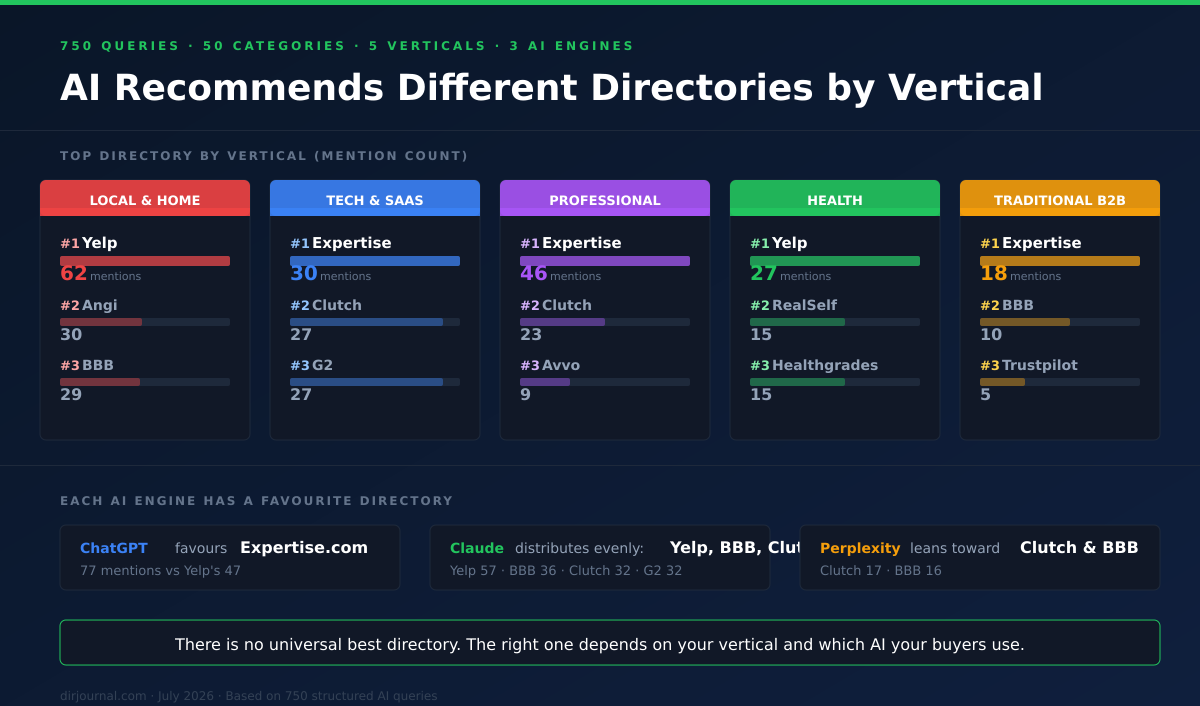
AI Recommends Clutch for Tech, Yelp for Local, RealSelf for Health
Ask an AI engine how to find a trustworthy plumber and it tells you to check Yelp. Ask about a…
Best Personal Injury Lawyers in New York City: Ranked by AI Citation Data
We asked Claude, ChatGPT, and Perplexity to name NYC personal injury lawyers. Gair Gair Conason was…
Related Resources
Looking for verified service providers? Browse our directory categories below — all human-audited and trusted by decision-makers since 2007.