Independent. Human-Curated. Established 2007.
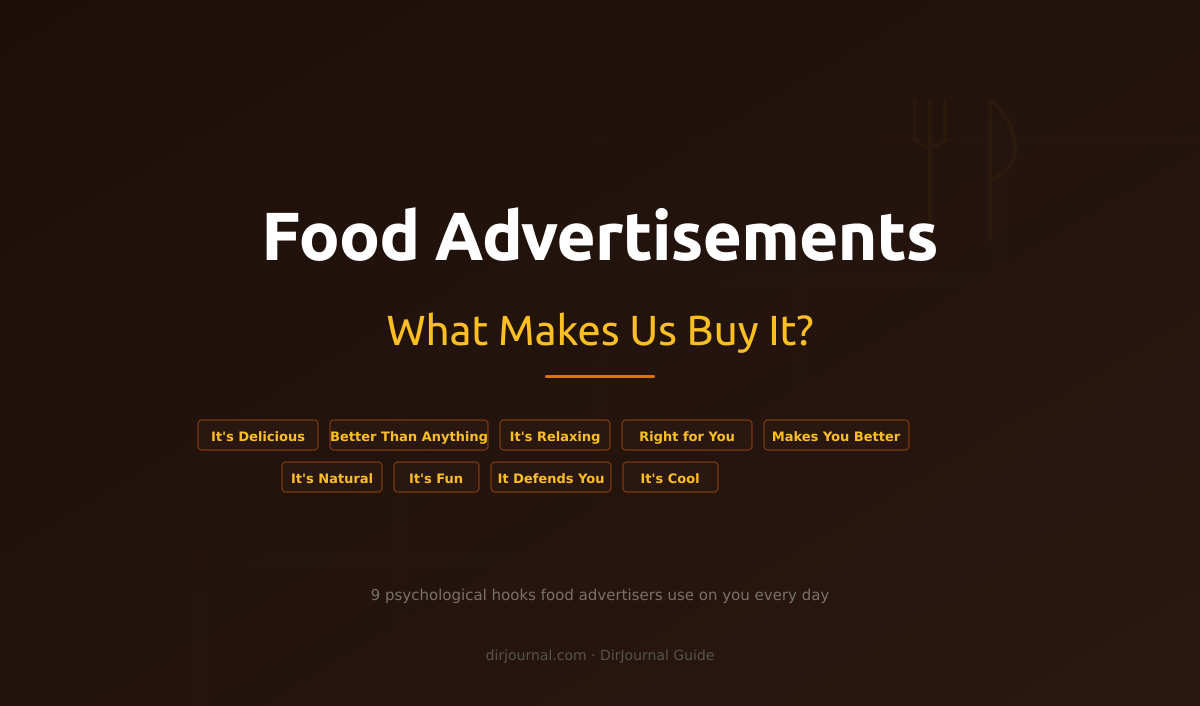
Food Advertisements: What Makes Us Buy It?
DirJournal Contributing Author. Editorial-team verified.
Key Topics in This Guide
- 1It is Delicious — covered in detail below
- 2It is Better Than Anything — covered in detail below
- 3It is Relaxing — covered in detail below
- 4It is Right for You — covered in detail below
- 5It Makes You Better — covered in detail below
- 6It is Natural — covered in detail below
- 7It is Fun — covered in detail below
- 8It Defends You — covered in detail below
- 9It is Cool — covered in detail below
- 10What to Do With This — covered in detail below
Food advertisements work through nine psychological appeals: taste idealization, superiority claims, mood association, personalization, functional health claims, natural framing, entertainment targeting, fear-based protection, and status signaling. Each appeal sells an emotion or identity, not the food itself. The techniques have been stable since at least 2009; only the delivery (AI imagery, programmatic targeting, social content) has changed.
The average person sees between 4,000 and 10,000 ads per day, and food brands buy a disproportionate share of that attention. The US food industry spends over $14 billion a year on advertising. Almost none of it tells you what the product actually tastes like.
This post first ran in 2009 as a gallery of misleading food ads. Seventeen years later, every trick in that gallery still runs daily. The only difference is that AI now generates the images instead of a food stylist with a glue bottle.
Here are the nine appeals food advertisers use, what each one hides, and how to spot them.
It is Delicious
The burger in the ad and the burger in the box are different products. Ad shoots use undercooked patties because they stay plump, blowtorch the edges for grill marks, and pin every sesame seed in place. The milk in cereal ads is often white glue because real milk sinks the flakes.
In 2026 the stylist is optional. Brands generate photoreal food imagery with AI tools, which means the "product photo" may depict a burger that has never physically existed. No regulation currently requires food ads to disclose AI-generated imagery in most markets.
The tell: if the texture looks perfect under studio light, you are looking at a construction, not a meal.
It is Better Than Anything
Comparative claims sell superiority without proof. "Better taste," "preferred 2 to 1," "America''s favorite" — these phrases survive legal review because they are either subjective puffery or based on paid taste panels with tiny samples.
Puffery is legally protected precisely because no reasonable person is supposed to believe it. Advertisers rely on the fact that you believe it anyway.
The tell: any superlative without a cited, third-party source is decoration.
It is Relaxing
Beer, chocolate, and coffee ads sell a mood, not a product. The formula pairs the product with a state you want: the beach, the break, the quiet evening. Your brain links the two through repetition, a mechanism advertisers borrowed directly from classical conditioning research.
You are not buying chocolate. You are buying the 30 seconds of calm the ad promised, and the chocolate is the receipt.
The tell: if the ad spends more frames on the setting than the food, the setting is the product.
It is Right for You
Personalization used to mean a demographic guess. Now it means programmatic targeting built from your purchase history, location, and browsing data, serving you the exact comfort food ad at the exact low moment.
Studies on ad targeting show food ads increasingly reach users during late-night browsing windows when impulse resistance drops. The ad did not find you by accident.
The tell: an ad that feels uncannily well-timed was timed.
It Makes You Better
Protein-enriched, immunity-boosting, brain-fueling. Functional claims turn snacks into supplements. Most of these claims sit in a regulatory gray zone: "supports immune health" requires no clinical evidence in the way a drug claim would.
The 2026 version is the wellness influencer partnership, where the claim moves from the label to a trusted face and escapes label regulation entirely.
The tell: "supports," "helps," and "contributes to" are hedge words. A product that actually did the thing would say so directly, and would be regulated as a drug.
It is Natural
"Natural" has no binding legal definition for most food products in the US. A product can be ultra-processed and still wear the word, alongside kraft-paper packaging, hand-drawn fonts, and farm imagery.
The green-and-beige visual language works because your brain processes packaging cues faster than ingredient lists. Researchers call this the health halo: one virtuous signal makes you rate the entire product as healthier.
The tell: flip the pack. If the ingredient list needs a chemistry degree, the leaf on the front is a costume.
It is Fun
Mascots, games, and now branded content on TikTok and Roblox aim at the youngest possible audience. Brand preference forms in childhood and persists for decades, which is why cereal mascots make eye contact with children from shelf height. That shelf placement is deliberate and documented in retail planogram research.
The modern version is the branded filter or the in-game item, where the ad is the entertainment and children cannot distinguish the two. Regulators in several countries are moving on this. Slowly.
The tell: if it is fun, it is aimed at someone whose impulse control is still developing. Possibly you.
It Defends You
Fear sells as hard as pleasure. Antioxidants against aging, probiotics against illness, fortified everything against deficiency. The frame positions food as armor and eating as risk management.
The pandemic years supercharged this appeal, and "immunity" remains one of the highest-growth claim categories in packaged food marketing. Most immunity claims on food packaging reference nutrients you already get from a normal diet.
The tell: an ad that makes you anxious before it makes you hungry is running the defense play.
It is Cool
Status appeal moved from the billboard to the feed. Limited drops, collabs between fast food chains and streetwear brands, menu items that exist to be photographed. The product is the post.
This is the one appeal that got genuinely stronger since 2009. When the purchase is content, the buyer becomes the ad, and the brand gets distribution it never paid for.
The tell: if your first instinct is to photograph it, the recipe was engineered for the camera, not your palate.
What to Do With This
You cannot opt out of food advertising, but you can buy from verified sellers instead of whoever ran the best ad. Our Food and Drink directory lists specialty food retailers, gourmet suppliers, and beverage sellers that cleared human editorial review — the audit checks the business, not the ad budget.
The nine appeals above have not changed since this post first ran in 2009. The next time an ad makes you hungry, name the trick. It usually kills the craving.