Independent. Human-Curated. Established 2007.
How to Conduct a Training Needs Analysis (2026)
DirJournal Founder · 19+ years building directory and discovery products. Editorial-team verified.
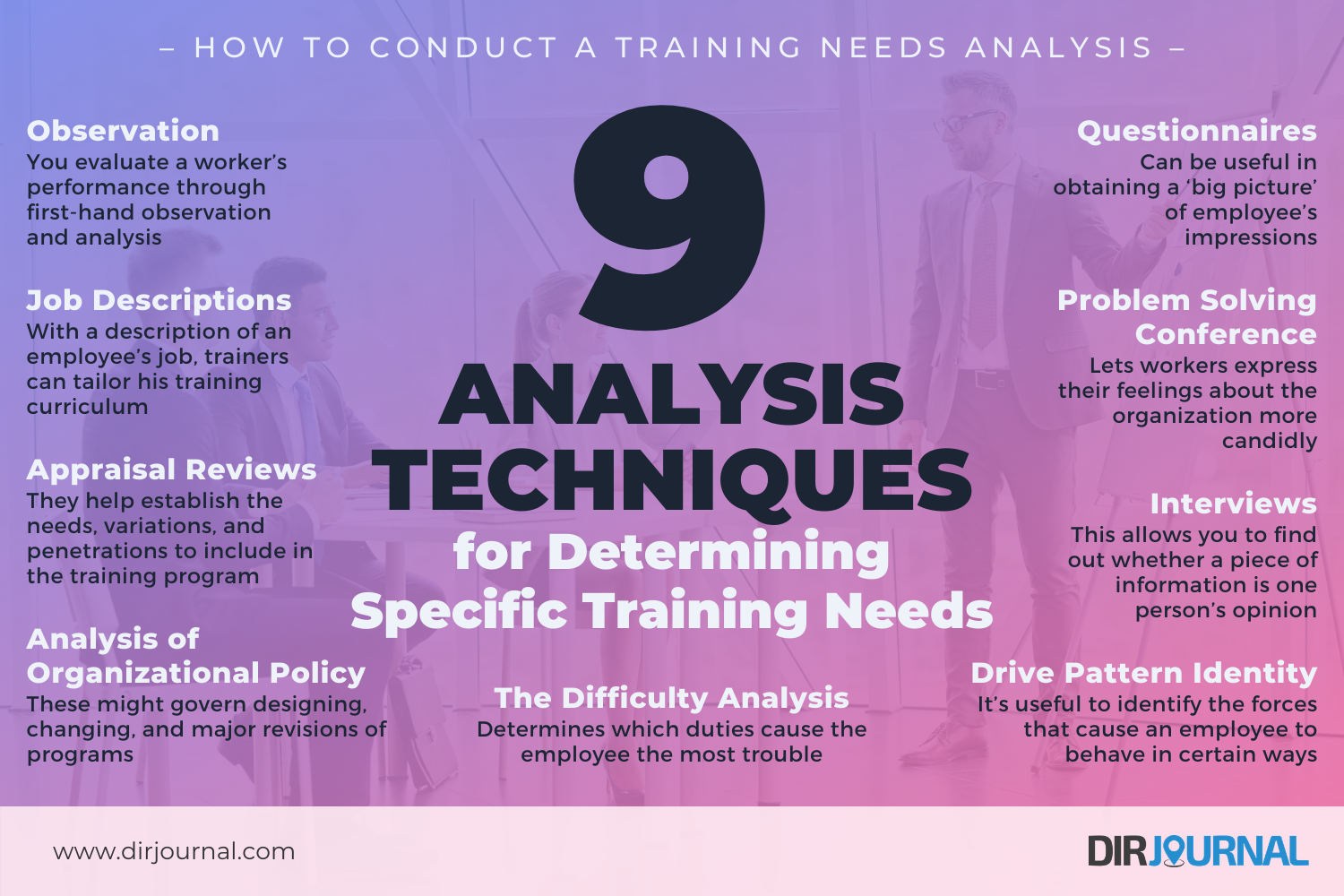
Key Takeaways: Training Needs Analysis
- 1Training is a 5-step strategic investment: Assess → Design → Develop → Deliver → Evaluate (ADDIE).
- 2The goal is to close the "Gap" between actual and desired employee performance.
- 3Use three levels of analysis: organizational, task/role, and individual.
- 4ROI-positive training programs start with data, not assumptions.
A training needs analysis is a series of activities conducted to identify problems or other issues in the workplace. It determines whether - and what - training is an appropriate response.
The needs analysis is usually the first step taken in a process of change. Usually, there is a gap between the current and the desired individual and organizational performance. A needs analysis specifically defines that gap, and how much of it can be addressed with training.
Corporate training is a huge market. In 2022, it was valued at over $145 billion. It’s also rapidly expanding, set to grow nearly 10% every year. By 2028, it’s expected to exceed $250 billion in value. The last decade - and throughout the pandemic especially - has seen a major shift towards virtual training, but in-person training is just as important.
Not all of that training is really necessary - or well-executed. Inefficient training is a major waste of business resources.
The biggest cause of this waste is a lack of accurate data on what an employee or group of employees actually needs to improve performance. A good Training Needs Analysis (TNA) can give you this data.
Investing in a deep analysis pays off, because it reduces resources wasted on ineffective training. Well-chosen training ups performance in the long run - and, finally, keeps high achievers in your company.
Who Conducts a Training Needs Analysis, and Why?
Both an in-house trainer or a consultant can perform a needs analysis to collect and document information. They'll look for data on any of the following three issues:
- Performance problems
- Anticipated introduction of new system, task, or technology
- A desire by the organization to benefit from a perceived opportunity
In all three situations, the starting point is a desire to effect a certain change. Given this, you must know how the people who will experience the change perceive it. In the absence of a needs analysis and proper communication, you may find employees and even managers resistant to change and reluctant to training.
Training is also wasted when organizational constraints prevent trainees from transferring their newly acquired skills to their day-to-day jobs.
A needs analysis often reveals the need for well-targeted training areas. It will also reveal where training is not the best way to close a particular gap between an organization’s goals and its actual performance.
Those conducting the needs analysis must get a clear idea of the problem first. Then, they'll look at all possible remedies and report their findings to management. Finally, there'll be a decision on the best solution.
How Organizations Can Benefit
When done properly, a training needs analysis is a wise investment for the organization. It saves time, money, and effort by working on the right problems.
Organizations that dispense with needs analysis are much more likely to make costly mistakes. They might use training when another remedy would have been more effective. Use too much or too little training. They might train the wrong people - as when there is not a skill issue, but a management issue. Or they may use training but fail to follow up on it.
A well-performed analysis provides the information needed to find solutions that adress the areas of greatest need.
Conducting a training needs analysis is a systematic process. It uses specific information-gathering techniques. A needs analysis has stages, with the findings of one stage affecting and helping to shape the next one. There is no easy formula or short-cut for carrying out this process. Each particular situation requires its own mix of observing, probing, analysis, and deduction.
In many ways, the needs analysis is like detective work. You follow up on every lead and check every piece of information. You'll examine every alternative before drawing any solid conclusions. Only then you can be sure of having the evidence on which to base a sound strategy for problem solving.
The 4-Step Problem Solving Process
A training needs analysis is not a one-time event. Professional organizations run a needs analysis at regular intervals, usually every year or two.
Why Training Sometimes Fails
The majority of companies have developed training schemes for new hires and veteran employees. Their quality varies, of course. But that aside, these companies do have the advantage over those that don’t - and these aren’t few. About 40% of businesses lack formal training programs, and 32% don’t even have formal instruction to develop employees’ and new hires’ skills.
The root cause is this: Training is seen as a costly expense with an uncertain return. That means that results will vary. Moreover, they are difficult to quantify in the first place. Organizations naturally tend to minimize this type of expense, trying to cut costs by cutting corners. They’re unwilling to use resources for a proper Training Needs Analysis. After all, a proper one does take a lot of work and work-hours.
All too often, managers or HR departments will therefore simply recommend training for employees or groups of them. For this, they may rely on data from performance reviews. In practice, they often go with instinct, or just select what training they’re already familiar with.
Under these circumstances, the chance that the training actually addresses the underlying issues or needs are low. Performance often does not improve - and the organization’s initial assumption of uncertain return is then fulfilled. Training thus falls by the wayside.
With a proper training needs analysis, this process can be a lot more targeted, and companies can break out of the vicious circle of bad training. Whenever new hires or veteran employees receive new tasks, they can get up to speed quickly – rather than having to figure out everything on the job.
Frequently Asked Questions
What is a training needs analysis in simple terms?
How big is the corporate training market and why does it matter?
Who should conduct a training needs analysis?
Found this useful?
Share this article
Related Resources
Looking for verified service providers? Browse our directory categories below — all human-audited and trusted by decision-makers since 2007.