Independent. Human-Curated. Established 2007.
Major U.S. Companies That Went Bankrupt — and What Brought Them Down
DirJournal Founder · 19+ years building directory and discovery products. Editorial-team verified.
Key Topics in This Guide
- 1Lehman Brothers — September 15, 2008 — covered in detail below
- 2Enron — December 2, 2001 — covered in detail below
- 3General Motors — June 1, 2009 — covered in detail below
- 4Bed Bath & Beyond — April 23, 2023 — covered in detail below
- 5WeWork — November 6, 2023 — covered in detail below
- 6Party City — December 2024 (Second Filing) — covered in detail below
- 7Rite Aid — October 2023, Then Again May 2025 — covered in detail below
- 8What Bankruptcy Teaches — covered in detail below
Updated: May 6, 2026 — refreshed with current data and fact-checked.
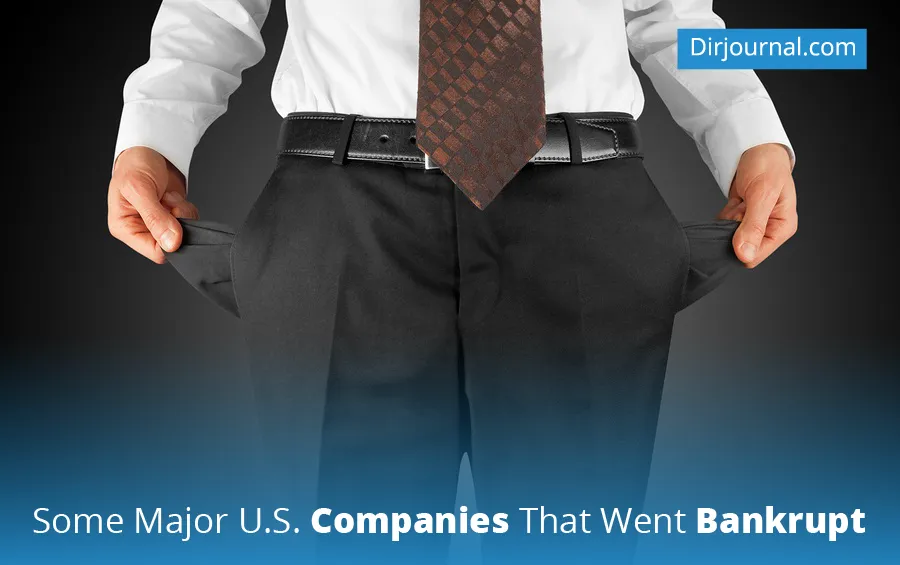
Companies fail. Even enormous ones. Chapter 11 bankruptcy in the United States allows a business to restructure its debts while continuing to operate — or, in many cases, to wind down as gracefully as a multi-billion-dollar collapse allows. Chapter 7, by contrast, means liquidation: the lights go off, the assets get auctioned, and the brand becomes a memory.
The list below spans both the largest bankruptcies in American history and several that hit closer to home — the stores and brands that ordinary people actually walked into. Some of these companies recovered. Most did not.
Lehman Brothers — September 15, 2008
The one that broke everything. Lehman Brothers, the fourth-largest investment bank in the United States, filed for Chapter 11 with $639 billion in assets — making it the largest bankruptcy filing in U.S. history, a record that still stands. The collapse triggered a global financial panic, froze credit markets, and is widely considered the single event that turned a housing crisis into the Great Recession.
The U.S. government had bailed out Bear Stearns months earlier. It chose not to bail out Lehman. That decision remains one of the most debated calls in modern financial history. Whether letting Lehman fail was the right move depends entirely on whom you ask — and when you ask them.
Enron — December 2, 2001
Before Lehman, Enron was the bankruptcy that defined an era. At its peak, the Houston-based energy company was valued at over $60 billion and employed roughly 20,000 people. The problem was simple: the books were fake. Enron executives, aided by accounting firm Arthur Andersen, used off-balance-sheet entities to hide billions in debt and inflate profits.
When the fraud unravelled in late 2001, stock that had traded above $90 fell below $1. Arthur Andersen, one of the Big Five accounting firms, was destroyed. The scandal directly led to the Sarbanes-Oxley Act of 2002, which overhauled corporate financial disclosure requirements in the United States.
General Motors — June 1, 2009
GM was, for most of the 20th century, the largest automaker on Earth. By 2009, it was bankrupt. The company filed for Chapter 11 with roughly $82 billion in assets and $173 billion in debt. The U.S. and Canadian governments injected approximately $49.5 billion to keep the company alive — a bailout that remains politically divisive.
GM emerged from bankruptcy in just 40 days, shed several brands (Pontiac, Saturn, Hummer, Saab), and returned to profitability. It went public again in November 2010. The "new GM" survived. Whether taxpayers got a fair return on their investment is a different question; the U.S. Treasury estimated a net loss of about $11.2 billion on the deal.
Bed Bath & Beyond — April 23, 2023
The slow death of Bed Bath & Beyond was painful to watch. The home goods chain, once a suburban staple with over 1,500 locations at its peak, had been bleeding cash for years. A brief reprieve came in 2021 when meme-stock traders on Reddit pumped the share price — but that was a sugar high, not a cure.
By the time the company filed for Chapter 11, it had already closed hundreds of stores. The remaining locations shuttered within months. Overstock.com bought the brand name and rebranded its own website to BedBathandBeyond.com — a bizarre afterlife for a company that once defined American retail.
WeWork — November 6, 2023
WeWork's fall was spectacular even by startup standards. Founded in 2010 as a co-working space provider, the company was valued at $47 billion ahead of its planned 2019 IPO. Then the prospectus came out. Investors read about co-founder Adam Neumann's self-dealing, the company's staggering losses, and a governance structure that gave Neumann near-absolute control.
The IPO collapsed. Neumann was ousted. WeWork eventually went public via SPAC in 2021 at a fraction of its former valuation, then filed Chapter 11 in November 2023. The company emerged from bankruptcy in June 2024, having shed most of its lease obligations. It still operates — smaller, quieter, and with a market cap that would have been a rounding error in 2019.
Party City — December 2024 (Second Filing)
Party City filed for Chapter 11 twice. The first time, in January 2023, it restructured and emerged in October of that year. The second time, in late December 2024, was terminal. The company announced it would close all 700-plus remaining stores and liquidate. Helium shortages, inflation on party supplies, and the steady migration of celebrations to experiences over products all contributed.
For a generation of Americans, Party City was where you went for Halloween costumes and birthday balloons. That era is over.
Rite Aid — October 2023, Then Again May 2025
Rite Aid holds the unhappy distinction of filing for bankruptcy twice in under two years. The first filing, in October 2023, came amid opioid-related litigation — the company faced billions in potential liability for its role in the prescription drug crisis. It emerged from that bankruptcy in September 2024 after closing roughly 500 stores.
The second filing, in May 2025, suggested the restructuring had not gone deep enough. Rite Aid is now closing its remaining locations and selling off pieces of the business. The American pharmacy landscape, once dominated by three major chains, is down to two — and even CVS and Walgreens are shrinking.
What Bankruptcy Teaches
The pattern is not mysterious. Companies go bankrupt when debt exceeds their ability to service it, when the market shifts beneath them, or when fraud hollows them out from the inside. Sometimes all three at once.
What has changed is the speed. Lehman took decades to build and weeks to die. WeWork went from $47 billion to bankruptcy in four years. The question for 2026 is not whether more major companies will file — they will. The question is which household name goes next, and whether anyone is genuinely surprised when it happens.
Join the DirJournal newsletter
Weekly insights on directories, listings, SEO, and how businesses get found online.
No spam. Unsubscribe anytime.
Found this useful?
Share this article
Recommended for You

Best SEO Companies: 15 Agencies Ranked by Specialization, Case Studies, and AI Citation Data
Victorious is our top pick for companies that want a search-only specialist. OuterBox leads for…

Online Reputation Management: Why You Need to Understand It
How AI is Replacing Outsourcing for US Businesses in 2026
Related Resources
Looking for verified service providers? Browse our directory categories below — all human-audited and trusted by decision-makers since 2007.