Independent. Human-Curated. Established 2007.
What Is Vibe Coding? And When Should You Actually Use It?
DirJournal Founder · 19+ years building directory and discovery products. Editorial-team verified.
Key Topics in This Guide
- 1How It Works — covered in detail below
- 2Vibe Coding vs Traditional Coding vs No-Code — covered in detail below
- 3What AI Engines Say About Vibe Coding — covered in detail below
- 4What Nobody Tells You: the Day 2 Problem — covered in detail below
- 5The Security Problem — covered in detail below
- 6Who Should Use Vibe Coding — covered in detail below
- 7Who Shouldn't Use Vibe Coding (Yet) — covered in detail below
- 8The Numbers Behind the Category — covered in detail below
On February 2, 2025, Andrej Karpathy posted on X: "I just see stuff, say stuff, run stuff, and copy paste stuff, and it mostly works." He called it vibe coding. The former Tesla AI director and OpenAI researcher was describing how he'd started building entire projects with Claude Sonnet by talking to it instead of writing code. He said he "fully gave in to the vibes" and stopped reading the code the AI produced.
That post went viral. Within weeks, Y Combinator reported that 25% of its Winter 2025 cohort had codebases almost entirely generated by AI. By mid-2026, Replit crossed 50 million users and $9 billion in valuation. Cursor hit $3 billion in annual revenue. Lovable went from launch to $400 million ARR in eight months.
Vibe coding is now a category. Here's what it actually is, what it isn't, and when you should care.
How It Works
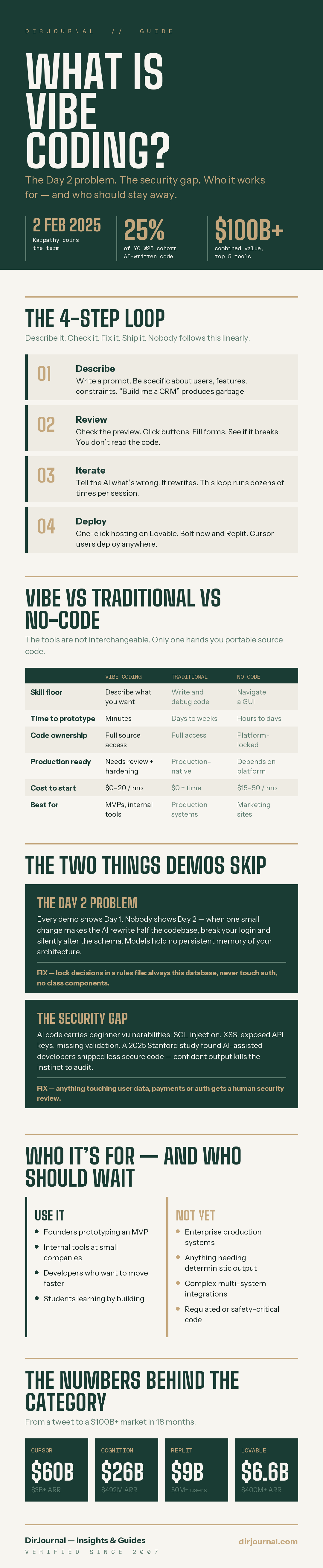
You describe what you want in plain English. The AI writes the code. You check whether it works. You tell the AI what to fix. Repeat.
That's it. No syntax. No file structure decisions. No Stack Overflow. You type "build me a dashboard that shows monthly revenue with a chart" and get a working React app with a database connection in under a minute.
The tools handle everything from frontend components to backend APIs to database schemas. Some run entirely in the browser (Bolt.new, Lovable). Others work inside your existing development environment (Cursor, Windsurf). A few operate from the terminal with no visual interface at all (Claude Code, Aider).
The workflow has four steps, though nobody follows them linearly.
The 4-Step Vibe Coding Workflow
1
Describe
Write a prompt explaining what the app should do. Be specific about users, features, and constraints.
2
Review
Check the preview. Click buttons. Fill forms. See if it breaks. You don't need to read the code.
3
Iterate
Tell the AI what's wrong. It rewrites. This loop runs dozens of times per session.
4
Deploy
One-click deployment. Lovable, Bolt.new, and Replit include hosting. Cursor users deploy anywhere.
Describe. You write a prompt explaining what the app should do. The more specific you are about users, features, and constraints, the better the output. "Build me a CRM" produces garbage. "Build me a CRM for a 3-person sales team that tracks leads by source and sends Slack notifications when a deal closes" produces something usable.
Review. The AI generates code and shows you a preview. You don't need to read the code. You check whether the app does what you described. Click buttons. Fill in forms. See if it breaks.
Iterate. It will break. You tell the AI what's wrong. "The chart doesn't show data from the last 7 days" or "the login page redirects to a 404." The AI rewrites the relevant code. This loop runs dozens of times per session.
Deploy. Most vibe coding platforms include one-click deployment to hosting providers. Lovable deploys to its own infrastructure. Bolt.new pushes to Netlify. Replit hosts everything on its own cloud. Cursor users deploy wherever they want because it's a local IDE.
Vibe Coding vs Traditional Coding vs No-Code
Vibe Coding | Traditional Coding | No-Code (Webflow, Bubble) | |
|---|---|---|---|
Input | Natural language prompts | Programming languages | Drag-and-drop visual editor |
Skill floor | Can describe what you want | Can write and debug code | Can navigate a GUI |
Speed to prototype | Minutes | Days to weeks | Hours to days |
Code ownership | Full access to source code | Full access | Platform-locked |
Customisation ceiling | High (AI generates any pattern) | Unlimited | Limited to platform features |
Production readiness | Requires review and hardening | Production-native | Depends on platform |
Cost to start | $0-20/month | $0 (plus time) | $15-50/month |
Best for | MVPs, internal tools, prototypes | Production systems, complex logic | Marketing sites, simple workflows |
The distinction between vibe coding and traditional coding isn't binary. Most working developers use both. You might vibe code a prototype in Lovable, export the code to GitHub, then refine it in Cursor with traditional editing alongside AI assistance.
No-code is a separate category entirely. Webflow and Bubble don't generate source code you can take elsewhere. Vibe coding tools do. That difference matters when your project outgrows the tool.
What AI Engines Say About Vibe Coding
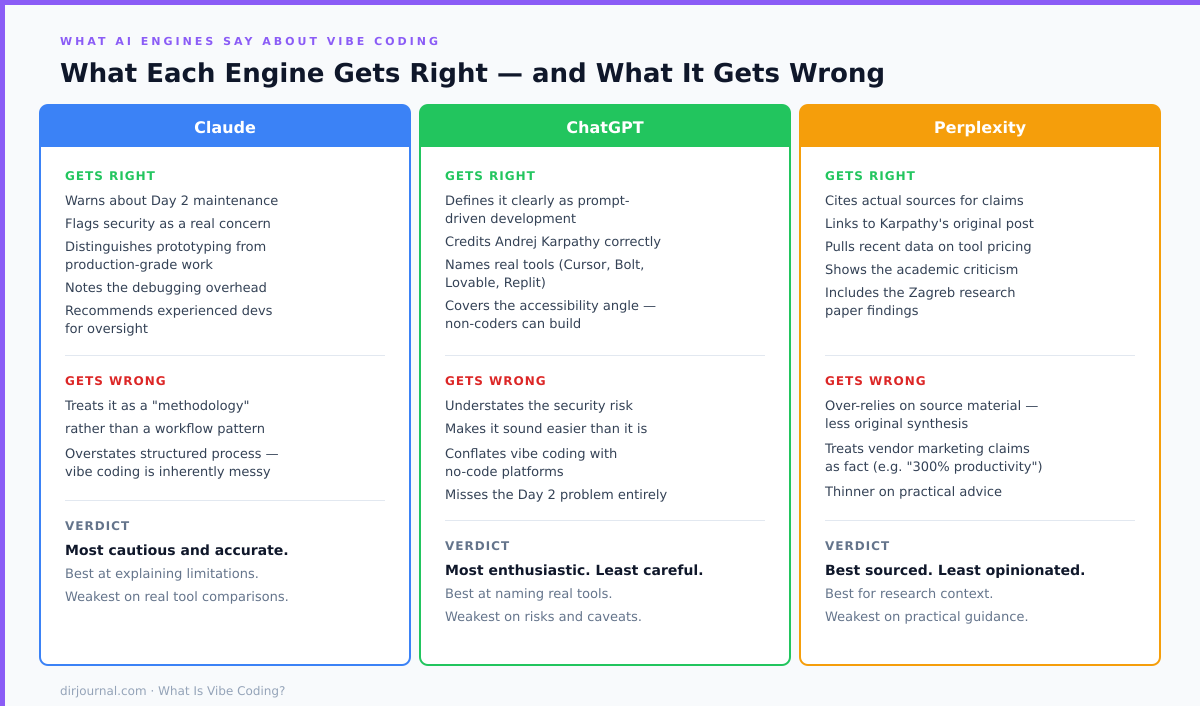
We queried Claude, ChatGPT, and Perplexity about vibe coding tools as part of our AI Citation Study. The three engines converge on the same core recommendation: Cursor for developers, Lovable for non-technical builders, Replit for learning while shipping.
Perplexity pulls from live search results and tends to surface newer tools. ChatGPT draws from training data and favours tools with strong documentation. Claude generates the most detailed technical comparisons. All three recommend starting with a specific, well-scoped project rather than an open-ended "build me an app" prompt.
What Nobody Tells You: the Day 2 Problem
Every vibe coding demo shows Day 1. You describe an app. AI builds it. You deploy. Applause.
Nobody shows Day 2. That's when a client asks for one small change and the AI rewrites half your codebase to add it. Your login page stops working because the AI "refactored" the authentication flow while adding a sidebar. The database schema changed without warning. Your deployment breaks because a dependency version shifted.
This happens because AI models don't have persistent memory of your architectural decisions. Each prompt is partially fresh context. The AI doesn't know you intentionally chose Supabase over Firebase or that the checkout flow must never change. It optimises for the current request, not the overall system.
The practical fix: write a system prompt or rules file that locks your architectural decisions. "Always use Supabase for the database. Never modify the auth flow unless explicitly asked. Use React with Tailwind. No class components." Cursor supports rules files. Lovable accepts project-level instructions. Without these constraints, vibe coding at scale becomes whack-a-mole.
The Security Problem
AI-generated code has the same vulnerabilities as beginner-written code. SQL injection. Cross-site scripting. Exposed API keys. Hardcoded secrets. Missing input validation.
A 2025 Stanford study found that developers using AI assistants produced less secure code than those writing it manually, partly because the AI's confident output discouraged manual review. When the code "looks right" and the app runs, the instinct to audit disappears.
If you're building anything that handles user data, payments, or authentication, you need someone who understands security to review the output. Vibe coding produces working code. Working and secure are different things.
Who Should Use Vibe Coding
Founders prototyping an MVP. You have an idea. You want to test it with real users before hiring engineers. Vibe coding gets you from concept to deployed prototype in a weekend. Lovable and Bolt.new are built for this.
Internal tools at small companies. Your sales team needs a dashboard. Your ops team needs a form that writes to a database. Nobody's going to hire a developer for a 3-page internal app. Vibe code it in Replit and deploy.
Developers who want to move faster. You already know how to code. Cursor and Claude Code accelerate your workflow by handling boilerplate while you focus on architecture and logic. This is where vibe coding adds the most value per dollar.
Students learning to build. Replit and Lovable lower the barrier to building real projects. You learn by seeing what the AI produces, breaking it, and understanding why.
Who Shouldn't Use Vibe Coding (Yet)
Enterprise production systems. If your codebase serves millions of users, processes payments, or handles regulated data, vibe-coded components need rigorous review before production. The speed gain disappears if you spend more time auditing than you saved writing.
Anything requiring deterministic behaviour. Financial calculations, medical device firmware, aerospace control systems. AI-generated code is probabilistic. It produces different output for the same prompt. That's fine for a landing page. It's unacceptable for anything where a wrong output has physical consequences.
Projects with complex multi-system integrations. Vibe coding works well for self-contained apps. It struggles when your project needs to coordinate with legacy APIs, specific database schemas, or enterprise authentication systems that require exact configuration. The AI doesn't know your company's LDAP setup.
The Numbers Behind the Category
Company | Founded | Valuation | ARR | Users |
|---|---|---|---|---|
2022 | $60B (SpaceX acquisition) | $3B+ | 60%+ Fortune 500 | |
2016 | $9B | Targeting $1B by EOY 2026 | 50M+ | |
2023 | $6.6B (talks at $12B) | $400M+ | 8M+ | |
2023 | $26B | $492M | Enterprise | |
2021 | Part of Cognition | Part of Cognition | Millions |
These are not small experiments. Combined, the top 5 vibe coding companies are valued at over $100 billion. The category went from a tweet to a $100B+ market in 18 months.
For a detailed comparison of every major tool with pricing and feature breakdowns, see our Best Vibe Coding Tools roundup.
Browse Vibe Coding Agencies on DirJournal | Browse AI Coding Assistants on DirJournal
Join the DirJournal newsletter
Weekly insights on directories, listings, SEO, and how businesses get found online.
No spam. Unsubscribe anytime.
Found this useful?
Share this article
Recommended for You
The 2026 Architecture Audit: How to Choose Between Agentic AI, LLM Fine-Tuning, and RAG
The question for most CEOs has shifted from "Should we use AI?" to "Which specific architecture…
The Agentic AI Glossary: 26 Terms Every Builder Should Know in 2026
The 26 agentic AI terms I actually use day-to-day, defined plainly for builders and operators.…
Migrating Legacy Code to Jamstack: The Role of AI Coding Assistants
A legacy-to-Jamstack migration that budgeted two quarters in 2022 now closes in four to eight…
Related Resources
Looking for verified service providers? Browse our directory categories below — all human-audited and trusted by decision-makers since 2007.