Independent. Human-Curated. Established 2007.
The World's Best Intelligence Agencies (2026 Edition)
DirJournal in-house research desk. Sources verified against declassified records, peer-reviewed work, and confirmed reporting.
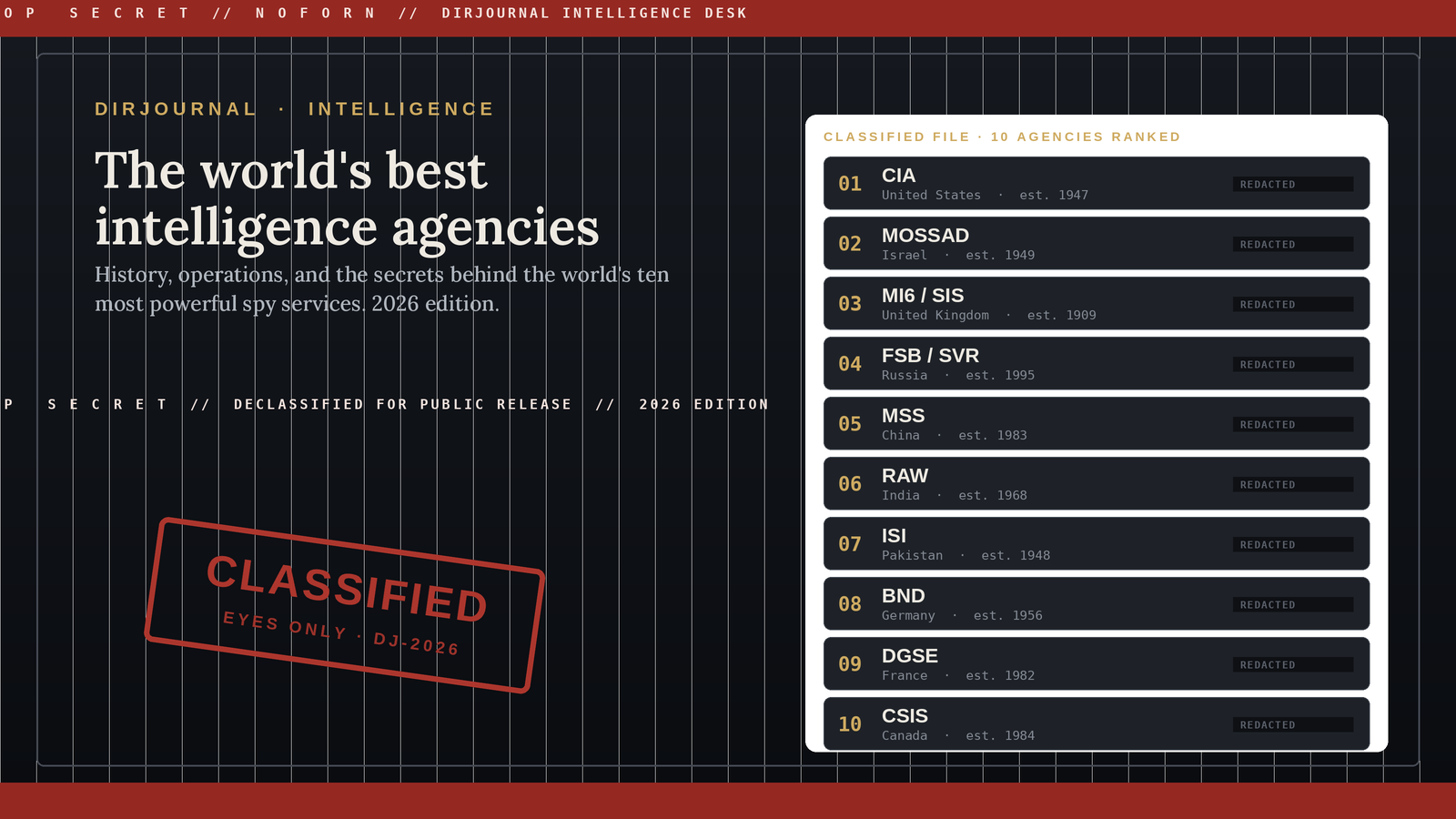
Key Topics in This Guide
- 11. CIA (Central Intelligence Agency) — United States — covered in detail below
- 22. Mossad — Israel — covered in detail below
- 33. MI6 / SIS (Secret Intelligence Service) — United Kingdom — covered in detail below
- 44. FSB & SVR — Russia — covered in detail below
- 55. MSS (Ministry of State Security) — China — covered in detail below
- 66. RAW (Research and Analysis Wing) — India — covered in detail below
✓ Official DirJournal Authority Guide
The World’s Best Intelligence Agencies: History, Operations & Secrets (2026 Edition)
DJ
DirJournal Research Team Verified Guide
✓ Last Human Verified: June 2026 Originally published 2009 · rewritten 2026 from declassified records, congressional testimony, peer-reviewed academic work, and confirmed reporting.
⚡ TL;DR — The 2026 ranking, at a glance
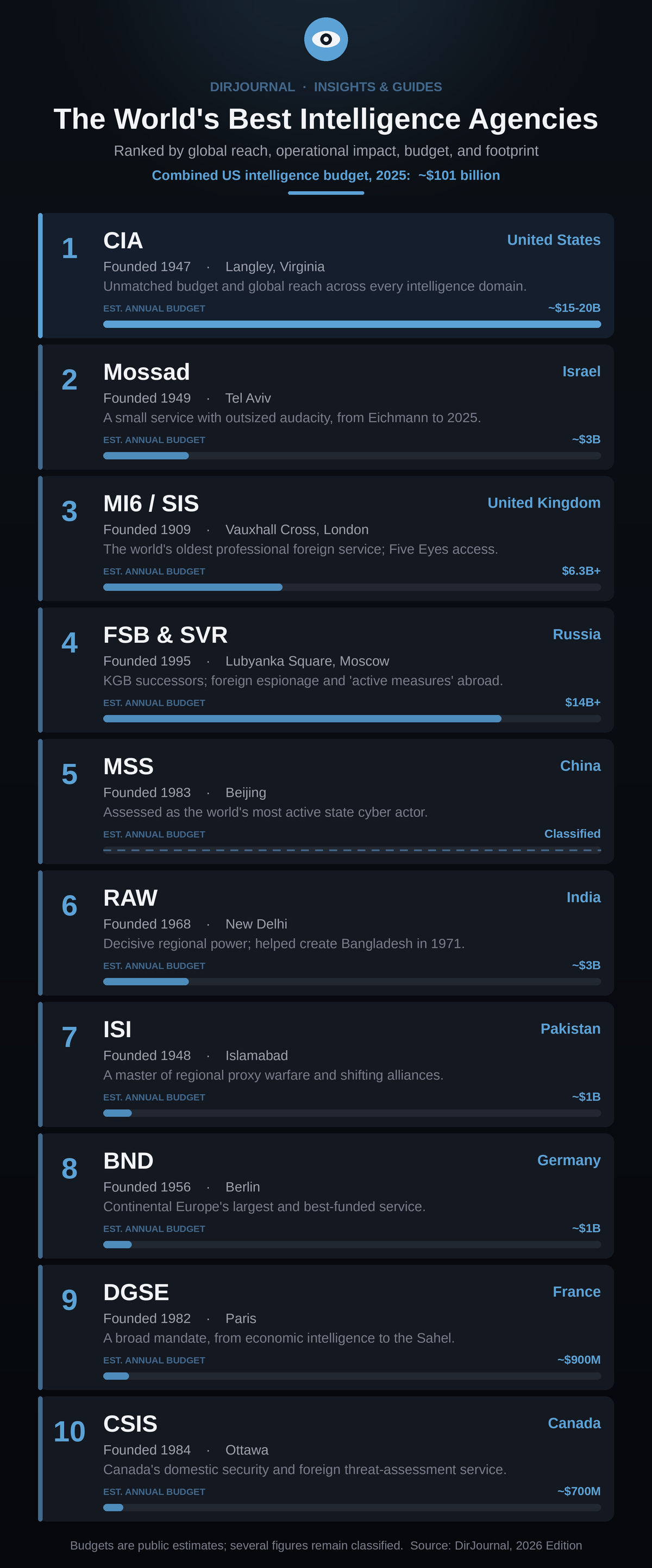
The world’s strongest intelligence agencies in 2026 are, in ranked order: CIA (United States), Mossad (Israel), MI6 / SIS (United Kingdom), the FSB & SVR (Russia), the MSS (China), RAW (India), the ISI (Pakistan), the BND (Germany), the DGSE (France), and CSIS (Canada). The CIA ranks first on combined budget, global reach, and the integration of HUMINT, SIGINT, IMINT, and paramilitary capabilities; Mossad ranks second on operational audacity and recent strike performance.
Master comparison — the ten most powerful intelligence agencies in 2026 | |||||
Rank | Agency | Country | Founded | Est. Annual Budget | Primary Mission |
|---|---|---|---|---|---|
1 | United States | 1947 | ~$15–20 billion (est.) | Foreign intelligence & covert action | |
2 | Israel | 1949 | ~$3 billion (est.) | Foreign intelligence, targeted operations, counter-proliferation | |
3 | United Kingdom | 1909 | $6.3 billion+ (est., SIA total) | Human intelligence outside British Isles | |
4 | Russia | 1995 (FSB); KGB roots 1954 | $14 billion+ (est., combined) | Counterintelligence, domestic security, foreign espionage | |
5 | China | 1983 | Classified (tens of billions, est.) | Foreign & domestic intelligence, cyber & economic espionage | |
6 | India | 1968 | ~$3 billion (est.) | Foreign intelligence, counter-terrorism, counter-proliferation | |
7 | Pakistan | 1948 | ~$1 billion (est.) | Military intelligence, proxy warfare, regional operations | |
8 | Germany | 1956 | ~$1 billion (est.) | Foreign intelligence, counter-espionage, technical collection | |
9 | France | 1982 | ~$900 million (est.) | Foreign intelligence, counter-terrorism, technical collection | |
10 | Canada | 1984 | ~$700 million (est.) | Domestic security intelligence, foreign threat assessment |

The world’s intelligence agencies operate in the shadows — but their footprints are everywhere.
📌 Key Takeaways
Intelligence agencies have been decisive in every major conflict and geopolitical shift of the last 100 years — from stealing atomic bomb blueprints to paging Hezbollah to death.
The line between espionage, covert action, and outright conspiracy is thinner than most governments will admit — this guide covers all three.
In 2026, AI-powered cyber operations have fundamentally changed what intelligence agencies can do — and how fast they can do it.
Every agency on this list has been caught doing something it shouldn’t have — the scandals are as revealing as the successes.
They work in secret. They topple governments, steal secrets, recruit double agents, and occasionally make history-altering mistakes. Intelligence agencies have always fascinated the public — and for good reason. The decisions made in their quiet offices shape the world in ways that rarely surface for decades.
This guide is a genuine deep-dive. Not a sanitised list. We cover each agency’s founding, its greatest achievements, its most damaging failures, the conspiracies and controversies that have followed it, and where it stands in 2026. We’ve updated every entry with the latest publicly available intelligence, declassified documents, and confirmed recent operations.
The ranking is deliberately imperfect — you cannot rank secret organisations with precision. But based on global reach, operational impact, historical significance, budget, and the weight of their footprint on world events, these ten agencies stand in a class of their own.
Note on sources: All information in this guide is drawn from publicly available sources, including declassified government documents, congressional testimony, established journalism, and peer-reviewed academic research. We do not speculate beyond what reliable public sources support. Where operations remain officially unconfirmed but are widely attributed by credible reporting, we say so explicitly.
🏆 How We Ranked Them
Each agency was assessed across six dimensions: historical impact (what they actually changed), technical capability (HUMINT, SIGINT, cyber, and paramilitary), global reach (how far their operations extend), budget and resources, notable successes and failures, and current operational status in 2025–26. The agencies that rank highest generally excel across all six dimensions, not just one or two.
1. CIA (Central Intelligence Agency) — United States
Central Intelligence Agency
🇺🇸 United States of America
Founded
1947
Est. Annual Budget
~$15–20 billion (est.)
Headquarters
Langley, Virginia
Primary Mission
Foreign intelligence & covert action
The CIA ranks first for its unmatched combination of budget, global operational reach, and integration of human, signals, imagery, and paramilitary intelligence — no peer agency operates at the same scale across all four domains.
No intelligence agency in history has spent more money, operated in more countries, or generated more controversy than the CIA. Born out of the Office of Strategic Services (OSS) after World War II, it was created by the National Security Act of 1947 under President Harry S. Truman, who intended it to be a quiet analytical service. Within a decade it had become a global covert action machine, engineering coups, recruiting double agents on every continent, and conducting experiments on its own citizens that still shock the conscience seventy years later.
The CIA’s greatest asset is its integration of the full intelligence spectrum: human intelligence (HUMINT) through its global network of case officers and assets, signals intelligence (SIGINT) conducted in partnership with the NSA, imagery intelligence (IMINT) from satellite systems, and direct paramilitary operations through its Special Activities Center. No other foreign intelligence service combines all four at the same scale. Its budget, while officially classified, is estimated to be substantially larger than any peer agency. For fiscal year 2025, the total US intelligence budget was approximately $101 billion — about $73.3 billion for the National Intelligence Program (which funds the CIA and other civilian agencies) and roughly $27.8 billion for the Military Intelligence Program. The CIA’s individual share remains classified but is estimated to be the largest of any single agency.
Historic Operations
1953
Operation Ajax (Iran). The CIA and Britain’s MI6 orchestrated the overthrow of Iran’s democratically elected Prime Minister Mohammad Mosaddegh after he moved to nationalise the country’s oil industry. The coup installed the Shah, whose repressive rule directly fuelled the 1979 Islamic Revolution. The CIA officially acknowledged the operation in 2013. Its long-term consequences — the Islamic Republic, the hostage crisis, decades of US–Iran enmity — are still being felt today.
1954
Operation PBSUCCESS (Guatemala). The CIA removed Guatemala’s elected president Jacobo Árbenz after he attempted land reform that threatened the United Fruit Company’s holdings. A CIA-trained paramilitary force combined with a psychological warfare campaign to drive Árbenz from power. The resulting military dictatorship kicked off decades of civil war and death squads.
1961
Bay of Pigs — The Great Failure. The CIA trained and deployed approximately 1,400 Cuban exiles in a failed attempt to overthrow Fidel Castro. The operation was a catastrophic intelligence and operational failure: the invasion force was wiped out within three days. The embarrassment deepened when it emerged that the CIA had withheld key information from President Kennedy, including that senior officials had privately concluded the operation was unlikely to succeed. It remains the CIA’s most studied failure.
1953–73
Project MKUltra — The Mind Control Programme. Perhaps the CIA’s darkest chapter. Operating across more than 80 institutions — universities, hospitals, and prisons — the CIA conducted covert experiments on unwitting human subjects in a search for mind-control techniques. Subjects, including mental patients, prisoners, drug addicts, and members of the public, were administered high doses of LSD, subjected to electroshock therapy, sensory deprivation, hypnosis, and various forms of psychological torture. Several subjects died. The programme’s director, Sidney Gottlieb, ordered the destruction of most files in 1973 before Congress could investigate. What survived was discovered only by accident in 1977. In 1975, the Church Committee called it one of the most serious abuses of power in CIA history.
1980s
Operation Cyclone (Afghanistan). The most expensive covert operation in CIA history at the time. The CIA channelled billions of dollars in weapons and support to Afghan mujahideen fighters resisting the Soviet invasion — funding escalated to $630 million annually by 1987. The operation contributed to the Soviet withdrawal and the eventual collapse of the USSR. It also laid the groundwork for the Taliban’s rise and the chaos that followed.
2011
Operation Neptune Spear — Killing Bin Laden. CIA operatives tracked Osama bin Laden to a compound in Abbottabad, Pakistan through a years-long surveillance operation that included monitoring a courier network. The intelligence was the foundation for the US Navy SEAL raid on May 2, 2011, that killed bin Laden. It is widely considered the CIA’s most celebrated intelligence coup of the 21st century.
🔍 Controversies & Unresolved Questions
The JFK Question. The Warren Commission concluded Lee Harvey Oswald acted alone. But the CIA’s known links to Oswald (he was on their radar), the fact that significant documents were withheld from investigators for decades, and repeated extensions of their classification have kept this debate alive. In 2023, the Biden administration released another tranche of JFK documents; as of 2026, some files remain classified. A 2024 House investigation concluded the CIA had been “less than forthcoming” with the Warren Commission.
Operation Mockingbird. The Church Committee confirmed in 1975 that the CIA had secretly funded and placed assets within major US news organisations during the Cold War to shape domestic opinion — a direct violation of its charter prohibiting domestic operations. The full scope was never established because too many files were destroyed.
Post-9/11 Torture Programme. The Senate Intelligence Committee’s 2014 report concluded that the CIA’s “enhanced interrogation” programme — including waterboarding, sleep deprivation, and rectal feeding — was far more brutal than described to Congress, produced little actionable intelligence, and was concealed through systematic deception. No CIA officer was prosecuted.
In 2026: The CIA’s focus has shifted substantially toward China and AI-enabled espionage. Its cyber operations, conducted in partnership with the NSA and Cyber Command, are among the most sophisticated in the world. The agency has also been caught operating in a changed domestic political climate — the Trump administration’s 2025 moves to install loyalists and reorient agency priorities generated significant internal tension and public reporting.
2. Mossad — Israel
HaMossad leModi’in uleTafkidim Meyuḥadim — Institute for Intelligence and Special Operations
🇮🇱 Israel
Founded
1949
Est. Annual Budget
~$3 billion (est.)
Headquarters
Tel Aviv, Israel
Primary Mission
Foreign intelligence, targeted operations, counter-proliferation
Mossad ranks second for the consistent audacity and operational effectiveness of its work on hostile soil — from the 1960 capture of Adolf Eichmann to the 2024 Operation Grim Beeper and the 2025 Operation Rising Lion against Iran — achieving disproportionate impact for a service of fewer than 7,000 staff.
No intelligence agency on earth punches above its weight like Mossad. Founded in 1949 for a nation of fewer than one million people surrounded by enemies who publicly declared their intent to destroy it, Mossad has spent 75 years building one of the most feared and admired covert operations services in history. Its motto, taken from the Book of Proverbs, says everything: “Where no counsel is, the people fall, but in the multitude of counsellors there is safety.”
What makes Mossad exceptional is not just its willingness to act — it’s the audacity, creativity, and precision of its operations. In an era when most intelligence services are becoming more bureaucratic and risk-averse, Mossad has repeatedly demonstrated an operational boldness that seems more Cold War thriller than modern reality. Except it’s real, and it happened last year.
Historic Operations
1960
Operation Finale — Capturing Adolf Eichmann. Nazi architect of the Holocaust Adolf Eichmann was living under a false identity in Argentina. Mossad identified him, sent a team to Buenos Aires, abducted him from the street, sedated him, dressed him as an El Al flight attendant, and flew him to Israel to stand trial. He was convicted and executed in 1962. It remains one of the most remarkable intelligence and operational feats in history.
1960s
Eli Cohen — Israel’s Greatest Spy. An Israeli of Egyptian origin, Cohen was trained by Mossad and sent to Damascus with a false identity, where he penetrated the highest levels of Syrian government and military over several years. His intelligence on Syrian military positions and fortifications was directly credited with Israel’s decisive victory in the Six-Day War of 1967. Captured and publicly hanged in 1965 before he could be extracted, Cohen is still mourned as Israel’s greatest intelligence asset.
1972–79
Operation Wrath of God. Following the massacre of 11 Israeli athletes at the 1972 Munich Olympics by the Palestinian group Black September, Prime Minister Golda Meir authorised a global assassination campaign against those responsible. Mossad agents hunted targets across Europe and the Middle East over the following years, using letter bombs, car bombs, and direct shootings. A 2025 peer-reviewed study using Swiss intelligence archives revealed the full extent of European intelligence agencies’ covert cooperation with the operation. The campaign had one devastating misstep: the 1973 Lillehammer affair, in which Mossad agents shot dead the wrong man — a Moroccan waiter — in Norway, triggering an international crisis.
1976
Operation Entebbe. Air France Flight 139 was hijacked by Palestinian and German terrorists and diverted to Entebbe Airport, Uganda. Mossad intelligence was critical to the IDF’s planning for a rescue operation 2,500 miles away. Israeli commandos landed at Entebbe, eliminated the hijackers, and rescued 102 of the approximately 106 remaining hostages in under 90 minutes. The sole Israeli military casualty was the commander, Lieutenant Colonel Yonatan Netanyahu — brother of future Prime Minister Benjamin Netanyahu.
2018
The Iran Nuclear Archive Heist. Mossad agents broke into a warehouse in a Tehran suburb, cracked open 32 safes, and walked out with half a tonne of documents and digital files documenting Iran’s clandestine nuclear weapons programme. The operation was not discovered until Prime Minister Netanyahu publicly revealed the files months later. Iran’s official position: the documents were fake. Global experts’ assessment: they were genuine and devastating.
2024
Operation Grim Beeper. In September 2024, thousands of pagers and walkie-talkies held by Hezbollah members simultaneously exploded across Lebanon and Syria, killing dozens of people and wounding several thousand. The devices had been purchased by Hezbollah, apparently without realising they had been manufactured by or through Mossad-linked front companies and packed with concealed explosives remotely detonated. It was an intelligence and supply-chain operation of extraordinary sophistication and scale.
2025
Operation Rising Lion — Iran. In June 2025, in coordination with the Israeli Air Force’s strikes on Iran’s nuclear facilities, Mossad revealed it had been operating a clandestine drone base inside Iran’s borders. Mossad assets had spent months smuggling in weapons and systematically sabotaging Iranian air defences and missile launchers to coincide with the aerial assault. It was one of the most audacious deep-penetration intelligence operations in modern history.
🔍 Controversies & Unresolved Questions
The Vanunu Affair . Mordechai Vanunu, a former Israeli nuclear technician, told the Sunday Times that Israel had secretly built nuclear weapons at the Negev Nuclear Research Centre. Before the story ran, Mossad honeytrapped Vanunu in Rome using a female agent, drugged him, smuggled him to Israel on a cargo ship, and imprisoned him for 18 years — 11 in solitary confinement. Israel still officially neither confirms nor denies possessing nuclear weapons.
The Mahmoud al-Mabhouh Assassination . Mossad agents in Dubai assassinated a Hamas commander using British, Irish, Australian, and German passport forgeries. The embarrassment was not the killing — it was that 27 agents were caught on surveillance cameras, their passport numbers published globally, and allied intelligence services were furious. A masterclass in what happens when operational security fails at scale.
October 7 Intelligence Failure . The Hamas attack of October 7, 2023, in which approximately 1,200 people were killed and 251 taken hostage, represents the most significant intelligence failure in Israeli history. Mossad and Shin Bet had reportedly obtained a detailed Hamas operational plan months earlier but assessed it as aspirational rather than imminent. The subsequent investigation revealed systemic failures in both collection and analysis.
3. MI6 / SIS (Secret Intelligence Service) — United Kingdom
Secret Intelligence Service (SIS)
🇬🇧 United Kingdom
Founded
1909
Est. Annual Budget
$6.3 billion+ (est., 2025–26 Single Intelligence Account)
Headquarters
Vauxhall Cross, London
Primary Mission
Human intelligence outside British Isles
MI6 ranks third as the oldest professional foreign intelligence service in the world, combining a century of HUMINT tradecraft with privileged access to the Five Eyes signals-intelligence alliance.
The oldest professional foreign intelligence service in the world, MI6 — officially the Secret Intelligence Service (SIS) — was not officially acknowledged to exist until 1994, despite operating since 1909. This century of official deniability reflects a particular British approach to intelligence: quiet, patient, relationship-driven, and built on the most sophisticated HUMINT tradecraft in the world. Ian Fleming worked for Naval Intelligence during WWII and James Bond was loosely inspired by real MI6 officers — but the reality is both more mundane and more interesting than the fiction suggests.
MI6’s primary advantage is the Five Eyes alliance — a signals and intelligence sharing agreement with the US, Canada, Australia, and New Zealand that gives it access to a surveillance infrastructure far larger than it could maintain alone. Combined with its deep diplomatic network, a 116-year institutional knowledge base, and its famous “licence to cultivate” approach to foreign recruitment, MI6 remains one of the most effective intelligence collectors in the world.
Notable Operations & Agents
1940s
The Double Cross System. During World War II, MI5 and MI6 together captured every single German spy sent to Britain, turned many of them, and fed disinformation back to the Abwehr for the entire war. The operation, known as the Double Cross System, allowed the Allies to successfully deceive Germany about the D-Day landing location — arguably the most consequential intelligence operation in history.
1950s–60s
The Cambridge Five — Britain’s Greatest Failure. Five British intelligence insiders — Kim Philby, Donald Maclean, Guy Burgess, Anthony Blunt, and John Cairncross — had been recruited as Soviet agents while students at Cambridge University in the 1930s and spent decades inside MI6, MI5, and the Foreign Office feeding secrets to the KGB. Philby was MI6’s chief liaison with the CIA in Washington when he was suspected; he fled to Moscow in 1963 and died there in 1988. The Cambridge Five caused damage that took decades to fully assess and destroyed the CIA’s trust in British intelligence for years.
1970s–80s
Oleg Gordievsky — The Spy Who Changed the Cold War. A senior KGB colonel and double agent for MI6 from 1974 onwards, Gordievsky provided a continuous stream of intelligence so valuable that it directly shaped Margaret Thatcher’s and Ronald Reagan’s thinking on the Soviet threat. When he was exposed by CIA mole Aldrich Ames in 1985, MI6 executed a remarkable exfiltration — smuggling Gordievsky from Moscow in the boot of a car in a precision operation that remains one of the most celebrated acts of tradecraft in the service’s history.
2000s–present
Counter-proliferation operations. MI6 has been credited with significant disruption of nuclear proliferation networks, including work that helped expose A.Q. Khan’s Pakistani nuclear black market in 2003–04. More recently, MI6 operations against Russian intelligence since the 2018 Salisbury poisoning — combined with the open-source identification of the GRU Unit 29155 officers responsible by investigators including Bellingcat and The Insider — have reinforced its status as a premier counterintelligence force.
🔍 Controversies & Unresolved Questions
The Princess Diana Conspiracy. Despite multiple official inquiries concluding Diana, Princess of Wales, died in a road accident in Paris in 1997, persistent theories have pointed to MI6 involvement. Former MI6 officer Richard Tomlinson alleged in a sworn statement that an intelligence-linked team had been involved; a 2004 inquest ultimately found no evidence of MI6 involvement. The theories persist partly because MI6 admits it had a file on Diana, the nature of which has never been disclosed.
Rendition and Torture Complicity. A 2018 Parliamentary report found that MI6 had been “involved in or complicit in the improper treatment and rendition of detainees” post-9/11, passing on intelligence used to identify and locate individuals who were then tortured by US or partner agencies. The Gibson Inquiry into British complicity in torture was quietly wound down before it could report publicly.
4. FSB & SVR — Russia
Federal Security Service & Foreign Intelligence Service (KGB Successors)
🇷🇺 Russia
FSB Founded
1995 (KGB: 1954)
Est. Combined Budget
$14+ billion (est., combined)
Headquarters
Lubyanka Square, Moscow
Primary Mission
Counterintelligence, domestic security, foreign espionage
Russia’s FSB and SVR rank fourth as the institutional inheritors of the KGB, combining one of the world’s deepest counterintelligence traditions with a demonstrated willingness to conduct lethal operations and election-interference campaigns on Western soil.
No intelligence organisation casts a longer shadow over the 20th century than the KGB. Founded in 1954 as the “sword and shield of the Communist Party,” it was simultaneously a foreign intelligence service, a domestic secret police, a propaganda engine, a border guard, and an assassination bureau — operating at scales that still stagger the imagination. At its peak, a 1983 Time magazine article identified it as the world’s most effective information-gathering organisation. Its most famous alumnus is Vladimir Putin, who joined the KGB in 1975 and described its dissolution as “the greatest geopolitical catastrophe of the 20th century.”
When the Soviet Union collapsed in 1991, the KGB was formally dissolved and split into two primary successor agencies: the FSB (Federal Security Service) handles domestic security and counterintelligence, while the SVR (Foreign Intelligence Service) handles foreign espionage in the tradition of the KGB’s First Chief Directorate. The GRU (military intelligence) continued largely unchanged. In practice, Putin’s Russia has rebuilt the old machine under new names, with the FSB effectively serving as the most powerful institution in the Russian state.
KGB’s Greatest Espionage Coups
1940s
Stealing the Atomic Bomb. The KGB’s predecessor NKVD/GRU ran perhaps the most consequential espionage network in history: multiple agents embedded in the Manhattan Project — including Klaus Fuchs (who provided the bomb’s design), David Greenglass, Theodore Hall (recruited at 19 from Harvard), and the Rosenberg network — handed the Soviet Union the atomic bomb blueprints. The USSR tested its first bomb in 1949, years ahead of Western estimates. This single intelligence operation defined the nuclear age.
1930s–60s
The Cambridge Five. Perhaps the greatest long-term penetration in intelligence history. The KGB’s NKVD recruited five Cambridge-educated Britons in the 1930s who spent 20–30 years in the heart of British and American intelligence. Kim Philby alone — the KGB’s man inside MI6 and then CIA liaison in Washington — compromised hundreds of operations and was directly responsible for the deaths of numerous Western agents.
1967–85
John Walker — The Navy Spy Ring. Chief Warrant Officer John Walker approached the Soviet Embassy in Washington in 1967 and offered to sell navy secrets for cash. Over 18 years, his spy ring — which included his son, brother, and best friend — passed the KGB over a million decoded US Navy messages, giving the Soviets the ability to track and theoretically destroy the US Navy in wartime. The New York Times called it “the most damaging Soviet spy ring in history.”
1985–94
Aldrich Ames — The Mole Who Sold the Network. CIA officer Aldrich Ames began selling the identities of every US intelligence asset inside the Soviet Union to the KGB in 1985 for money — he received over $4.6 million. At least ten CIA assets were executed. Ames also identified Oleg Gordievsky to the KGB (Gordievsky survived by escaping). Ames was not caught until 1994, and his successful operation for a decade inside the CIA’s Soviet Division remains one of the most damaging counterintelligence failures in US history.
FSB / SVR in the Modern Era
2006–18
The Polonium Murders & Novichok Attacks. Former FSB officer Alexander Litvinenko was murdered in London in 2006 with polonium-210, a rare nuclear material only state actors can produce. A 2016 British public inquiry found Putin “probably approved” the killing. In 2018, former GRU officer Sergei Skripal and his daughter were poisoned in Salisbury, England with the nerve agent Novichok; a British civilian died from exposure. GRU officers were identified and publicly named. Both attacks demonstrated the Russian intelligence community’s willingness to conduct assassination operations on Western soil.
2016–present
Election Interference Operations. Russian intelligence, primarily through the GRU’s Unit 26165 (Fancy Bear) and the SVR-linked APT29 (Cozy Bear), conducted systematic interference in the 2016 US presidential election, the 2017 French election, the 2019 UK election, and multiple other democratic processes. The operations included email hacking, social media manipulation, and targeted disinformation. In its 2025 Digital Defense Report, Microsoft documented more than 200 instances in a single month of foreign state actors — Russia, China, Iran, and North Korea collectively — using AI to generate fake content online, more than ten times the level seen in 2023, with Russian operations a significant share.
🔍 The “Active Measures” Legacy
KGB defector Yuri Bezmenov famously claimed that 85% of all KGB operations were not traditional espionage but “active measures” — psychological operations designed to demoralise, divide, and destabilise adversary societies over the long term. His 1984 interviews describing a four-stage process of subversion — demoralisation, destabilisation, crisis, normalisation — have attracted enormous renewed interest in the social media era. Whether his figures were accurate is debated; that this strategy exists and is actively practised by modern Russian intelligence is not.
The Anna Chapman Network . The FBI’s arrest of ten deep-cover Russian “illegals” — people living entirely normal American lives while secretly working for the SVR — reminded the world that Cold War-style espionage never ended. Anna Chapman, the most famous of the group, was deported to Russia in a spy swap and became a celebrity.
Frequently Asked Questions
Which is the world's strongest intelligence agency in 2026?
Is Mossad more effective than the CIA?
Which intelligence agency has the largest budget?
How are intelligence agencies using AI in 2026?
Found this useful?
Share this article
Related Resources
Looking for verified service providers? Browse our directory categories below — all human-audited and trusted by decision-makers since 2007.