Independent. Human-Curated. Established 2007.
AEO vs GEO vs SEO: What 750 AI Queries Actually Reveal
DirJournal Founder · 19+ years building directory and discovery products. Editorial-team verified.
Key Topics in This Guide
- 1AEO vs GEO vs LLMO: the Terminology Comparison — covered in detail below
- 2AEO vs SEO: What's Actually Different? — covered in detail below
- 3What the Experts Say — covered in detail below
- 4What 750 AI Queries Actually Reveal — covered in detail below
- 5Three Signals That Actually Predict AI Citations — covered in detail below
- 61. Structured Schema Data — covered in detail below
- 72. Presence on Multiple Authoritative Directories — covered in detail below
- 83. Consistent Entity Information Across Sources — covered in detail below
- 9How to Rank in ChatGPT — covered in detail below
- 10GEO vs SEO: the Academic Perspective — covered in detail below
- 11What is LLMO? — covered in detail below
- 12AEO Strategy: What to Do This Quarter — covered in detail below
Answer engine optimization, GEO, LLMO, and GAIO are competing names for the same practical task: making a source easy for AI systems to retrieve, understand, and cite. DirJournal tested 750 queries across Claude, ChatGPT, and Perplexity and found that the label did not predict citation visibility. The strongest recurring signals were structured entity data, corroboration across authoritative directories, and consistent business facts across sources, according to DirJournal's AI Citation Study: 750 Queries Across Claude, ChatGPT, and Perplexity.
Key Concept: What Is Answer Engine Optimization?
Answer engine optimization, or AEO, is the practice of improving how accurately and prominently a brand or source appears inside generated answers. The target surfaces include ChatGPT, Perplexity, Claude, Microsoft Copilot, and Google's AI features. Directive's 2026 AEO guide defines the work around being surfaced, quoted, and trusted across those systems. AEO combines familiar search work with a different measurement target. SEO teams have measured rankings and clicks, while AEO programs also measure citations, brand mentions, factual accuracy, share of voice, and recommendation position. Lily Ray's MozCon analysis for Amsive argues that accessible information, clear answers, brand authority, and sound technical SEO remain the foundation.
AEO vs GEO vs LLMO: the Terminology Comparison
| Term | Full Name | Origin or Association | Used By | Focus |
|---|---|---|---|---|
| AEO | Answer Engine Optimization | Long-running answer-search term; promoted by entity SEO practitioners including Jason Barnard | HubSpot, Directive, Amsive, agencies | Visibility and accuracy in generated answers |
| GEO | Generative Engine Optimization | IIT Delhi and Princeton-affiliated research team; 2023 preprint, 2024 KDD paper | Researchers, platforms, agencies | Source visibility inside generative-engine responses |
| LLMO | Large Language Model Optimization | Technical search and AI community | Technical SEOs and AI consultants | Retrieval and representation in LLM outputs |
| GAIO | Generative AI Optimization | Agency and vendor terminology | Selected agencies and software vendors | Brand visibility across generative AI products |
| SEO | Search Engine Optimization | Industry discipline established in the 1990s | Search teams and site owners | Discovery across search results, including AI search surfaces |
These terms differ in scope more than in execution. AEO can include featured snippets and voice answers outside an LLM, while LLMO names the model layer directly. GEO comes with the clearest academic definition because the GEO research paper formalized visibility metrics for cited generative responses.
The paper's attribution needs precision. Pranjal Aggarwal listed IIT Delhi, while Vishvak Murahari, Karthik Narasimhan, and Ameet Deshpande listed Princeton University; the remaining authors listed independent affiliations. The work first appeared on arXiv in November 2023 and was published at KDD in 2024, not as a Georgia Tech paper.
GAIO functions mainly as another label for the same commercial services. Directive explicitly says AEO and GEO now describe largely the same playbook, and Amsive says the terminology overlaps. Neither source provides evidence that changing the acronym changes how a retrieval system selects citations.
Google's public position also narrows the claimed difference. SEOPress's May 2026 report on Google's AI-search guidance records Google telling site owners that established SEO practices still apply to AI experiences. That is closer to “keep doing sound SEO” than to a separate technical standard called AEO.
AEO vs SEO: What's Actually Different?
AEO is best treated as a measurable subset of SEO. Traditional organic search aims to earn a visible result and a click, while AEO aims to become part of the generated response or its citations. Amsive reports that AI search expands traditional search rather than replacing it and that retrieved, trustworthy, structured information supports both channels.
The shared work includes crawlability, indexable content, internal linking, source authority, useful answers, and reputation. Directive's published comparison adds semantic clarity and consistency to the AEO column but still lists schema markup, clean URLs, and crawlability as relevant. No credible source supports a universal “80 percent overlap” measurement, so that figure should be treated as shorthand rather than a study result.
AEO puts more operational weight on entity resolution. Organization, LocalBusiness, and Person schema can state names, identifiers, founders, locations, and sameAs relationships in machine-readable form. Google's structured-data documentation describes markup as a way to provide explicit clues about page meaning, although Google does not promise that markup alone will cause an AI citation.
Answer-oriented publishing also favors passages that remain meaningful when extracted. Named sources, dates, units, defined terms, and compact comparison tables reduce ambiguity for human readers and retrieval systems. The GEO paper reported that citations, quotations, and statistics improved source visibility in its experimental setup, but results varied by query domain.
Measurement creates the clearest operational difference. A conventional rank tracker can record one URL at one position, while a generated answer may mention a brand without linking, cite a directory that mentions the brand, or place several sources beside one sentence. The GEO paper therefore proposed measures based on attributed word count, citation position, and subjective influence rather than copying blue-link rank.
That complexity also changes reporting. A useful AEO scorecard separates linked citation, unlinked mention, recommendation inclusion, sentiment, and factual accuracy, then segments results by engine and prompt class. Directive recommends tracking prompt visibility, while NoGood's tool framework distinguishes citation coverage from how prominently and accurately a brand appears.
What the Experts Say
Lily Ray is currently Vice President, SEO and AI Search at Amsive. Her MozCon 2025 presentation separates real search changes from acronym-driven hype and states that AI-search success still rests on accessible information, brand reputation, clear answers, and technical quality. Amsive also reports that AI referrals remain small compared with organic traffic for many sites, making abandonment of conventional SEO a poor inference.
Rand Fishkin focuses on declining outbound clicks and brand demand rather than adopting an AEO label. SparkToro's June 2026 zero-click study, based on Similarweb data, found that 68.01 percent of US Google searches in the first four months of 2026 ended without a click. The same report cites Ahrefs research estimating that AI Overviews reduce click-through rate by nearly 60 percent when present.
| Year | Zero-Click Rate | Source |
|---|---|---|
| 2016 | About 45% | Jumpshot data reported by SparkToro |
| 2019 | 49% | SparkToro using Jumpshot data |
| 2020 | 64.82% | Similarweb study reported by SparkToro |
| 2024 | 60.45% in the US | Datos data reported by SparkToro |
| 2026, January through April | 68.01% in the US | Similarweb data reported by SparkToro |
SparkToro cautions that its historical series mixes panels and methodologies, so the table shows direction rather than a laboratory-quality continuous measure. The 2024 figure in the current article is 60.45 percent for the United States, not the 58.5 percent supplied in the brief. That correction matters because geography and device coverage change the result.
HubSpot reports three-times better lead conversion from AEO traffic than other sources, but its article presents that as HubSpot's own observed result rather than a universal benchmark. The same report ties stronger AI discovery to precise user intent and consistent local entity information. Companies should reproduce the analysis in their own analytics before forecasting revenue from the multiplier.
Directive argues that brands absent from valuable LLM answers become hard for AI-first buyers to see. NoGood makes a broader claim that 80 percent of consumers rely on AI summaries for nearly half their searches, but its article does not expose enough methodology beside the number to treat it as a market baseline. The sourced zero-click series offers the more transparent evidence.
What 750 AI Queries Actually Reveal
DirJournal submitted 750 business-recommendation queries, divided across Claude, ChatGPT, and Perplexity. None of the prompts used the word “directory,” yet the engines repeatedly introduced directories as evidence or recommendation sources. The protocol and query findings appear in the full AI Citation Study.
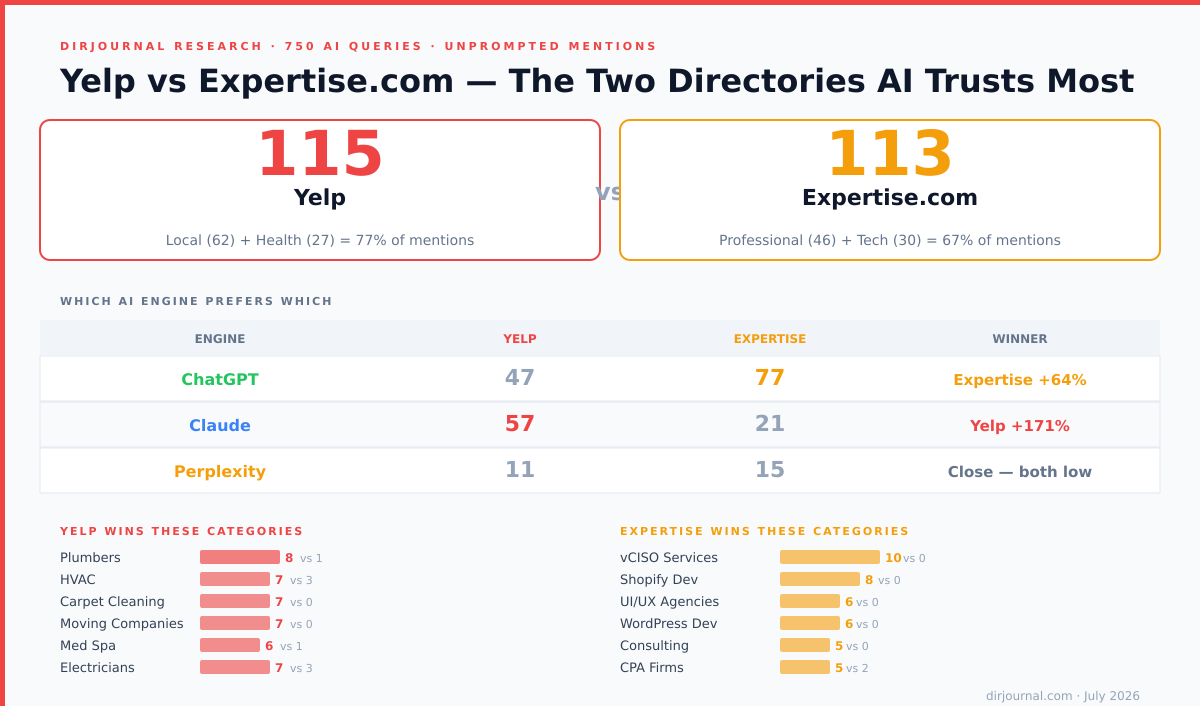
Yelp appeared 115 times and Expertise.com 113 times in the study's observed recommendations. BBB appeared 65 times, Clutch 55, G2 41, Google Reviews 38, Trustpilot 26, and Angi 18. Those counts describe this prompt set and collection period, not the global probability that an engine will cite each service.
Directories accounted for 88 percent of recommendation citations in the coded results, compared with 12 percent for individual business websites. The three engines also converged on a relatively small recurring group of roughly 80 brands across industries. This supports a corroboration hypothesis: recommendation engines often prefer aggregators that compare several businesses and expose reviews or category context.
| AI Engine | Queries Tested | Directory Share of Recommendation Citations | Individual Website Share |
|---|---|---|---|
| ChatGPT | 250 | 88% in the coded recommendation results | 12% |
| Claude | 250 | Similar directional pattern; engine-specific percentage not reported | Similar directional pattern |
| Perplexity | 250 | Similar directional pattern; engine-specific percentage not reported | Similar directional pattern |
The 88 percent figure should not be repeated as though each engine independently produced exactly that split. It is the combined coded result available from the study summary, while Claude and Perplexity showed similar patterns. Reporting unavailable engine-level numbers as exact would create false precision.
The experiment measures recommendations, not every kind of AI answer. Informational, navigational, medical, and news prompts may use a different source mix, and repeated runs can change because engines update retrieval indexes and response models. The study's value lies in a controlled cross-engine snapshot and its disclosed prompts, not a permanent law about citation behavior.
Directory citations also need interpretation. An engine may cite a directory because it offers reviews, category comparisons, address data, or a page that ranks well in an underlying search index. The 750-query study establishes the frequency pattern, but it does not isolate which directory property caused selection.
DirJournal then compared the experiment with Ahrefs Brand Radar citation counts from August 2026. Trustpilot led the selected directories with 1,350,175 citations, followed by Yelp at 366,501 and BBB at 276,739. Ahrefs measures a broader data set and methodology than the 750 prompts, so the two sources corroborate directory visibility without being directly interchangeable.
| Directory | Total AI Citations | ChatGPT | Perplexity | Google AI Overviews | Copilot |
|---|---|---|---|---|---|
| Trustpilot | 1,350,175 | 423,926 | 409,084 | 165,194 | 142,754 |
| Yelp | 366,501 | 3,908 | 177,838 | 47,714 | 1,767 |
| BBB | 276,739 | 146,874 | 48,965 | 12,530 | 37,795 |
| G2 | 175,865 | 66,980 | 52,600 | 13,063 | 29,463 |
| Clutch | 17,867 | 5,190 | 6,754 | 1,182 | 1,846 |
| GoodFirms | 7,885 | 2,232 | 1,684 | 564 | 1,796 |
| DirJournal | 1,092 | 284 | 84 | 8 | 716 |
Source: Ahrefs Brand Radar, August 2026, as recorded by DirJournal. The displayed engine columns do not sum to the total because the total includes other tracked AI surfaces. DirJournal publishes this article and appears in the table, so readers should treat its inclusion as disclosure rather than independent endorsement.
The platform spread shows why a single-engine metric can mislead. Yelp recorded far more Perplexity citations than ChatGPT citations in the supplied snapshot, while DirJournal's largest displayed column came from Copilot. A company should track the assistants its buyers use instead of treating aggregate citations as uniform reach.
Three Signals That Actually Predict AI Citations
1. Structured Schema Data
JSON-LD can give crawlers explicit Organization, LocalBusiness, or Person properties, including legal name, address, founder, knowsAbout, and sameAs identifiers. Google's structured-data documentation supports using markup to clarify page entities, while the GEO paper supports clear, source-backed presentation as a visibility tactic. Neither source proves that schema causes citations across every LLM.
DirJournal observed early examples among 41 listings enriched to its deeper entity standard. Perplexity cited the Seki Edge listing for a query about whether the company is Japanese and cited Wayne Dalton for a question about whether the company remains in business. These are case observations from DirJournal, not a controlled estimate of schema uplift.
Use valid properties that match visible page content. A Schema Generator can create the starting JSON-LD, but Google's validation tools should still check syntax and eligibility. Fabricated founders, awards, or sameAs links weaken the entity record rather than improving it.
2. Presence on Multiple Authoritative Directories
The study's 88 percent directory share makes third-party presence the strongest observed pattern in this data set. A listing on Trustpilot, BBB, G2, Clutch, Yelp, or a relevant industry directory gives an engine an additional source for category, reputation, and business details. HubSpot's AEO article also shows a Google AI Overview recommending HubSpot while citing Zapier, illustrating how third parties can frame a brand.
Directory quantity alone cannot establish trust. Choose platforms that cover the actual category, disclose review or editorial methods, and rank visibly in the target market. DirJournal's 60+ Free Business Directories Ranked by AI Visibility compares options using citation evidence, and businesses can also List your business on DirJournal.
3. Consistent Entity Information Across Sources
Names, addresses, phone numbers, founding dates, and founder identities must refer to the same entity across the website and third-party profiles. HubSpot recommends consistent local listings and warns that mismatched addresses or service details can introduce errors in AI answers. Directive likewise identifies consistency and credibility as part of AEO work.
Consistency does not require every description to use identical marketing copy. It requires stable factual identifiers and a clear relationship between parent companies, brands, locations, and people. The Entity Verification Checklist provides a repeatable audit for those fields.
How to Rank in ChatGPT
- Audit trusted directory coverage. Compare your profiles on category-relevant platforms found in the DirJournal study, then correct obsolete facts before adding new listings.
- Add entity schema. Mark up the Organization or LocalBusiness, connect founders with Person entities, and use sameAs only for profiles that identify the same subject.
- Earn reference-quality coverage. A legitimate Wikipedia article can aid disambiguation, but Wikipedia's notability guideline requires significant independent coverage; pursue cited trade or news coverage whether or not an article becomes possible.
- Normalize business facts. Use one canonical name, NAP record, founding date, and founder list across owned pages and profiles.
- Publish direct answers with evidence. State the question, answer it in a self-contained passage, and attach a named primary source, date, and unit where the claim needs them.
- Connect verified identities. Add sameAs links from the canonical entity to major profiles, then check reciprocal website fields where platforms provide them.
- Measure repeated prompts. Record the same high-value questions across engines and dates with the Free AI Visibility Checker, Ahrefs Brand Radar, or a controlled manual sheet.
No publisher can guarantee a ranking in ChatGPT because answers vary with the model, retrieval index, prompt, user context, and date. The GEO paper describes generative systems as black boxes and reports different effects across domains. Track citation rate and factual accuracy across a stable query set instead of treating one favorable answer as a ranking.
Prompt design needs the same discipline as keyword tracking. Separate discovery prompts such as “best payroll software for a small retailer” from entity prompts such as “who founded Company X,” because they test different evidence. Record location, logged-in state, model label, and whether web retrieval was active so a later comparison has context.
A baseline technical audit can still find fixable omissions. DirJournal's Free AEO Readiness Checker reviews accessible signals, but its output cannot observe every training or retrieval system. Pair tool results with actual prompt testing.
GEO vs SEO: the Academic Perspective
The GEO paper introduced a creator-focused framework for measuring and improving source visibility inside cited generated responses. Its GEO-bench contained 10,000 queries, and the experiment modified source presentation before evaluating citation visibility. The authors reported gains of up to 40 percent in their benchmark and up to 37 percent on Perplexity, with strong variation by domain.
Adding citations, quotations from relevant sources, and statistics produced the largest reported gains across many tested queries. Keyword stuffing performed poorly relative to those evidence-based methods. The finding supports source-rich publishing, but it does not prove that any fixed recipe transfers unchanged to current commercial models.
The paper differs from routine SEO by measuring a citation's position, attributed word count, and influence within one synthesized answer. Traditional rank tracking measures a URL's position in a list of results. Both depend on retrievable pages and credible information, which explains the large practical overlap described by Amsive and Google.
What is LLMO?
LLMO means large language model optimization. Practitioners use it for work aimed specifically at how LLM-based products retrieve, represent, and cite an entity, rather than all answer surfaces. The term can exclude older featured snippets or voice assistants that AEO might include.
The execution remains the same in current published guidance: make facts crawlable, reduce entity ambiguity, support claims, and earn corroborating mentions. Amsive groups LLMO with AEO and GEO as overlapping terminology, while Directive treats AEO and GEO as one playbook. No independent evidence shows that an “LLMO page” needs a separate markup language or index.
AEO Strategy: What to Do This Quarter
- Week 1, record the baseline. Select ten commercially valuable prompts, run them in the same engines and locations, then save cited domains, brand wording, and answer dates.
- Weeks 2 and 3, audit corroboration. Check the five directory types that appear most often for the category, claim existing profiles, and correct factual conflicts before requesting reviews.
- Weeks 4 and 5, repair the entity graph. Add valid Organization markup, LocalBusiness properties for physical locations, founder Person entities, and verified sameAs links.
- Weeks 6 through 8, close answer gaps. Build or revise pages for the ten baseline prompts using direct answers, dated evidence, named sources, and comparison tables where readers need them.
- Weeks 9 and 10, improve local evidence. Update the Google Business Profile, hours, categories, services, and location pages so they match the canonical business record.
- Weeks 11 and 12, publish primary evidence. Release one original data set, test, benchmark, or survey with a documented method that other publishers can verify and cite.
Run the original ten prompts again at quarter end and compare citation frequency, factual errors, source diversity, and recommendation language. Keep SEO traffic and conversions in the same report because Amsive's analysis shows that conventional search still supplies the larger discovery base for many sites. Change the next quarter's work only where repeated observations show a gap.
Join the DirJournal newsletter
Weekly insights on directories, listings, SEO, and how businesses get found online.
No spam. Unsubscribe anytime.
Found this useful?
Share this article
Recommended for You
The Claude Connectors List, Organized by People Who Build Directories (2026)
Claude connectors are prebuilt, hosted integrations that link Claude to outside services like…
The Brands AI Engines Agree On (And What They Have in Common)
42 brands were named by Claude, ChatGPT, and Perplexity independently across 750 queries. Same…
Yelp vs Expertise.com: The Two Directories AI Engines Trust Most
Yelp got 115 AI mentions across 750 queries. Expertise.com got 113. They're nearly tied overall but…
Related Resources
Looking for verified service providers? Browse our directory categories below — all human-audited and trusted by decision-makers since 2007.