Independent. Human-Curated. Established 2007.
Why AI Visibility Now Depends on Human-Curated Directories, Not Backlinks
DirJournal Founder · 19+ years building directory and discovery products. Editorial-team verified.
Key Topics in This Guide
- 1Why Does AI Struggle With Automated Data? — covered in detail below
- 2What Makes a Source a "trusted Hub" to an AI Engine? — covered in detail below
- 31. Strict Editorial Gates — covered in detail below
- 42. Historical Domain Authority — covered in detail below
- 53. Structured Entity Linking — covered in detail below
- 6How is Local Citation Strategy Changing in 2026? — covered in detail below
- 7Why is Human Curation Your Strongest AIO Weapon? — covered in detail below
- 8Why the Data Layer Matters: Next.js + Semantic JSON-LD — covered in detail below
- 9The Takeaway: Stop Mass-Producing, Start Verifying — covered in detail below
- 10Claim Your Verified Entity Placement on DirJournal — covered in detail below
- 11Frequently Asked Questions — covered in detail below
- 12Why Are AI Engines Moving Away From Backlinks? — covered in detail below
The open web is drowning in synthetic content. As Large Language Models (LLMs) crawl billions of auto-generated, scraped, and machine-spun pages, they face a structural crisis: hallucinations, fact drift, and what researchers call model collapse — the quality degradation that happens when AI trains on its own output.
So how do platforms like Google AI Overviews (AIO), ChatGPT, Perplexity, and Gemini protect the integrity of their answers when the source material itself is contaminated?
They outsource trust.
The Semrush AI Visibility Index — which analyzed more than 126 million real US search prompts across the leading AI platforms — reveals a decisive pattern: AI engines no longer reward raw content volume or backlink quantity. They reward Source-Mention Overlap, the degree to which an entity is consistently referenced across a small set of pre-vetted, human-curated hubs. In the era of automated spam, human curation has become the single most valuable trust signal in AI Visibility.
Why Does AI Struggle With Automated Data?
Ground truth: LLMs cannot independently verify whether a business is real, whether an address is occupied, or whether a directory listing was created by a person or a script. They compensate by anchoring their answers to sources that have already done that verification.
This is the foundation of modern Generative Engine Optimization (GEO). LLMs are statistical pattern engines — brilliant at synthesizing language, but blind to physical reality. To avoid hallucinating a fake plumber or recommending a defunct agency, their retrieval layers are explicitly weighted toward ground-truth sources: domains with an established editorial layer, a stable Knowledge Graph footprint, and a long history of unspammed entity data.
When Google composes an AI Overview or ChatGPT answers a commercial-intent prompt like "best digital marketing agencies in Dubai," its retrieval system filters out the noise by pulling from a narrow set of trusted third-party hubs. If your business is not embedded in the Citation Graph of these hubs, you do not exist to the AI — regardless of how much content sits on your own domain. We covered the same dynamic from the training-data side in our companion piece on human-curated directories in LLM training data.
What Makes a Source a "trusted Hub" to an AI Engine?
Ground truth: Three signals — strict editorial gates, historical domain authority, and structured entity linking. Platforms that combine all three are disproportionately cited in AI answers.
1. Strict Editorial Gates
Automated directories that allow instant, unverified submissions are increasingly treated as low-information sources. Their listings carry near-zero Information Gain for an LLM because the same boilerplate appears across thousands of scraped clones. Human-curated platforms that manually review, verify, and categorize entries function as a pre-filtered dataset — exactly the substrate retrieval models prefer.
2. Historical Domain Authority
AI ranking systems lean heavily on legacy domains with long-term data consistency. A domain with nearly two decades of clean, unspammed history provides a stable anchor for the AI's Entity Hub — a structured cluster of attributes (name, address, services, reviews, parent brand) that the model can confidently associate with one real-world business.
3. Structured Entity Linking
Trusted hubs do not just display text; they map data. Through rich JSON-LD Structuring — Organization, LocalBusiness, Service, Review, and BreadcrumbList schemas — these hubs translate human-verified information into the native machine language LLMs ingest during both training and live retrieval.
How is Local Citation Strategy Changing in 2026?
Ground truth: Local Citations in 2026 are no longer measured by NAP volume across hundreds of low-quality directories. They are measured by entity consistency across a short list of human-vetted hubs that AI engines actually cite.
The old playbook — blasting your Name, Address, and Phone across 300 free directories — now produces diminishing or negative returns. LLMs detect repetitive boilerplate, deduplicate it, and discount the source. The new playbook is concentration: fewer, higher-trust placements that reinforce a single canonical entity record. Our shortlist of AI-citable directories for SEO and Local SEO walks through how to choose those placements.
| Old SEO (2015–2022) | Modern GEO / AEO |
|---|---|
| 300+ automated citations | 10–20 human-vetted entity placements |
| Backlink quantity | Source-Mention Overlap across trusted hubs |
| Keyword density | Entity consistency + Information Gain |
| HTML scraping | JSON-LD + Knowledge Graph ingestion |
| Anchor-text optimization | Schema-validated attribute matching |
Why is Human Curation Your Strongest AIO Weapon?
Ground truth: You cannot force Google AIO or ChatGPT to trust your own domain overnight, but you can borrow the trust of a platform they already rely on.
When you secure a placement in a strictly curated directory like DirJournal, you are not buying a traditional backlink. You are injecting your business into a verified Entity Hub that has spent 19 years building an unspammed, human-edited trust footprint. When an LLM looks for an authoritative source to validate a recommendation, it cross-checks your business data against that hub's human-vetted graph. The citation is not a link — it is a vote of factual confidence.
The shift in one line: Backlinks were a signal of popularity. Entity citations are a signal of verifiability. AI engines care about the second one.
Why the Data Layer Matters: Next.js + Semantic JSON-LD
Most legacy directories were built on PHP/MySQL stacks where structured data was an afterthought — bolted on as a plugin and rendered inconsistently. DirJournal runs on a modern Next.js 16 application with semantic JSON-LD emitted at the route level. That distinction matters for AI ingestion in three concrete ways:
- Server-rendered, schema-first pages. Each listing ships fully hydrated HTML with embedded
Organization,LocalBusiness, andReviewJSON-LD on the first byte — no client-side execution required for an LLM crawler to read it. - Connected entity graphs. Listings are linked via
@idreferences to parent categories, parent brands, and service entities, forming a navigable Knowledge Graph rather than isolated pages. - Edge-cached freshness. Incremental Static Regeneration (ISR) keeps verified data current without rebuilding the entire graph, so AI crawlers always see the latest human-reviewed state of every record.
For an LLM, the difference between scraping a 2008-era PHP directory and ingesting a schema-graph-validated Next.js entity is the difference between reading a phone-book photocopy and querying a structured database.
The Takeaway: Stop Mass-Producing, Start Verifying
The Semrush AI Visibility Index proves the future of search visibility is not about who can generate the most content — it is about who can prove they are trusted. As synthetic content continues to degrade the open web, AI retrieval models will tighten their filters and concentrate citations on a shrinking list of human-vetted entity hubs.
The businesses that win the next five years of AI search will be the ones that stopped chasing automated footprints and started anchoring their brand to the sources LLMs already trust.
Claim Your Verified Entity Placement on DirJournal
DirJournal has spent 19 years building one of the web's most heavily curated business directories — and every paid listing is reviewed by a human editor before it goes live. Each approved placement ships with full JSON-LD entity markup, a permanent canonical URL, and inclusion in the same Citation Graph that Google AI Overviews, ChatGPT, and Perplexity actively pull from.
Submit your business for editorial review →
Get cited by the engines that decide what your customers see next.
Frequently Asked Questions
Why Are AI Engines Moving Away From Backlinks?
AI engines need to cite sources they can trust as ground truth. Backlinks measure popularity, which is easy to fake at scale with automated link networks. Entity citations from human-vetted hubs measure verifiability — proof that a real editor reviewed the business — which is what retrieval models actually weight when composing answers.
What is Source-Mention Overlap?
Source-Mention Overlap is the degree to which a single entity is consistently referenced across a small set of pre-vetted, human-curated sources. AI engines use it as a confidence signal: the more trusted hubs that independently confirm the same facts about a business, the more likely that business is to be cited inside an AI answer.
What is an Entity Hub?
An Entity Hub is a structured cluster of attributes — name, address, services, reviews, parent brand — that an AI model associates with one real-world entity. Trusted directories function as Entity Hubs by linking these attributes through JSON-LD schema and editorial review, giving the AI a single reliable record to anchor its answers to.
How Are Local Citations Changing in 2026?
Local Citations in 2026 are no longer measured by NAP volume across hundreds of low-quality directories. They are measured by entity consistency across a short list of human-vetted hubs that AI engines actually cite. Concentration in trusted sources beats distribution across automated ones.
Does a Paid DirJournal Listing Improve AI Visibility?
Yes. A paid DirJournal placement is human-reviewed before publication and ships with full Organization, LocalBusiness, and Review JSON-LD markup. That combination — editorial verification plus machine-readable schema on a 19-year-old domain — is the exact substrate AI Overviews, ChatGPT, and Perplexity prioritize when sourcing commercial-intent answers.
Frequently Asked Questions
Why are AI engines moving away from backlinks?
What is Source-Mention Overlap?
What is an Entity Hub?
How are Local Citations changing in 2026?
Does a paid DirJournal listing improve AI Visibility?
Join the DirJournal newsletter
Weekly insights on directories, listings, SEO, and how businesses get found online.
No spam. Unsubscribe anytime.
Found this useful?
Share this article
Recommended for You
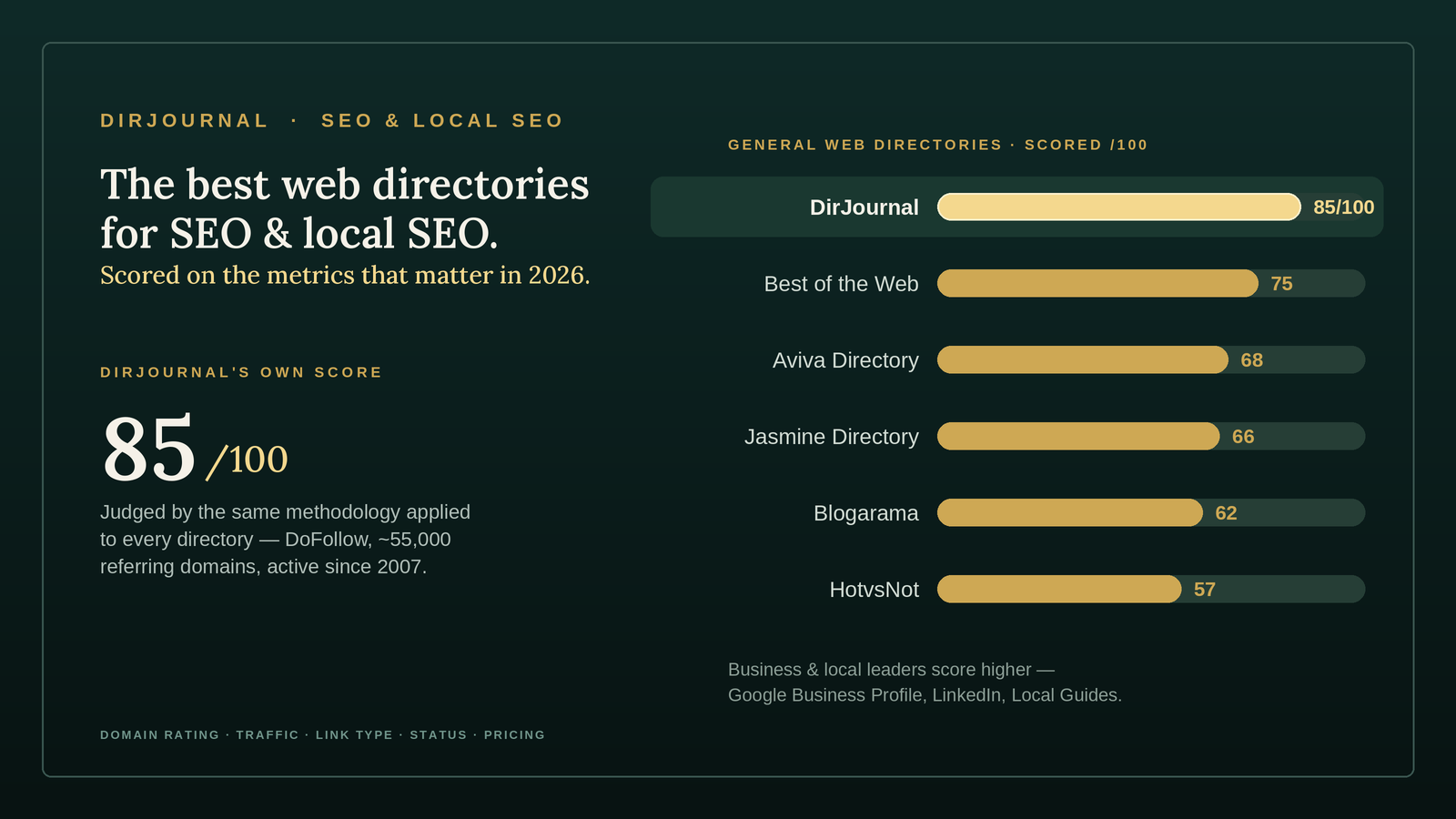
The Best Web Directories for SEO and Local SEO
The best directories for SEO are Best of the Web, Jasmine Directory, Aviva, and Blogarama among…
What Everyone Gets Wrong About Talking to AI (And the Mistakes That Keep Costing People Money, Time, and Sometimes Their Careers)
A few months back I was deep into a website rebuild, working through a single Claude thread that…
The Ultimate List of Free Business Directories (Ranked by AI & SEO Value)
60+ free business directories ranked by AI citations, not just DA. Trustpilot gets 1.35M AI…
Related Resources
Looking for verified service providers? Browse our directory categories below — all human-audited and trusted by decision-makers since 2007.