Independent. Human-Curated. Established 2007.
AI Citation Index: 27 Directories Ranked by AI Engine Citations
DirJournal Founder · 19+ years building directory and discovery products. Editorial-team verified.
Key Topics in This Guide
- 1AI Citation Index: 27 Directories Ranked by AI Engine Citations — covered in detail below
- 2Five Findings That Contradict Conventional SEO Wisdom — covered in detail below
- 31. Trustpilot Gets 3.7 Times More AI Citations Than Yelp at the Same DR — covered in detail below
- 42. BBB Outperforms Yellow Pages by About 25 Times — covered in detail below
- 53. Foursquare is Nearly Absent Despite a DR of 91 — covered in detail below
- 64. Justia Dominates FindLaw in Legal Citations — covered in detail below
- 75. G2 Retains AI Citations While Its Organic Traffic Falls — covered in detail below
- 8AI Brand Mentions by Engine — covered in detail below
- 9ChatGPT Favors Trustpilot and Reference-Rich Vertical Sites — covered in detail below
- 10Perplexity Gives Travel and Local Discovery More Weight — covered in detail below
- 11Google AI Overviews Concentrate Citations at the Top — covered in detail below
- 12Copilot Elevates BBB and Home Services — covered in detail below
Trustpilot receives 1,350,175 AI citations across five engines, the highest total in this index and a clear signal for AI search optimization. Ahrefs Domain Rating does not predict the order: Foursquare has a DR of 91 and 2,613 citations, while DirJournal has a DR of 55 and 1,092. Trustpilot leads every individual directory, although its total does not exceed the next four directories combined.
AI Citation Index: 27 Directories Ranked by AI Engine Citations
The index measures source citations, meaning links from an AI response to a directory page or domain. It does not measure referral visits, favorable sentiment, or the number of businesses named from each directory.
Trustpilot, TripAdvisor, and WebMD occupy the first three positions, each with more than 790,000 citations. The distribution then drops sharply: Yelp ranks fourth with 366,501, while the final five directories each record fewer than 4,000.
| Rank | Directory | Ahrefs Domain Rating | Total AI Citations | ChatGPT | Perplexity | Google AIO | Copilot | Grok |
|---|---|---|---|---|---|---|---|---|
| 1 | Trustpilot | 94 | 1,350,175 | 423,926 | 409,084 | 165,194 | 142,754 | 209,217 |
| 2 | TripAdvisor | 94 | 1,134,087 | 288,825 | 461,088 | 107,906 | 52,805 | 223,463 |
| 3 | WebMD | 94 | 791,801 | 217,676 | 224,364 | 123,938 | 78,193 | 147,630 |
| 4 | Yelp | 94 | 366,501 | 3,908 | 177,838 | 47,714 | 1,767 | 135,274 |
| 5 | Angi | 91 | 290,825 | 143,611 | 62,555 | 28,935 | 30,672 | 25,052 |
| 6 | BBB | 91 | 276,739 | 146,874 | 48,965 | 12,530 | 37,795 | 30,575 |
| 7 | G2 | 92 | 175,865 | 66,980 | 52,600 | 13,063 | 29,463 | 13,759 |
| 8 | Justia | 90 | 173,590 | 149,698 | 6,504 | 2,748 | 7,420 | 7,220 |
| 9 | Houzz | 92 | 153,226 | 28,811 | 58,294 | 25,232 | 1,184 | 39,705 |
| 10 | ConsumerAffairs | 88 | 147,155 | 62,535 | 39,503 | 12,366 | 13,378 | 19,373 |
| 11 | Capterra | 90 | 95,442 | 34,798 | 29,970 | 6,559 | 11,076 | 13,039 |
| 12 | Zillow | 92 | 85,480 | 32,779 | 19,728 | 11,579 | 8,113 | 13,281 |
| 13 | Thumbtack | 88 | 33,938 | 135 | 21,141 | 5,216 | 1,366 | 6,080 |
| 14 | FindLaw | 87 | 26,392 | 14,214 | 5,094 | 1,240 | 2,874 | 2,970 |
| 15 | Healthgrades | 88 | 25,674 | 5,774 | 8,694 | 5,365 | 1,116 | 4,725 |
| 16 | Clutch | 91 | 17,867 | 5,190 | 6,754 | 1,182 | 1,846 | 1,784 |
| 17 | Nextdoor | 91 | 12,270 | 3,650 | 1,128 | 3,518 | 629 | 3,345 |
| 18 | DesignRush | 90 | 11,334 | 4,065 | 2,791 | 937 | 1,484 | 1,296 |
| 19 | Yellow Pages | 91 | 11,043 | 5,679 | 3,340 | 116 | 1,386 | 522 |
| 20 | Avvo | 84 | 10,076 | 1,975 | 3,445 | 1,645 | 224 | 2,787 |
| 21 | GoodFirms | 86 | 7,885 | 2,232 | 1,684 | 564 | 1,796 | 1,070 |
| 22 | Zocdoc | 85 | 3,711 | 1,848 | 893 | 295 | 459 | 216 |
| 23 | Foursquare | 91 | 2,613 | 177 | 1,727 | 46 | 573 | 90 |
| 24 | Expertise.com | 76 | 2,074 | 1,493 | 311 | 1 | 255 | 14 |
| 25 | Manta | 86 | 1,844 | 488 | 846 | 0 | 274 | 236 |
| 26 | DirJournal | 55 | 1,092 | 284 | 84 | 8 | 716 | 0 |
| 27 | Porch | 78 | 924 | 126 | 639 | 0 | 51 | 108 |
Source: Ahrefs Site Explorer, August 28, 2026. All figures are citation counts, not traffic. DR means Ahrefs Domain Rating.
The totals expose engine-specific dependence. Justia gets 149,698 of its 173,590 citations from ChatGPT, while Yelp gets only 3,908 of its 366,501 there. A directory can rank well in the combined index while remaining absent from one major answer system.
The first 12 rows also show that citation reach is not confined to one business model. The group includes consumer review sites, professional directories, and reference publishers, yet each supplies pages that connect named entities to evidence an answer engine can quote or cite.
The lower half is equally varied. Clutch, Nextdoor, DesignRush, and Yellow Pages sit between 11,043 and 17,867 citations, while Avvo and GoodFirms fall below that band. High awareness outside AI search does not automatically move a domain into the leading citation group.
Zeroes in individual engine columns require a narrow reading. Manta has zero Google AIO citations and DirJournal has zero Grok citations in this pull, but a zero in a sampled index does not establish permanent exclusion. It records no observed citations for that domain in that engine's covered response set on the measurement date.
Five Findings That Contradict Conventional SEO Wisdom
1. Trustpilot Gets 3.7 Times More AI Citations Than Yelp at the Same DR
Trustpilot records 1,350,175 citations against Yelp's 366,501, even though both domains carry an Ahrefs Domain Rating of 94. The gap is about 3.7 times, so link-based domain strength cannot explain it.
Trustpilot publishes review scores, review counts, business identities, and category relationships in a repeatable format. Yelp also holds rich business data, but the citation mix shows that AI systems treat the two sources differently: ChatGPT cites Trustpilot 423,926 times and Yelp 3,908 times.
Cleaner structured review data offers a plausible explanation, not proof of causation. Brand recognition, crawl access, topical coverage, and each engine's retrieval system may also affect the gap.
2. BBB Outperforms Yellow Pages by About 25 Times
BBB receives 276,739 citations, compared with 11,043 for Yellow Pages. Both have a DR of 91, and both come from the pre-web tradition of helping buyers evaluate local businesses.
The content model differs. BBB pages carry accreditation status, complaint information, ratings, and business identity fields, while Yellow Pages centers its product on listings. The result supports a narrow inference: AI engines cite structured trust evidence more often than listing volume alone.
That inference should not be read as a verdict on lead quality. The counts show how often each domain appears as a cited source, not whether a citation produces a customer or settles a buying decision.
3. Foursquare is Nearly Absent Despite a DR of 91
Foursquare records 2,613 citations across the five engines. DirJournal records 1,092 at DR 55, which places both near the foot of the total-citation ranking despite a 36-point DR difference.
Foursquare's total remains higher per DR point than DirJournal's, so the data does not support the opposite claim. What the figures do show is that a DR of 91 can coexist with very little direct citation visibility in AI answers.
Foursquare supplies location intelligence to other products, but a data supplier can influence an answer without receiving the visible source link. Citation measurement captures attribution, not every upstream data dependency.
4. Justia Dominates FindLaw in Legal Citations
Justia receives 173,590 citations, more than six times FindLaw's 26,392. ChatGPT creates the widest part of that separation, citing Justia 149,698 times and FindLaw 14,214 times.
Justia combines attorney profiles with court opinions, codes, and other legal reference material. That mix can answer both entity questions and research questions, giving the domain more routes into retrieval than an attorney directory alone.
Legal citation volume still needs context. A citation to case law does not necessarily expose an attorney profile, so firms should measure whether the cited pages connect to the service and location queries that matter to them.
5. G2 Retains AI Citations While Its Organic Traffic Falls
G2 holds 175,865 AI citations in the August 2026 index. Its estimated organic traffic fell from 955,000 in December 2025 to 615,000 in August 2026, a decline of 36 percent according to the supplied Ahrefs comparison.
The two measures describe different events. Organic traffic estimates count visits associated with search rankings, while citation counts record source appearances inside generated answers. A source can remain useful to an answer engine even as fewer searchers click its pages from conventional results.
G2's 66,980 ChatGPT citations and 52,600 Perplexity citations keep it prominent in software research. Publishers that judge AI brand visibility through organic sessions alone will miss that exposure.
The five findings point to retrieval fit rather than one universal ranking factor. Review evidence helps Trustpilot, legal reference material helps Justia, and accreditation data helps BBB. Each source gives an answer system a different reason to cite it.
They also expose the limits of aggregate totals. Yelp looks strong in fourth place but depends heavily on Perplexity and Grok, while Justia relies heavily on ChatGPT. A platform change could alter either directory's total without any corresponding change to its DR.
AI Brand Mentions by Engine
Each engine produces a different source hierarchy. Trustpilot leads four of the five columns, while TripAdvisor leads Perplexity with 461,088 citations.
ChatGPT Favors Trustpilot and Reference-Rich Vertical Sites
ChatGPT cites Trustpilot 423,926 times, followed by TripAdvisor at 288,825 and WebMD at 217,676. Justia reaches 149,698, BBB reaches 146,874, and Angi reaches 143,611.
The order gives specialized sources a large role. Travel, health, legal, and home-service directories all enter the leading group, while general local directory Yelp contributes only 3,908 citations.
Perplexity Gives Travel and Local Discovery More Weight
TripAdvisor leads Perplexity with 461,088 citations, ahead of Trustpilot at 409,084. WebMD follows at 224,364, Yelp at 177,838, Houzz at 58,294, and G2 at 52,600.
Yelp's performance changes most between engines. Its Perplexity count is more than 45 times its ChatGPT count, showing why a single-engine tracker can misstate overall AI brand mentions.
Thumbtack shows another Perplexity-heavy pattern: 21,141 of its 33,938 total citations come from that engine, compared with 135 from ChatGPT. Perplexity also supplies 639 of Porch's 924 citations and 1,727 of Foursquare's 2,613.
Google AI Overviews Concentrate Citations at the Top
Trustpilot leads Google AI Overviews with 165,194 citations. WebMD has 123,938, TripAdvisor has 107,906, Yelp has 47,714, Angi has 28,935, and Houzz has 25,232.
Five directories in the full table record fewer than 300 Google AIO citations. Manta and Porch each record zero, while Expertise.com records one.
Google AIO gives Nextdoor 3,518 citations, close to its 3,650 on ChatGPT. That relative balance contrasts with Justia, where Google AIO contributes 2,748 against ChatGPT's 149,698.
Copilot Elevates BBB and Home Services
Trustpilot ranks first on Copilot with 142,754 citations, followed by WebMD at 78,193 and TripAdvisor at 52,805. BBB records 37,795, Angi records 30,672, and G2 records 29,463.
Copilot supplies 716 of DirJournal's 1,092 total citations. That concentration makes DirJournal's combined position sensitive to changes in one engine.
Copilot is also G2's third-largest source in raw terms at 29,463, behind ChatGPT and Perplexity. Yelp reverses that pattern, with only 1,767 Copilot citations despite its fourth-place overall rank.
Grok Gives Yelp Its Strongest Share
TripAdvisor leads Grok with 223,463 citations, while Trustpilot follows at 209,217. WebMD records 147,630, Yelp 135,274, BBB 30,575, and Angi 25,052.
Yelp receives more Grok citations than Trustpilot receives from Copilot. Engine preference can outweigh the broad reputation hierarchy visible in the total column.
Grok contributes 39,705 citations to Houzz, more than Houzz receives from ChatGPT or Google AIO. Avvo also gets its largest single-engine count from Perplexity at 3,445, with Grok second at 2,787.
These splits change how a company should define an AI visibility baseline. A buyer audience that uses Perplexity may encounter Yelp and Thumbtack often, while a ChatGPT-centered audience may see more Justia or BBB citations. The combined column supplies reach, but the engine columns reveal exposure risk.
AI Search Optimization: What the Data Shows
High citation counts cluster around sources that turn subjective claims into comparable records. Trustpilot, G2, and BBB expose ratings or trust indicators at the entity level, letting a retrieval system connect a named company with evidence attached to that company.
Complete entity data also matters. A directory profile that ties a business name to an address, category, and founding year gives an engine explicit facts to reconcile. Sparse profiles leave more ambiguity, particularly when businesses share a name or serve overlapping locations.
Cross-source consistency increases confidence in those associations. The same legal name, location, leadership details, and website should appear across the company site and its directory profiles. Conflicting facts can split an entity into multiple records or weaken a system's confidence that two pages describe the same business.
Editorial controls provide another signal. BBB accreditation and Clutch verification badges represent review processes beyond self-submitted copy, though neither guarantees a high citation count. The 60+ Free Business Directories Ranked by AI Visibility separates listing access from measured exposure.
Ahrefs Domain Rating alone predicts little in this sample. Foursquare's DR of 91 accompanies 2,613 citations, while lower-DR directories can approach or exceed that scale. AI search optimization therefore needs source-level measurement rather than a backlink metric used as a proxy.
Citation frequency also differs from recommendation frequency. The related AEO vs GEO vs SEO: What 750 AI Queries Actually Reveal explains how entity coverage, answer inclusion, and source attribution represent separate outcomes.
A practical audit should begin at the page level. Identify which directory pages earn citations for the prompts that matter, then compare the fields and evidence on those pages with uncited competitors. Domain totals can identify promising sources, but they cannot show whether a company's own profile is retrievable.
Businesses should also separate controllable facts from editorial outcomes. They can correct an address, expand a service description, or add matching schema to their own site. They cannot force an engine to cite a page or a directory to award an accreditation badge.
Changes need dated evidence. Save a profile snapshot before editing, keep the same prompt set, and measure mentions and citations separately after the update. Without that record, a ranking shift could come from a model refresh or a changed response corpus rather than the profile work.
LLM Visibility: Industry Vertical Leaders
Vertical context changes the useful comparison. A law firm gains little from Trustpilot's overall lead if legal prompts repeatedly retrieve Justia, and a software company should compare G2 with Capterra before judging its LLM visibility.
| Industry | No. 1 Directory | Citations | No. 2 Directory | Citations |
|---|---|---|---|---|
| Reviews/Trust | Trustpilot | 1,350,175 | ConsumerAffairs | 147,155 |
| Travel | TripAdvisor | 1,134,087 | Houzz | 153,226 |
| Healthcare | WebMD | 791,801 | Healthgrades | 25,674 |
| Local Services | Yelp | 366,501 | Angi | 290,825 |
| Legal | Justia | 173,590 | FindLaw | 26,392 |
| Software | G2 | 175,865 | Capterra | 95,442 |
| Agencies | Clutch | 17,867 | DesignRush | 11,334 |
| Real Estate | Zillow | 85,480 | Nextdoor | 12,270 |
Industry labels follow the supplied comparison set. Houzz focuses on home design and renovation rather than travel, so readers should not treat that pairing as a pure travel-directory comparison.
The largest vertical gap appears in healthcare, where WebMD's 791,801 citations exceed Healthgrades' 25,674 by a wide margin. The agency category is tighter: Clutch has 17,867 and DesignRush has 11,334.
The table ranks domains, not individual listings. A business still needs a complete profile and relevant evidence on the leading directory before the directory's citation reach can create meaningful exposure for that entity.
Category boundaries can also overlap. Houzz belongs more naturally with home design than travel, Nextdoor spans local services and neighborhood information, and BBB crosses nearly every commercial category. The table works as a shortlist, not a formal taxonomy.
Within software, G2's 175,865 citations exceed Capterra's 95,442, but their engine distributions remain fairly broad. G2's largest engine contributes 66,980 and Capterra's largest contributes 34,798, giving software buyers multiple cited sources rather than one engine-specific gatekeeper.
Legal shows the opposite shape. Justia leads FindLaw by a wide total margin and receives most of its exposure from ChatGPT. A law firm measuring only Perplexity could see a much smaller advantage because Justia records 6,504 there and FindLaw records 5,094.
How to Get Mentioned by ChatGPT
-
Start with the citation leader in your industry. Software companies should inspect G2 first, legal practices should inspect Justia, and local service providers should inspect Yelp or Angi. A broad list of registrations can come later.
-
Complete every structured field. Supply the full business name, canonical URL, address, service category, founding year, and relevant people. Add reviews, accreditation details, or portfolio evidence when the directory supports them.
-
Keep entity facts consistent. Use the same business identity across directory profiles, the company website, and major social profiles. Update old addresses and former brand names rather than leaving contradictory records live.
-
Match website schema to public profiles. Organization or LocalBusiness markup should repeat verified facts from the visible page. Add
sameAsreferences for official profiles, and do not mark up claims that visitors cannot see. -
Record a baseline and retest it. Run the Free AEO Readiness Checker to inspect optimization signals, then compare citation or mention tracking over time. Ahrefs Brand Radar can add recurring prompt and index data.
A listing does not guarantee a ChatGPT mention. Query relevance, supporting evidence, prompt wording, and retrieval timing all affect which entities appear. The goal is to make accurate business facts easy to verify across independent sources.
Profile copy should remain factual and specific. Service areas, credentials, and ownership details are easier to verify than unsupported claims such as “best” or “leading.” Review the public page after submission because hidden dashboard fields may not appear in crawlable content.
Schema needs the same discipline. Markup can clarify the entity described on a page, but it cannot make a false or stale fact trustworthy. A visible company name that differs from the schema name creates another reconciliation problem.
Track prompts that reflect an actual buying task rather than a branded vanity query. Category and location prompts show whether the engine discovers the business before the user already knows its name. Brand prompts are still useful for checking factual accuracy and source selection.
Businesses that need another corroborating profile can list your business on DirJournal. Placement in a directory should support a wider entity record, not replace first-party pages or customer evidence.
AI Visibility Checker: How to Measure Your AI Brand Mentions
An AI visibility checker tests whether answer engines mention or cite a brand for selected prompts. A useful report separates a name appearing in answer text from a source link pointing to the brand's site or directory profile.
- Ahrefs Brand Radar stores responses generated from search-backed prompt sets and reports mentions, citations, share of voice, and estimated impressions. Its official description covers ChatGPT, Perplexity, Google AI Overviews, Copilot, and other AI surfaces.
- Free AI Visibility Checker tests brand discoverability across buyer prompts and reports named competitors and trusted sources. The tool was in beta and free for a limited time when verified in September 2026.
- Free AEO Readiness Checker measures site and entity optimization signals. It addresses readiness rather than serving as a historical citation database.
- Profound remains active as an AI search marketing platform. Its Answer Engine Insights product monitors how AI systems represent a brand, while Agent Analytics tracks AI crawler activity.
- Otterly remains active as an AI search monitoring product. It tracks brand mentions, cited links, and prompt positions across services such as ChatGPT, Perplexity, and Google AI Overviews.
Measurement methods differ, so totals from separate products should not be combined. Ahrefs builds a large index from search-backed prompts and also offers custom prompt tracking, while other platforms may run a smaller set of direct checks chosen by the customer.
Prompt geography, account state, model version, and test date can change an answer. Teams should save the prompts and raw responses behind each score, then compare like with like on later runs.
Start with a fixed set that covers discovery and verification intent. For each response, record whether the brand appears, whether a link appears, which domain receives the link, and where the brand sits in the answer. Those fields prevent a favorable mention from being mistaken for an owned-site citation.
Competitive context matters as much as the raw count. A company with five mentions may lead a narrow category or trail every close rival in a crowded one. Share of voice and source overlap reveal that difference better than a standalone score.
Methodology
All counts in the 27-directory index came from Ahrefs Site Explorer's AI Responses Count endpoint and were pulled on August 28, 2026. The source file covers citations across ChatGPT, Perplexity, Google AI Overviews, Copilot, and Grok. Ahrefs Domain Rating is Ahrefs' proprietary measure of backlink-profile strength, and it is not Moz Domain Authority.
Ahrefs describes Brand Radar as a system that runs search-backed prompts through AI platforms and stores the responses. Its citation metric counts linked source appearances, while its mention metric counts appearances of a brand name in answer text. The index represents sampled prompts and a reporting window, not every response shown to every user.
DirJournal ran its separate AI Citation Study: 750 Queries Across Claude, ChatGPT, and Perplexity in July 2026. The project sent 750 direct queries across 50 commercial categories without using the word “directory” in a prompt, then parsed brand names, source URLs, and directory references.
The live study page verified Yelp at 115 recommendations, Expertise.com at 113, BBB at 65, Clutch at 55, and G2 at 41. It currently reports Angi and Trustpilot at 39 each, which differs from the supplied article snapshot of Angi at 18 and Trustpilot at 26; the live page does not place Google Reviews at 38 in its displayed leading table.
The citation index and 750-query study answer different questions. The Ahrefs dataset measures how often domains receive source citations across a large sampled corpus, while the DirJournal study measures recommendations within a fixed experiment. DirJournal appears at rank 26 in the index with 1,092 citations and received no preferential adjustment.
Join the DirJournal newsletter
Weekly insights on directories, listings, SEO, and how businesses get found online.
No spam. Unsubscribe anytime.
Found this useful?
Share this article
Recommended for You
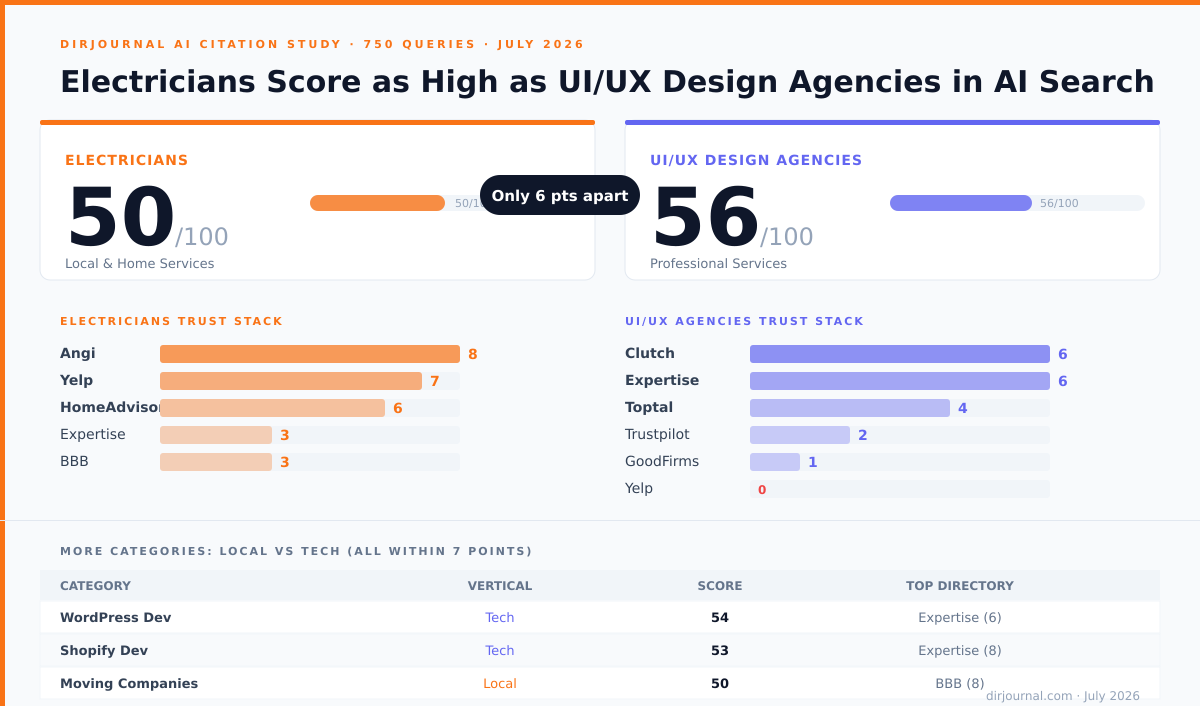
Electricians Score as High as UI/UX Design Agencies in AI Search. Here's Why.
Electricians scored 50/100 in our AI Citation Study. UI/UX Design Agencies scored 56. Six points…
Best Personal Injury Lawyers in Houston: Ranked by AI Citation Data
We asked Claude, ChatGPT, and Perplexity to name Houston personal injury lawyers. Arnold & Itkin,…

Best Personal Injury Lawyers in Los Angeles: Ranked by AI Citation Data
We asked Claude, ChatGPT, and Perplexity to name LA personal injury lawyers. Panish Shea Ravipudi,…
Related Resources
Looking for verified service providers? Browse our directory categories below — all human-audited and trusted by decision-makers since 2007.