Independent. Human-Curated. Established 2007.
The Role of Human-Curated Directories in LLM Training Data
DirJournal Founder · 19+ years building directory and discovery products. Editorial-team verified.
Key Topics in This Guide
- 1When AI Eats Its Own Tail — covered in detail below
- 2Do AI Search Engines Actually Prefer Human-Written Content? — covered in detail below
- 3What Makes a Directory a “trust Moat”? — covered in detail below
- 4Entities, Not URLs: How Directories Feed the Answer Engine — covered in detail below
- 5The Takeaway — covered in detail below
- 6Frequently Asked Questions — covered in detail below
- 7What is Model Collapse in AI? — covered in detail below
- 8Do AI Search Engines Cite Human-Written or AI-Generated Content More? — covered in detail below
- 9What is a Trust Moat in AEO? — covered in detail below
- 10What is the Difference Between AEO and GEO? — covered in detail below
- 11How Do Online Directories Help With AI Search Visibility? — covered in detail below
In April 2025, the SEO platform Ahrefs ran 900,000 freshly published web pages through its in-house AI-content detector. The result: 74.2% of them contained AI-generated text. Only about a quarter were judged purely human-written. That is the raw material now feeding the systems most people use to find anything — and it points to a problem the AI industry has known about for two years but rarely says out loud at the dinner table.
Answer engines have quietly taken over the front door of the internet. Google's AI Overviews now reach around 2.5 billion monthly users, its conversational AI Mode crossed a billion, and ChatGPT sits near 800 million weekly users. These tools don't hand you ten blue links and let you sort it out. They read the web, decide what's true, and tell you the answer. Which means the quality of what they read is no longer an academic concern. It is the whole game.
And here is the uncomfortable part: when these systems learn from a web that is three-quarters synthetic, they start to rot.
When AI Eats Its Own Tail
The technical term is model collapse, and it isn't a blog-post theory. In July 2024, Nature published research by Shumailov and colleagues showing that when a generative model is trained on content produced by earlier generative models, it suffers “irreversible defects.” Each generation of training smooths away the rare, the specific, the unusual — what the researchers call the tails of the distribution — until the model converges on a bland, confident, increasingly wrong average.
Think of it like photocopying a photocopy. The first copy looks fine. By the fortieth, the faces are gone. The danger isn't that AI invents one bad fact; it's that the unusual-but-true details — a niche provider, a regional business, a fact that only a handful of sources ever recorded — disappear first, because there was never much human signal holding them in place.
So you have a feedback loop. AI floods the web with text. The next model trains on that text. Accuracy degrades. The web fills further. The only thing that breaks the loop is a steady supply of data that a machine didn't write — verified records of real things, reviewed by real people.
Do AI Search Engines Actually Prefer Human-Written Content?
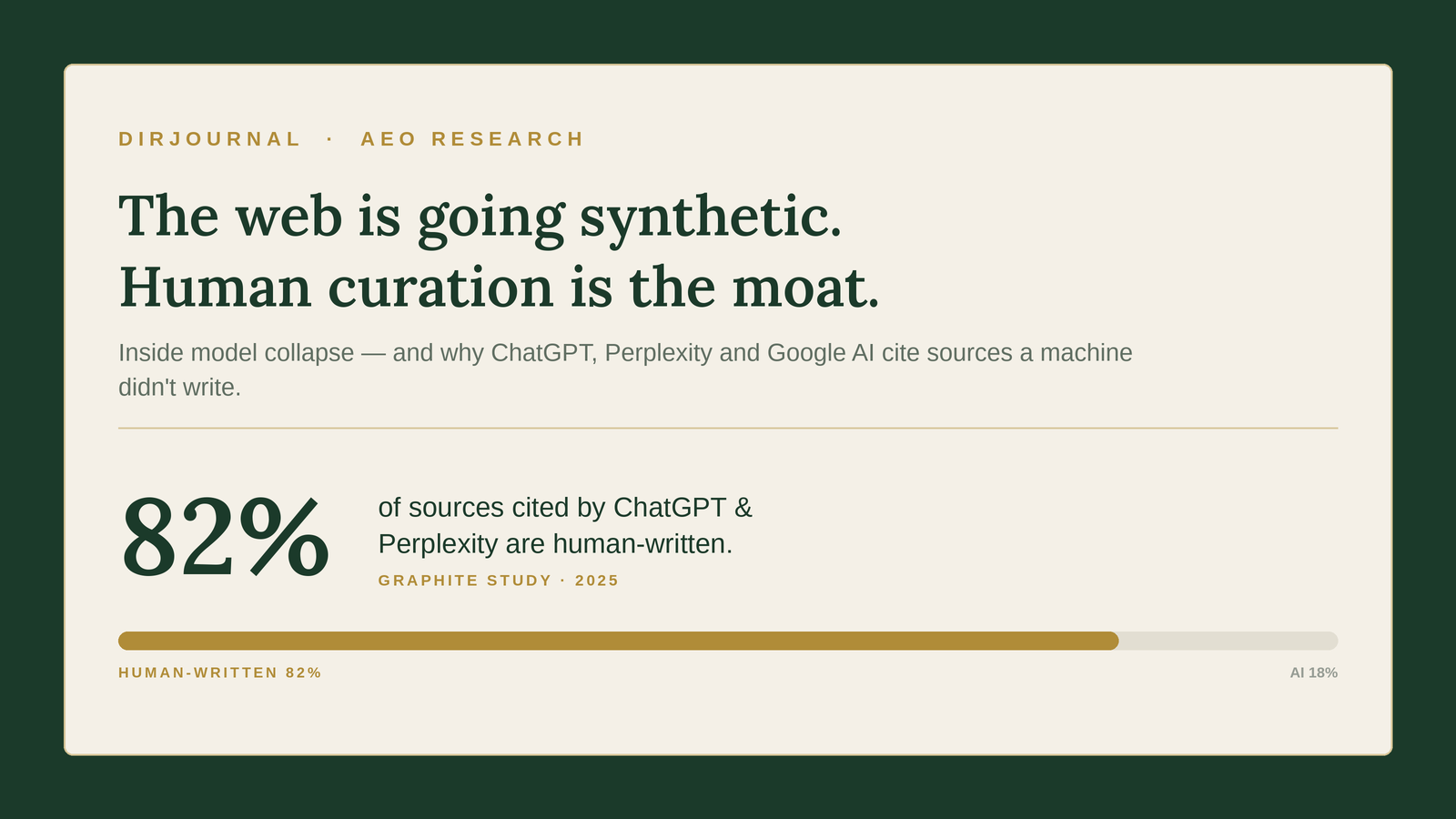
Yes — and this is the finding that should reshape how businesses think about visibility. A 2025 study by Graphite, reported by Axios, analyzed which content actually gets surfaced. The numbers are striking. Of articles ranking in Google Search, 86% were human-written. Of articles cited by ChatGPT and Perplexity, 82% were human-written. When AI-generated articles do appear, they tend to rank lower.
Read that again. The engines built on AI are disproportionately reaching for human work. Not out of sentiment — out of self-preservation. A system that wants to be trusted cannot afford to cite the synthetic sludge it is partly responsible for creating. So it learns to weight sources that are expensive to fake.
That single behavior is the foundation of everything that follows. The question for any business is no longer “how do I produce more content?” It's “how do I become the kind of source an answer engine is willing to stake its credibility on?”
What Makes a Directory a “trust Moat”?
A trust moat is a body of data that is costly to fake and therefore valuable to trust. The cost is the point.
Anyone can spin up a database. A script can scrape ten thousand business names, enrich them with an API, and publish them overnight. That data carries no signal, because it required no judgment — and machines are very good at recognizing the fingerprint of bulk-generated listings. The web is drowning in exactly this.
What can't be cheaply automated is the human approval step. When an editor physically reviews a submission, checks that the business exists, confirms the category is right, and approves it, that single act of judgment creates a signal no scraper can replicate at scale. It isn't that automation is worthless — verification tools, deduplication, and AI-assisted checks all do real work. It's that automation alone produces a fakeable artifact. The human in the loop is what raises the barrier to entry from “a credit card” to “actual editorial scrutiny.”
Time compounds this. A database assembled last quarter has no track record. A directory that has applied the same review standard consistently for close to two decades — the way DirJournal has since 2007 — carries something a new index simply cannot manufacture: a long, stable history of human-verified records. To a system trying to decide what's real, longevity and consistency are evidence.
Entities, Not URLs: How Directories Feed the Answer Engine
Modern search stopped being about ranking pages a long time ago. It now runs on entities — the businesses, people, and concepts behind the pages, and the relationships between them. When you search a brand, the engine isn't just matching keywords; it's trying to resolve “is this a real entity, and what do I reliably know about it?”
This is where a curated directory earns its keep. It acts as a corroborating validation node. When an answer engine encounters a brand and then finds that same brand listed in a rigorously reviewed, long-standing hub — with consistent name, address, category, and links — that cross-reference raises confidence. It's the difference between a stranger's claim and a claim confirmed by a source the system already respects.
Structuring that data makes the confirmation legible to crawlers. Clean JSON-LD schema describes the entity in a machine-readable way, and explicit sameAs links tie a listing to the brand's other verified profiles, stitching one entity together across the web. You aren't hoping the engine infers the connection. You're handing it to the crawler directly.
Key Concept: What is Answer Engine Optimization (AEO)?
Answer Engine Optimization is the practice of getting your business referenced inside AI-generated answers, rather than just ranking in a list of links. It's a real shift, because the old playbook doesn't transfer. Keyword density doesn't earn a citation. Neither do the citation blasts and link schemes that defined a decade of SEO if anything, those now read as exactly the kind of low-trust pattern the engines are learning to discount. What earns a mention is being present, accurately, in the sources the engine already trusts. That's the heart of both AEO and its close cousin GEO (Generative Engine Optimization): you don't optimize the answer, you optimize your standing among the sources the answer is built from.
The Takeaway
AI will keep scaling. There is no ceiling on how much synthetic text the web can hold, and model collapse guarantees that the more of it there is, the more valuable the human-verified exception becomes. Trust is the one thing in this system that cannot be coded — it has to be earned through judgment and confirmed through review. That makes human curation the premium currency of the search ecosystem, and the engines, by their own measured behavior, already agree.
Frequently Asked Questions
What is Model Collapse in AI?
Model collapse is the degradation that happens when AI models are repeatedly trained on content generated by other AI models. Research published in Nature in 2024 found this causes irreversible defects, where rare and specific information disappears first and outputs drift toward a narrow, increasingly inaccurate average.
Do AI Search Engines Cite Human-Written or AI-Generated Content More?
Human-written, by a wide margin. A 2025 Graphite study reported by Axios found that 82% of articles cited by ChatGPT and Perplexity, and 86% of articles ranking in Google Search, were human-written. AI-generated articles, when they appear at all, tend to rank lower.
What is a Trust Moat in AEO?
A trust moat is a collection of data that is costly to fake and therefore valuable for AI systems to trust. Human-reviewed directory listings are a classic example: the manual editorial approval step creates a signal that bulk scraping and automation cannot cheaply replicate.
What is the Difference Between AEO and GEO?
Answer Engine Optimization (AEO) focuses on getting referenced inside AI-generated answers in tools like Google AI Overviews and Perplexity. Generative Engine Optimization (GEO) is the broader practice of shaping how generative systems represent your brand. Both depend less on keywords and more on being present in sources the engine already trusts.
How Do Online Directories Help With AI Search Visibility?
A reputable, human-curated directory acts as a validation node for your business as an entity. When an AI system cross-references your brand and finds it in a rigorously reviewed hub — with structured schema and sameAs links — it confirms your legitimacy and makes you more likely to be cited.
Frequently Asked Questions
What is model collapse in AI?
Do AI search engines cite human-written or AI-generated content more?
What is a trust moat in AEO?
What is the difference between AEO and GEO?
How do online directories help with AI search visibility?
Join the DirJournal newsletter
Weekly insights on directories, listings, SEO, and how businesses get found online.
No spam. Unsubscribe anytime.
Found this useful?
Share this article
Recommended for You
Query Fan-Out: How to See the Exact Queries AI Runs Behind Your Keyword (Free Methods Included)
Query fan-out is a retrieval technique where an AI search system breaks a single prompt into…
ChatGPT vs Gemini vs AIO: Building a Platform Agnostic Entity Strategy
Optimizing for individual AI engines is a trap because their rules change weekly. Here is the…
What Everyone Gets Wrong About Talking to AI (And the Mistakes That Keep Costing People Money, Time, and Sometimes Their Careers)
A few months back I was deep into a website rebuild, working through a single Claude thread that…
Related Resources
Looking for verified service providers? Browse our directory categories below — all human-audited and trusted by decision-makers since 2007.