Independent. Human-Curated. Established 2007.
The 8 Data Points Every Business Listing Needs in 2026 (Or AI Will Skip You)
DirJournal Founder · 19+ years building directory and discovery products. Editorial-team verified.
Key Topics in This Guide
- 11. Human-Verified Editorial Context — covered in detail below
- 22. a Machine-Readable Entity Graph — covered in detail below
- 33. Listing Health and Technical Integrity Scores — covered in detail below
- 44. Verified KnowsAbout Expertise Tags — covered in detail below
- 55. Institutional Trust Timeline — covered in detail below
- 66. Quantitative Entity Scale Data — covered in detail below
- 77. Real-Time Entity Connections — covered in detail below
- 88. Multi-Media Human Evidence — covered in detail below
- 9Where This Leaves You — covered in detail below
For nearly two decades the directory game ran on one rule. Get more links, get more authority, get more traffic. That entire playbook is now obsolete.
The shift in 2026 is not subtle. Link accumulation no longer moves the needle. What matters now is something AI researchers have started calling entity authority — whether ChatGPT, Perplexity, Gemini and the rest of the answer engines can confidently identify your business as a real, verifiable thing that exists in the world. If they cannot, you do not appear in their responses. It is that binary.
At DirJournal we have spent the last 19 years watching this slow-motion change unfold. We rebuilt the entire platform in 2026 specifically to handle it. Below are the eight data points we now treat as non-negotiable for any business that wants to show up when an AI agent answers a buying-intent question.
1. Human-Verified Editorial Context
A standard description is not enough anymore. Anyone with a free OpenAI account can generate fifty plausible business descriptions in under a minute and the engines know it. What separates a real listing from an AI placeholder in 2026 is a short editorially vetted summary that a human reviewer has actually signed off on.
We call this the editorial layer at DirJournal. It is not flashy. It is a paragraph confirming that a person looked at this business, cross-checked it against its own website and decided it was the real thing. Language models have become uncomfortably good at detecting which descriptions were machine-generated versus human-curated and they weight accordingly.
2. a Machine-Readable Entity Graph
This is the technical layer. Large language models do not read your beautifully written About page the way a human would. They ingest structured data — specifically JSON-LD — and use it to ground their answers in verifiable facts.
For 2026 every listing on DirJournal ships with valid Organization or ProfessionalService schema. The graph includes the canonical name, founding date, address, a knowsAbout array and sameAs links to verified social profiles. Without this layer the model is guessing. With it the model can quote your business with confidence and footnote you as a source. That is the whole game.
3. Listing Health and Technical Integrity Scores
Modern discovery platforms now run continuous health monitoring on the listings they host. We check NAP consistency. We check page response times. We check whether sameAs links are still resolving and whether the business is still answering its phone. The aggregate of those checks becomes a public Health Score that lives on the listing itself.
Why bother? Because answer engines have started discounting stale data aggressively. A listing untouched since 2019 is treated as a liability rather than an asset. A live health score is how you tell a model "this data was verified yesterday — cite it without hesitation".
4. Verified KnowsAbout Expertise Tags
General categories are useless to AI search now. "Marketing agency" tells a language model almost nothing. "Technical SaaS SEO consultancy specialising in B2B fintech in the EU" tells it everything it needs.
The knowsAbout field in your structured data is what answer engines use to match you to long-tail queries. When somebody asks Perplexity "who is an expert in headless commerce migrations for mid-market retailers in Canada" the model is searching for entity graphs containing those exact semantic markers. Broad categories never surface there. They never will.
5. Institutional Trust Timeline
Legacy is doing real work in 2026. When two businesses look identical to a model on every other dimension the tiebreaker is age. Specifically the verified age of the entity's presence on a high-trust platform.
DirJournal was founded in 2007. A business verified on the platform since 2011 is treated as fundamentally different signal weight than one that appeared last Tuesday. Display that timeline. It is one of the few signals competitors genuinely cannot fake.
6. Quantitative Entity Scale Data
Stop telling people you are a leading provider. Give them numbers a model can parse and compare. Employee count. Years operating. Pricing tiers in actual currency. Number of clients served. Average project size in dollars or pounds.
Quantitative data is what gets you onto the comparison shortlists AI engines now generate on demand. When a user asks ChatGPT "what are the best three commercial law firms in Manchester with under fifty staff and fixed-fee pricing" the model needs structured numbers to filter on. Adjectives do not filter. They never have.
7. Real-Time Entity Connections
Your directory listing should function as the hub of your wider citation graph. That means verified outbound links to active social profiles. Professional license numbers where the regulation applies. Recent press mentions on independent publications like Forbes Entrepreneur or Benzinga.
The technical term for this is co-citation. Answer engines triangulate identity by checking whether the same business is referenced under the same name across independent sources. A profile with five live sameAs links and three recent press citations is significantly harder to fake — and therefore significantly more trustable — than a standalone page sitting alone on a single domain.
8. Multi-Media Human Evidence
AI search is going visual faster than most operators realise. Photo galleries of your actual premises. Team headshots with real faces. Client work shown in situ. Short walkthroughs of your office or workshop. This is the human evidence layer and it is becoming one of the strongest anti-spam signals in the entire system.
Generative models can produce reasonable text. They can produce convincing stock-style imagery. What they cannot yet produce is a verifiable photograph of your team at the office holiday lunch in December 2025 with timestamps and metadata intact. The listings that lean into real media are pulling away from the ones that do not.
Where This Leaves You
The shift from links to entities is the biggest structural change directory operators have seen since Google launched local results in 2005. The businesses adapting their listings to feed answer engines properly are compounding an advantage over the ones still treating directories like a 2014 SEO checklist.
If you have a listing somewhere — ours or anybody else's — pull it up and audit it against these eight points this week. Anything missing is a citation you are leaving on the table for a competitor to claim.
Join the DirJournal newsletter
Weekly insights on directories, listings, SEO, and how businesses get found online.
No spam. Unsubscribe anytime.
Found this useful?
Share this article
Recommended for You
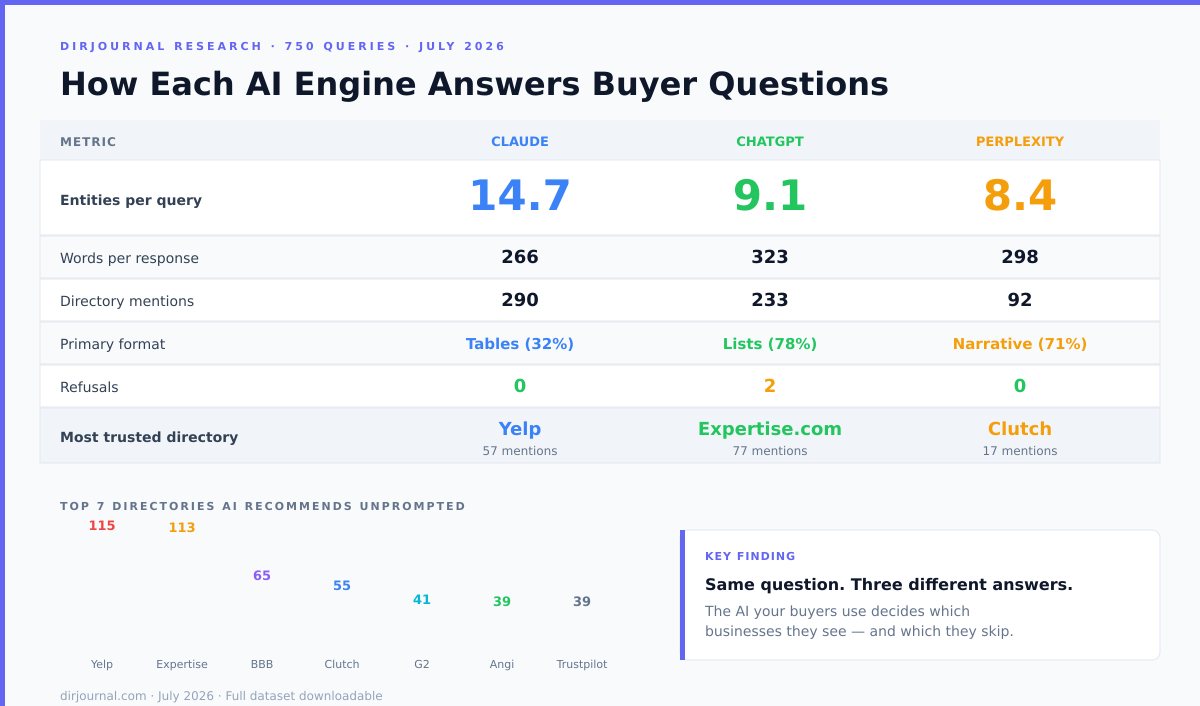
Claude vs ChatGPT vs Perplexity: How Each AI Engine Answers Buyer Questions Differently
Claude writes comparison tables and names 14.7 businesses per query. ChatGPT writes numbered lists…
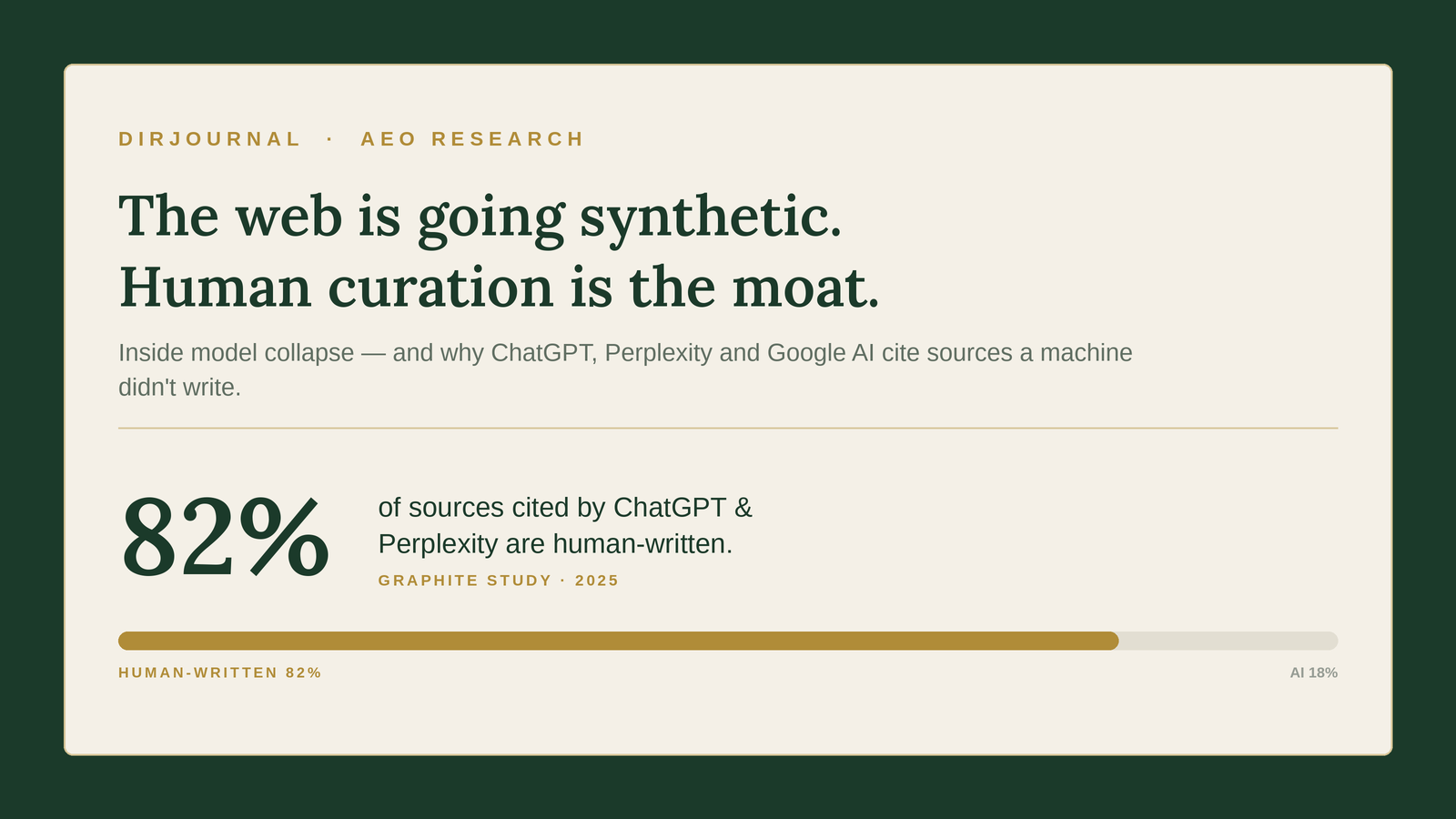
The Role of Human-Curated Directories in LLM Training Data
Why answer engines like ChatGPT, Perplexity, and Google AI Overviews disproportionately cite…
What Everyone Gets Wrong About Talking to AI (And the Mistakes That Keep Costing People Money, Time, and Sometimes Their Careers)
A few months back I was deep into a website rebuild, working through a single Claude thread that…
Related Resources
Looking for verified service providers? Browse our directory categories below — all human-audited and trusted by decision-makers since 2007.