Independent. Human-Curated. Established 2007.
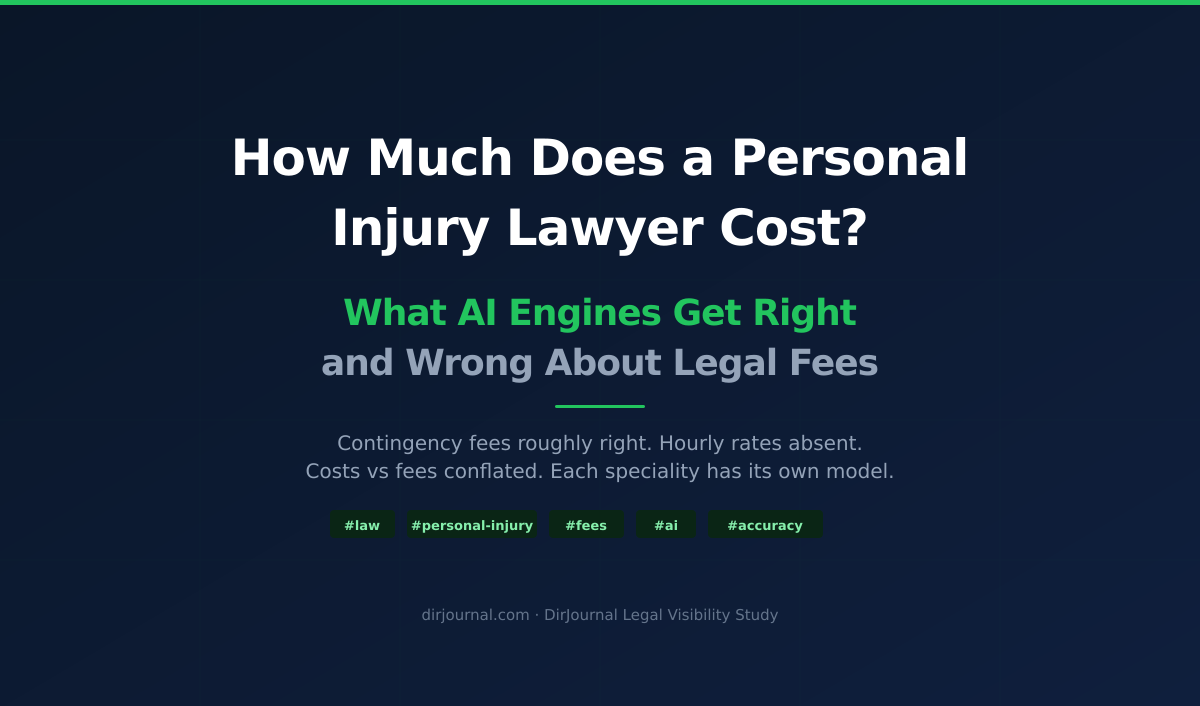
How Much Does a Personal Injury Lawyer Cost? What AI Engines Get Right and Wrong About Legal Fees
DirJournal Founder · 19+ years building directory and discovery products. Editorial-team verified.
Key Topics in This Guide
- 1What AI Gets Right About PI Fees — covered in detail below
- 2What AI Gets Wrong — covered in detail below
- 3Each Specialty Has Its Own Fee Model. AI Knows It. — covered in detail below
- 4The Employment Law Anomaly — covered in detail below
- 5What This Means for Buyers — covered in detail below
AI engines mentioned contingency fees 43 times across 60 personal injury queries. "Free consultation" appeared 23 times. "40%" appeared 10 times. "33%" appeared once.
AI knows PI lawyers work on contingency. It knows buyers pay nothing upfront. It gets the percentage range roughly right. But it skews high, citing 40% ten times more often than 33%, when most PI firms start at one-third and escalate only if the case goes to trial.
This data comes from our 600-query Legal AI Citation Study where we parsed every response for fee structure information across 10 legal specialties.
What AI Gets Right About PI Fees
Contingency is the standard model. AI mentioned "contingency" in 43 of 60 PI queries (72%). This is accurate. The vast majority of personal injury lawyers in the US work exclusively on contingency. No upfront cost. No hourly billing. The lawyer takes a percentage of the settlement or verdict.
Free consultations are expected. AI mentioned "free consultation" in 23 of 60 PI queries (38%). Also accurate. Nearly all PI firms offer free case evaluations. AI engines include this information unprompted, which helps buyers understand they can explore their options without financial risk.
Settlement is the likely outcome. "Settlement" appeared 45 times across 60 PI queries. AI correctly frames PI law as settlement-driven rather than trial-driven. Roughly 95% of PI cases settle before trial, and AI's emphasis on settlements reflects this reality.
What AI Gets Wrong
The percentage skews high. "40%" appeared 10 times. "33%" appeared once. In reality, most PI firms start at 33% (one-third) for pre-litigation settlements and increase to 40% only if a lawsuit is filed or the case goes to trial. Some firms charge 25% for straightforward claims. AI's training data overweights the higher figure, likely because 40% appears more frequently in legal marketing content and blog posts about "worst case" fee scenarios.
Hourly rates are virtually absent. "Hourly" appeared once in 60 PI queries. This is directionally correct (PI lawyers almost never charge hourly) but AI misses the edge cases: some PI firms bill hourly for pre-suit investigation in complex cases, and some charge hybrid contingency-plus-hourly structures for commercial litigation injury claims.
Costs vs fees are conflated. AI engines don't consistently distinguish between attorney fees (the contingency percentage) and case costs (filing fees, expert witnesses, court reporters, medical record retrieval). A PI case with a $100,000 settlement at 33% contingency costs the client $33,000 in fees plus $5,000-$20,000 in case costs. AI rarely surfaces this distinction.
Each Specialty Has Its Own Fee Model. AI Knows It.
| Specialty | Contingency | Hourly | Flat Fee | Retainer | Free Consult |
|---|---|---|---|---|---|
| Personal Injury | 43 | 1 | 0 | 3 | 23 |
| Medical Malpractice | 37 | 3 | 0 | 1 | 15 |
| Employment & Labor | 18 | 18 | 8 | 8 | 7 |
| Estate Planning | 3 | 25 | 24 | 6 | 7 |
| Corporate & Business | 0 | 20 | 5 | 8 | 1 |
| Real Estate & Closing | 2 | 21 | 15 | 5 | 1 |
| Family Law & Divorce | 0 | 18 | 9 | 25 | 2 |
| Immigration | 0 | 13 | 17 | 9 | 2 |
| Criminal Defense & DUI | 1 | 12 | 14 | 6 | 17 |
| Bankruptcy | 1 | 15 | 9 | 9 | 8 |
AI accurately maps each specialty to its dominant fee model.
Contingency-driven: PI (43 mentions) and Medical Malpractice (37) are overwhelmingly contingency. AI gets this right. These are the specialties where the client pays nothing unless they win.
Retainer-driven: Family Law leads with 25 retainer mentions. Divorce clients pay upfront retainers because the work is ongoing and outcome-uncertain. AI correctly flags retainers as the norm for family law.
Hourly-driven: Estate Planning (25), Real Estate (21), and Corporate (20) are hourly-dominant. AI correctly identifies these as transactional practices billed by the hour.
Flat-fee driven: Estate Planning (24), Immigration (17), Real Estate (15), and Criminal Defense (14) all have strong flat-fee signals. Simple wills, visa applications, closings, and DUI defences are standardised enough for fixed pricing.
Free consultation signals: PI leads at 23, Criminal Defense at 17, Medical Malpractice at 15. These three specialties compete heavily for clients and use free consultations as a marketing tool. AI reflects this competitive dynamic accurately.
The Employment Law Anomaly
Employment & Labor is the only specialty where AI mentioned contingency and hourly fees equally (18 each). This reflects reality: plaintiff-side employment lawyers (wrongful termination, discrimination) work on contingency. Employer-side employment lawyers (compliance, policy, HR) bill hourly. AI's even split accurately captures a specialty that operates under two different economic models depending on which side the lawyer represents.
What This Means for Buyers
AI gives you a reliable starting point for understanding how much a lawyer costs. The fee model per specialty is accurate. The specific percentages for PI and med mal are directionally correct but skew slightly high (40% gets cited more than 33%).
Before hiring based on AI fee information: ask the specific firm for their fee schedule in writing. Confirm whether quoted percentages are pre-suit or post-litigation. Ask what case costs are excluded from the contingency percentage. AI won't tell you these details. Your lawyer will.
Data from DirJournal's Legal AI Citation Study.
For readers comparing lawyers across cities, our Best Lawyers by City hub ranks 712 firms across 50 US cities using DirJournal's 12-point audit — filtered by scope so you see local matches first.
Frequently Asked Questions
How much does a personal injury lawyer cost?
Do AI search engines accurately describe lawyer fees?
Which type of lawyer fee structure does AI understand best?
Join the DirJournal newsletter
Weekly insights on directories, listings, SEO, and how businesses get found online.
No spam. Unsubscribe anytime.
Found this useful?
Share this article
Recommended for You
Best Personal Injury Lawyers in Houston: Ranked by AI Citation Data
We asked Claude, ChatGPT, and Perplexity to name Houston personal injury lawyers. Arnold & Itkin,…
Personal Injury Lawyers Spend the Most on Ads But Score Lowest in AI Search
Personal Injury scored 71. Estate Planning scored 81. The legal specialty with the highest Google…

The Brands AI Engines Agree On (And What They Have in Common)
42 brands were named by Claude, ChatGPT, and Perplexity independently across 750 queries. Same…
Related Resources
Looking for verified service providers? Browse our directory categories below — all human-audited and trusted by decision-makers since 2007.