Independent. Human-Curated. Established 2007.
What Is Emotional Intelligence? The 8 Core Fundamentals (2026 Guide)
DirJournal Founder · 19+ years building directory and discovery products. Editorial-team verified.
Key Topics in This Guide
- 1Why Emotional Intelligence Matters More in the AI Era — covered in detail below
- 2Quick Facts: Emotional Intelligence — covered in detail below
- 3Fundamental 1: Build Emotional Literacy — covered in detail below
- 4Fundamental 2: Recognize Patterns — covered in detail below
- 5Fundamental 3: Apply Consequential Thinking — covered in detail below
- 6Fundamental 4: Evaluate and Re-Choose — covered in detail below
- 7Fundamental 5: Motivate Yourself — covered in detail below
- 8Fundamental 6: Choose Optimism — covered in detail below
- 9Fundamental 7: Create Empathy — covered in detail below
- 10Fundamental 8: Commit to Noble Goals — covered in detail below
- 11The Bottom Line on EQ in 2026 — covered in detail below
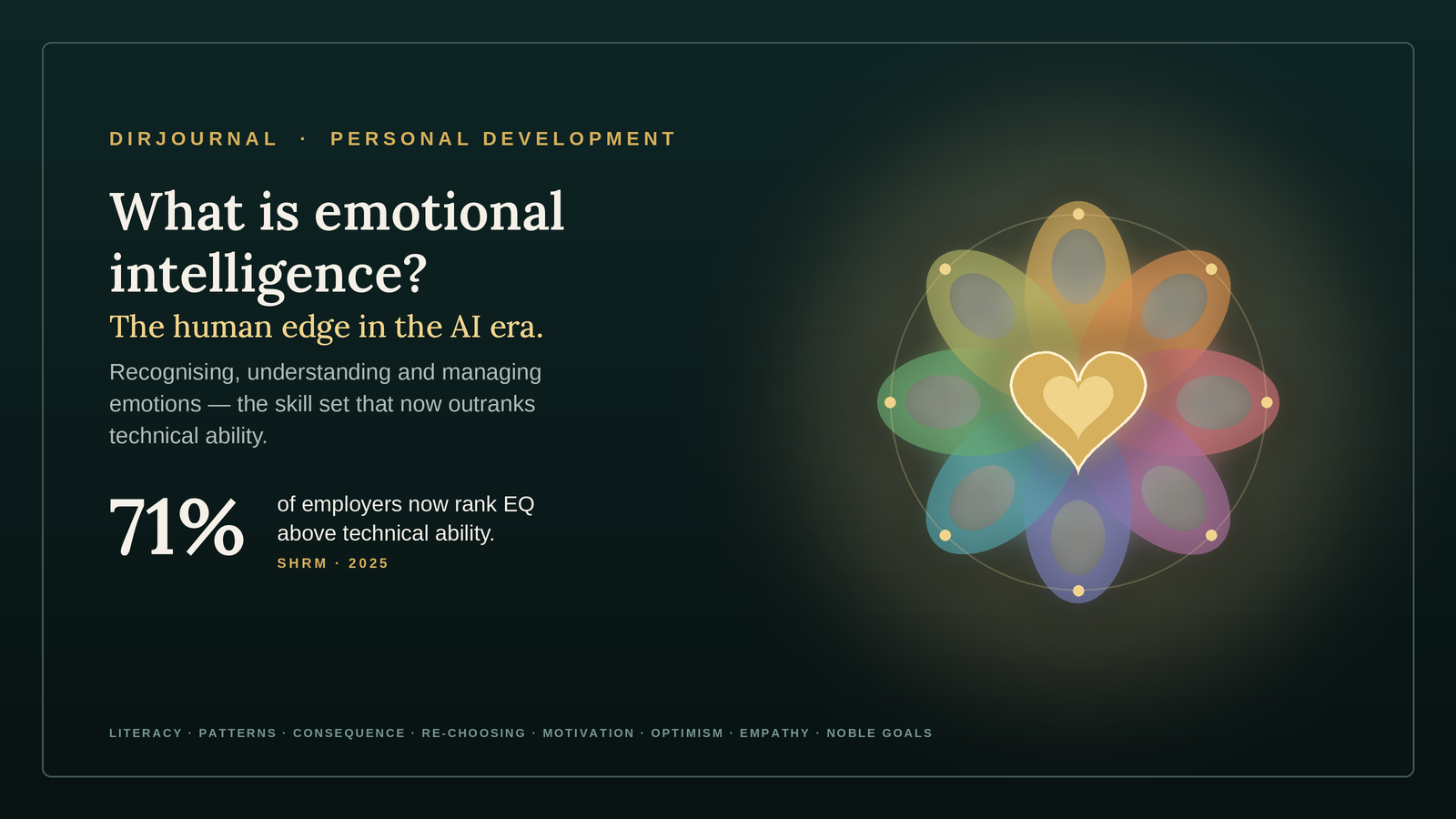
In 2025, 71% of employers ranked emotional intelligence above technical ability when hiring. In the same year, the World Economic Forum's Future of Jobs Report found that nearly 39% of current workplace skills will be disrupted by 2030 — and that empathy, active listening, and resilience are among the human capabilities employers want most. The World Economic Forum, SHRM, TalentSmart, and McKinsey all agree on one point: as AI takes over an expanding share of analytical and routine work, the value of being able to read, manage, and respond to human emotions has gone up, not down.
Emotional intelligence (EQ) is the capacity to recognize your own feelings and those of other people, to motivate yourself, and to manage emotions in yourself and in your relationships. The term entered mainstream business vocabulary through Daniel Goleman's 1995 book Emotional Intelligence, building on earlier academic work by psychologists Peter Salovey and John Mayer. Since then, the research base has only grown stronger. People with high EQ earn an average of $29,000 more annually than their peers, according to TalentSmart's longitudinal workplace research. Ninety percent of top workplace performers score high on EQ assessments. Only about 20% of bottom performers do.
This guide walks through the 8 fundamentals of emotional intelligence — the practical skills that make up EQ in daily life and at work. The framework is timeless. The reasons it matters in 2026 are not.
Why Emotional Intelligence Matters More in the AI Era
When AI can draft an email in seconds, summarize a meeting in milliseconds, and produce competent first-draft analysis in any domain, the work that remains uniquely human is the work that depends on emotional skill. Conflict resolution. Reading the room in a difficult conversation. Motivating a discouraged teammate. Sensing what a customer actually wants versus what they're saying. Building trust. Navigating change.
The numbers back this up. EQ accounts for approximately 58% of job performance across industries, according to TalentSmart research. Employees with high EQ score 40% lower for burnout risk than their peers — a finding consistent with broader work on the brain–body connection covered in our companion piece on brain foods that support cognitive resilience. Companies that prioritize emotional intelligence are 22 times more likely to outperform peer organizations. In a 2025 SHRM report titled Human Edge in the AI Age, 71% of employers said EQ was now among their top desired skills — ranking it above technical ability.
There's also a sobering counter-finding. TalentSmart's 2025 State of EQ Report, which assessed 37,000 working professionals, found that only 41% scored above 80 in self-awareness — and 23% scored below baseline in social awareness, identifying it as the single largest growth area in the modern workforce. Thirty-four percent of professionals named stress and work-life balance as their top challenge, and only 35% felt their organizations were prepared for ongoing change.
The pattern is clear. Emotional intelligence is now both more valuable and more in deficit than at any point since the concept entered the workplace lexicon thirty years ago. The 8 fundamentals below offer a practical map of what to work on.
Quick Facts: Emotional Intelligence
Career impact: 90% of top workplace performers score high on EQ; only 20% of bottom performers do (TalentSmart, ongoing research)
Salary premium: People with high EQ earn an average of $29,000 more annually (TalentSmart)
Performance correlation: EQ accounts for 58% of job performance across industries (TalentSmart)
Hiring priority: 71% of employers rank EQ above technical ability (SHRM, "Human Edge in the AI Age" 2025)
Burnout protection: High EQ reduces burnout risk by 40% (Gallup)
Leadership impact: Empathetic leaders see 76% higher employee engagement and 61% boost in creativity (Catalyst research)
Largest deficit: Social awareness — 23% of professionals score below baseline (TalentSmart 2025 State of EQ Report)
Future of work: 39% of current workplace skills will be disrupted by 2030; EQ-adjacent skills (empathy, active listening, resilience) are among the fastest-growing in importance (World Economic Forum Future of Jobs Report 2025)
Fundamental 1: Build Emotional Literacy
Feelings are a complex aspect of every person. While research has identified eight "core" feelings (fear, joy, acceptance, anger, sorrow, disgust, surprise, expectation), we each experience dozens, even hundreds, of variations each single day. These emotions blend and merge, and frequently they conflict.
This EQ fundamental helps us sort out all of those feelings, name them, and begin to understand their causes and effects. It also helps us understand how emotions function in our brains and bodies, and the interaction of thought, feeling, and action.
Modern neuroscience has refined what we know about the eight core feelings. Research using brain imaging suggests that the average adult can distinguish between roughly 27 emotional categories with reasonable consistency — a far richer vocabulary than the four or five most people regularly use. Building emotional literacy in 2026 means expanding the vocabulary itself: not just "I'm angry," but recognizing whether that's frustration, indignation, resentment, or contempt. Each points to a different underlying need and a different productive response.
Fundamental 2: Recognize Patterns
Human brain follows patterns, or neural pathways. Stimulus leads to response, and over time, the response becomes nearly automatic. On a neurological level the path way becomes a road, the road a highway, and the highway a super expressway — until it requires extraordinary measures to interrupt the automatic process.
On a behavioral level, the neural patterns lead to behavior patterns. At a young age, we learn lessons of how to cope, how to get our needs met, how to protect ourselves. These strategies reinforce one another, and we develop a complex structure of beliefs to support the validity of the behaviors. As we become more conscious of the patterns we exhibit, it becomes possible to (1) analyze the beliefs and replace them if appropriate, and (2) interrupt the pattern and replace it with conscious behavior that moves us closer to our real goals. This is an enormously difficult task that requires commitment and vigilance — but it is not difficult to begin.
This is the fundamental that AI tools cannot replicate for you. A language model can describe patterns abstractly. It cannot notice that you tense your shoulders every time your manager opens a meeting with "I just have a quick question," or that your inbox anxiety spikes specifically on Sunday evenings. The data of your own emotional life is yours alone to observe. Modern apps and journaling tools — Day One, Stoic, mood-tracking integrations in Apple Health and Google Fit — can help externalize the noticing, but the work of recognition still has to happen inside your own attention.
Fundamental 3: Apply Consequential Thinking
People are often told to control their emotions, to suppress feelings like anger, joy, or fear, and cut them off from the decision-making process. This old paradigm suggests that emotions make us less effective; nothing could be farther from reality. Feelings provide insight, energy, and are the real basis for almost every decision. Instead of disconnecting our emotions, we need to control our actions so that we have time to make the most creative, insightful, and powerful decisions. Particularly when dealing with conflict or crisis, we need to slow down the process and apply carefully practiced strategies that lead to decisions informed by the fused powers of heart and mind.
This "habit of mind" stems from a clear understanding of the consequences of our choices and the ability to imagine the cause and effect relationships. This process allows us to be as impulsive as we truly want to be, but also forces us to limit impulsivity when consequences are undesirable. One key mechanism to develop and monitor consequential thinking is "self-talk." Self-talk is a mechanism to mentally explore multiple options and viewpoints; it provides a system to balance the various aspects of our self. Just as in conversations outside ourselves, sometimes the louder voice gets more attention; the issue in both cases is to develop a process where listening is valued and all the voices — loud or soft — are heard.
Research on impulse control consistently shows that the gap between stimulus and response is where consequential thinking lives. Viktor Frankl described this gap as "the space in which we choose our response." In modern workplaces compressed by Slack, email, and AI-accelerated communication, that gap has gotten shorter. The professionals who maintain it — through deliberate pauses, scheduled response windows, or simply the discipline of waiting an hour before sending difficult messages — consistently make better decisions than those who respond at the speed of the inbox.
Fundamental 4: Evaluate and Re-Choose
In our daily lives, we have countless opportunities to get feedback about our thoughts, feelings and actions, and to then change if the feedback so warrants. Unfortunately, we also have a great capacity to ignore this feedback and continue with a scarcity of useful information. In this unconscious state it is easy to become selfish, to sever connections with our humanity, and to subjugate ourselves to addictions or other compensations.
The alternative is to listen — listen to ourselves and listen to others. When we become skilled at sensing our own emotions, we are able to tap into the energy that they provide and take action. Emotions are energy, and one place where that energy most frequently erupts is in conflict.
Conflict is inherent in human interaction; you need only look at a group of preschoolers at play to see its significance. To manage this strife, we develop skills for evaluation, negotiation, and compromise. To socialize effectively you must recognize and gauge other peoples' thoughts, feelings, and actions just as you monitor your own. These skills are heavily dependent on interpreting paralanguage (body-language, tone, utterances, facial expression, and other forms of nonverbal communication). An effective socializer is able to turn conflict into a positive force. S/he creates compromise and makes sure needs are met. S/he can mobilize people, persuade, and inspire others.
The most critical step to teaching effective socialization is to provide positive role models and opportunities for children to practice what they have observed. Today, children often do not see their parents interacting socially, nor do they have as many opportunities to practice social skills with extended family. Thus, it is even more important that parents provide these mechanisms and opportunities.
A 2024 meta-analysis of conflict-resolution research found that the single strongest predictor of constructive outcomes was not the parties' positions on the underlying issue — it was their willingness to update their initial framing after hearing the other side. Re-choosing, in the language of this framework, is what makes conflict productive rather than corrosive. In hybrid and remote work contexts where social signals are compressed into text and video tiles, that willingness to update has become harder and more valuable.
Fundamental 5: Motivate Yourself
"Motivation" comes from Latin "to move;" it is a goal-oriented behavior. In essence, we take action because it feels good to do so. It feels right to take a break when we are on overload, then it feels right to go back to work. The challenge is to make it feel right to take action that does not have an immediate reward. To do so, we have got to tap into the part of ourselves that has a longer-view — which also feels right. We each make countless decisions each hour. For example:
What should I eat for lunch?
What clothes should I wear today?
Which book should I read?
In part, we make those decisions unconsciously based on our patterns and habits. In part, we make those decisions based on our personal priorities. So, if we want to redirect our decision to take a longer-term view, we need to both shape unconscious habits and examine priorities to make sure they match.
In addition to motivating ourselves, it is important to learn how to motivate others. There are many ways to do so; the most obvious are "extrinsic" motivations. For example, "If you carry my bag, I'll give you a candy bar," is a simple example of extrinsic motivation — it is a bribe or a type of commercial interaction. Quite useful at times — but it doesn't last. Building lasting motivation requires a more complex strategy; one that employs both intrinsic and extrinsic motivation (ideally 60-80% of the focus is on intrinsic motivation). Building motivation in others begins with three elements:
They need to feel the benefit of the priority you are suggesting. If you want a child to use a more polite vocabulary, s/he needs to experience how such a decision would feel good. S/he will develop that experience by being spoken to with polite words — at the same time, it might feel good to avoid the consequences of using impolite words — and that will feel good.
Always treat them as you want them to be. John's mother always treated him as if he were honest — even when he was not. He internalized that value and struggled to improve his actions because it felt good to have his real behavior meet that high standard.
Give time. Motivation is a complex process and a vital one. Like so many intra-personal skills, it often takes years or decades for the seeds to bloom.
The research on intrinsic versus extrinsic motivation has only deepened since Daniel Pink's Drive popularized it in 2009. Self-determination theory, developed by Edward Deci and Richard Ryan, holds that durable motivation rests on three pillars: autonomy (a sense of choice), competence (a sense of growing capability), and relatedness (a sense of connection to others). Organizations that engineer these three conditions outperform those that rely on bonus structures and KPIs alone. The same principle applies to motivating yourself: structure your week to include at least one task with each pillar, and burnout becomes substantially less likely.
Fundamental 6: Choose Optimism
Likewise, children are born optimistic, and tend to stay optimistic until they are six or seven. At that time, life's difficulties impinge enough that the door is opened for hopelessness. Research suggests that to avoid getting trapped in the negativity, people need at least one refuge. The refuge can be a person or a practice (such as reading) that provides positive input. It is remarkable to think that one source of kindness, one source of comfort, one source of hope is enough to combat the terrible perils that some children experience.
Optimism validates our long-term motivation because it lets us see the future as positive and worthwhile. Optimism allows us to see beyond the present and feel good about what may happen. It is closely tied to perseverance which inspires us to continue the journey despite the difficulties of day-to-day life.
Martin Seligman's research on learned optimism gave this fundamental its modern scientific foundation. People can learn optimism the same way they learn pessimism — through attention to causal explanations of events. The optimist asks "What's temporary about this setback?" and "What's specific about this situation that's making it hard?" The pessimist asks "Why does this always happen to me?" and "What's wrong with me that this keeps happening?" The questions you ask yourself in difficult moments train your brain over time. In a workplace where AI-driven change is constant and uncertainty is the default, the skill of choosing optimism — without lapsing into denial — has measurable career and health benefits.
Fundamental 7: Create Empathy
Empathy is the ability to recognize and respond to other people's emotions. It is connected to optimism because it is through a sense of our connection to others that we see our own efficacy and importance. Together they govern a significant portion of our behaviour; they are the gatekeepers of our emotional selves. When we are empathic, it hurts us to hurt others or to see them hurt. We actually experience for ourselves the emotions of others.
It is motivating, then, not only to do what makes us feel good, but what makes others feel good. Thus, empathy is the force which makes the golden rule true. Some parts of empathy are instinctive. Infants will reach out and touch others in distress; in maternity wards, one infant's tears will lead to a room full of crying babies. This mimicry is the first step towards forming empathy. Unfortunately, this unconscious or instinctive behaviour does not automatically lead to conscious empathy. Instead, these flickering flames must be carefully banked and fueled through role-modeling, reinforcement, and practice. Once people develop empathy on a conscious level, it becomes self-reinforcing because it answers a deep-seated need to connect with others.
Empathy is the fundamental that has received the most attention in the AI era. A 2024 Catalyst study found that employees with empathetic leaders showed a 76% increase in engagement and a 61% increase in creativity. The World Economic Forum's 2025 Future of Jobs Report listed "empathy and active listening" among the top complementary skills to technological literacy — the human capabilities employers consistently identify as critical even as they automate other functions. Importantly, empathy is also the EQ skill where the largest workforce deficit shows up. TalentSmart's 2025 data found that 23% of professionals scored below baseline in social awareness, the cluster of skills that includes reading others' emotions and contextual cues. The skill is in demand. It is also in short supply.
Fundamental 8: Commit to Noble Goals
Noble goals activate all of the other elements of EQ. Through our missions and our acts of human kindness, the commitment to emotional intelligence gains relevance and power. Just as our personal priorities shape our daily choices, our noble goals shape our long-term choices. They give us a sense of direction, they give us a spar to hold in the storm, they are the compass for our soul. All the "inside" aspects of emotional intelligence change your attitudes. They shape your own life; they help you become the person you want to be. Your noble goals touch the future.
Research on purpose and meaning at work has consistently found that employees who connect their daily tasks to a larger purpose are more engaged, more resilient, and less likely to leave. McKinsey's 2024 research on the "Great Reflection" — the post-pandemic workforce shift in priorities — found that 70% of employees said their sense of purpose was defined by their work. In an era where AI can perform many functional tasks faster and cheaper than humans, the question of why your work matters becomes both more important to answer and harder to answer convincingly. Noble goals, in the original sense this article framed them, are the foundation of the answer.
The Bottom Line on EQ in 2026
The 8 fundamentals in this guide haven't changed in the fifteen years since they were first written. The world around them has changed completely. Hybrid work, AI-augmented productivity, compressed communication channels, and constant organizational change have all raised the value of the human skills that no algorithm can replicate.
If you take only one action after reading this, make it the smallest one. Pick the fundamental that you scored lowest on as you read — emotional literacy, pattern recognition, consequential thinking, re-choosing, motivation, optimism, empathy, or noble goals — and commit to one specific practice this week. Read a chapter of a book on it. Have one difficult conversation you've been avoiding. Notice one pattern you've been pretending you don't have. EQ doesn't get built through study; it gets built through reps.
The skill is in demand. The skill is in short supply. The work begins with you.
Frequently Asked Questions
What is emotional intelligence?
What are the four main components of emotional intelligence?
Is emotional intelligence more important than IQ?
Can you learn emotional intelligence, or are you born with it?
Why is emotional intelligence important in the age of AI?
How do I improve my emotional intelligence?
What is the difference between EQ and EI?
What jobs require high emotional intelligence?
Can emotional intelligence be measured?
Does emotional intelligence make you a better leader?
Join the DirJournal newsletter
Weekly insights on directories, listings, SEO, and how businesses get found online.
No spam. Unsubscribe anytime.
Found this useful?
Share this article
Recommended for You
15 Best Shopify Development Agencies
Shopify Development Agencies scored 53 out of 100 in our AI Citation Study, ranking 4th out of 50…
Personal Injury Lawyers Spend the Most on Ads But Score Lowest in AI Search
Personal Injury scored 71. Estate Planning scored 81. The legal specialty with the highest Google…
Kinesthetic Learning: What the Research Actually Says (and How to Study Better)
Kinesthetic learning is the idea that some people learn best through movement. The popular version…
Related Resources
Looking for verified service providers? Browse our directory categories below — all human-audited and trusted by decision-makers since 2007.