Independent. Human-Curated. Established 2007.
The Best Hospitals in the United States: How the Rankings Work and How to Choose Well
DirJournal Contributing Author. Editorial-team verified.
Key Topics in This Guide
- 1How the U.S. Hospital Rankings Actually Work — covered in detail below
- 2The Evidence That Should Actually Drive Your Choice — covered in detail below
- 3The Current Honor Roll: 20 Hospitals That Excel Across the Board — covered in detail below
- 4The National Leader in Each Specialty — covered in detail below
- 5A Closer Look at the Flagship Institutions — covered in detail below
- 6How to Choose a Hospital, Step by Step — covered in detail below
- 7Sources — covered in detail below
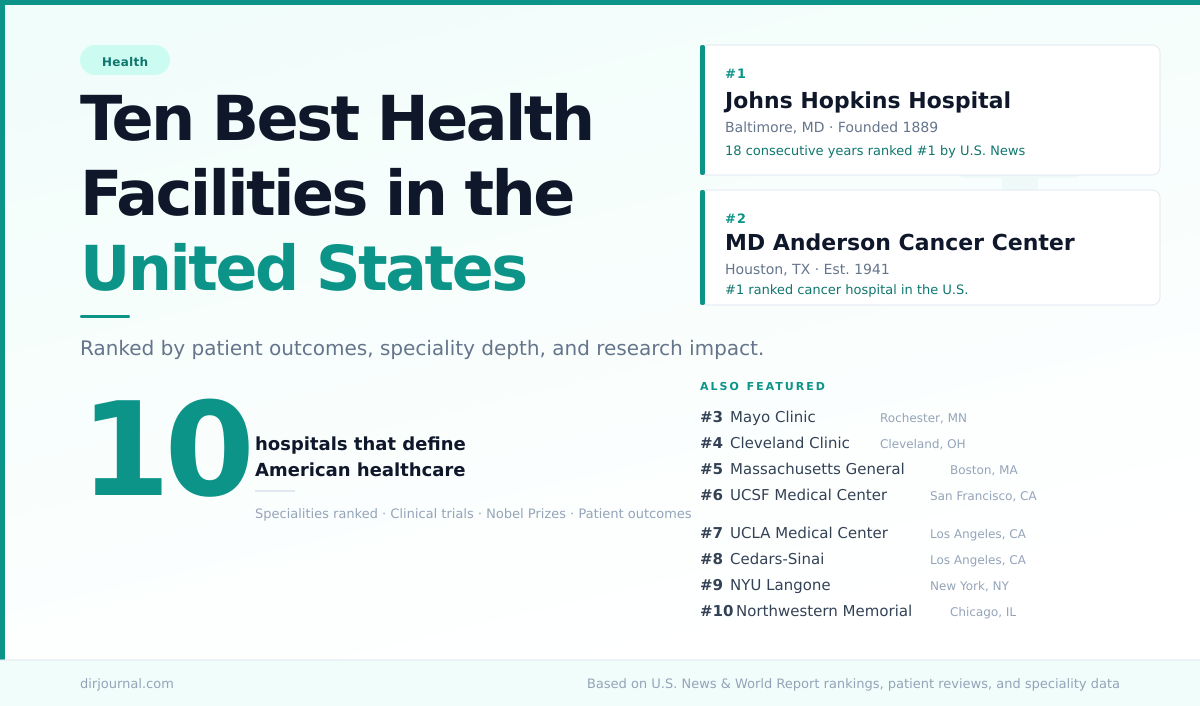
The hospitals most often named among the best in the United States include the Mayo Clinic, Cleveland Clinic, Johns Hopkins Hospital, Massachusetts General Hospital, NYU Langone, and Cedars-Sinai, all on the current U.S. News Best Hospitals Honor Roll of 20 medical centers. For specific conditions, the specialty leader matters more than the overall rank: MD Anderson for cancer, NYU Langone for cardiology and neurology, the Hospital for Special Surgery for orthopedics, Bascom Palmer for eye care, and Memorial Sloan Kettering for urologic cancer. The strongest evidence for choosing a hospital is not a magazine rank at all. It is procedure volume. Hospitals that perform a given operation often have lower mortality and fewer complications than those that rarely perform it, so the practical question is which hospital does your specific procedure most often and how it scores on independent quality data.
"Best hospital" lists are everywhere, and most of them simply restate one source: the annual U.S. News & World Report Best Hospitals rankings. Reprinting that list is not useful. Understanding what it measures, what it leaves out, and what the medical research actually says about where to get care is useful, and that is what this guide does.
The short version: for most conditions, you do not need a nationally ranked hospital. For serious or complex conditions, the right hospital is usually the one that treats your specific problem in high volume and posts strong outcomes, which is not always the most famous name. Below is how the rankings work, the current leaders, and an evidence-based way to choose.
How the U.S. Hospital Rankings Actually Work
The U.S. News Best Hospitals rankings are now in their 36th year. The most recent edition evaluated more than 4,400 hospitals using over 800 million patient care records, scoring them on measures such as risk-adjusted mortality, preventable complications, and nursing care levels. Out of all those hospitals, 504 were named Best Regional Hospitals, 152 ranked nationally in at least one specialty, and 20 made the Honor Roll, the small group that performs well across nearly every type of care evaluated.
Two details matter for how much weight to give the list:
First, the methodology is now mostly outcomes-driven, but not entirely. Of the 15 ranked specialties, 12 (including cancer, cardiology, neurology, and orthopedics) are scored largely on data such as survival rates and complications. The other three, ophthalmology, psychiatry, and rheumatology, are still ranked by reputation, based on surveys of more than 30,000 specialists asked where they would send their most complex patients. Reputation tracks brand and history as much as current performance, so treat those three categories as informed opinion rather than measured outcomes.
Second, the Honor Roll is no longer numbered. U.S. News stopped ranking the top hospitals one through twenty and now lists them alphabetically, a change it made to discourage the idea that one hospital is definitively "the best" in the country. The organization itself is explicit on this point: for most illnesses, patients do not need an Honor Roll hospital, and the rankings should be a starting point used in consultation with a doctor, not a destination.
The Evidence That Should Actually Drive Your Choice
Here is what the research supports, and it is more useful than any single ranking.
Procedure volume predicts outcomes. The landmark study is Birkmeyer and colleagues in the New England Journal of Medicine , which found that for many major operations, hospitals performing the procedure more often had meaningfully lower surgical mortality than low-volume hospitals. The pattern has held up since. An analysis using federal patient-safety indicators found that higher-volume hospitals had significantly lower rates of preventable adverse events across major surgical procedures. A large study of nearly 1.4 million patients found postoperative mortality of 5.7% at low-volume hospitals versus 2.7% at high-volume hospitals. The "practice makes perfect" effect is not absolute, and it is stronger for complex procedures than routine ones, but for anything serious, volume is one of the most reliable signals you have.
Specialty match beats overall prestige. A hospital that is superb at heart surgery may be unremarkable at cancer care. For a specific diagnosis, the specialty ranking and that hospital's volume for your exact procedure tell you far more than its overall fame.
Independent quality data exists and is free. Two sources complement the rankings:
- The federal Medicare Care Compare star ratings (one to five stars) summarize safety, readmissions, mortality, and patient experience for hospitals across the country.
- The Leapfrog Hospital Safety Grade (A through F) focuses specifically on errors, accidents, and infections, which are a different and important lens from clinical excellence.
Checking a hospital's specialty rank, its volume for your procedure, its Care Compare stars, and its Leapfrog grade together gives a far more complete picture than any one list.
The Current Honor Roll: 20 Hospitals That Excel Across the Board
These 20 medical centers earned the most points across U.S. News's specialty and procedure ratings in the most recent edition. They are listed alphabetically, because the rankings no longer order them, and they span 13 states.
AdventHealth Orlando (Florida). Brigham and Women's Hospital (Boston). Cedars-Sinai Medical Center (Los Angeles). Cleveland Clinic (Ohio). Hackensack University Medical Center (New Jersey). Hospitals of the University of Pennsylvania, Penn Presbyterian (Philadelphia). Houston Methodist Hospital (Texas). Johns Hopkins Hospital (Baltimore). Massachusetts General Hospital (Boston). Mayo Clinic, Arizona (Phoenix). Mayo Clinic, Rochester (Minnesota). Mount Sinai Hospital (New York City). NewYork-Presbyterian Hospital, Columbia and Cornell (New York City). Northwestern Memorial Hospital (Chicago). NYU Langone Hospitals (New York City). Rush University Medical Center (Chicago). Stanford Health Care, Stanford Hospital (Palo Alto). UCLA Medical Center (Los Angeles). UCSF Health, UCSF Medical Center (San Francisco). University of Michigan Health (Ann Arbor).
The National Leader in Each Specialty
For a specific condition, this is the most actionable table on the page. These are the hospitals ranked first in each of the 15 specialties in the most recent edition.
| Specialty | National leader |
|---|---|
| Cancer | University of Texas MD Anderson Cancer Center (Houston) |
| Cardiology, Heart & Vascular Surgery | NYU Langone Hospitals (New York City) |
| Diabetes & Endocrinology | Mayo Clinic, Rochester (Minnesota) |
| Ear, Nose & Throat | MD Anderson Cancer Center (Houston) |
| Gastroenterology & GI Surgery | Mayo Clinic, Rochester (Minnesota) |
| Geriatrics | NYU Langone Hospitals (New York City) |
| Neurology & Neurosurgery | NYU Langone Hospitals (New York City) |
| Obstetrics & Gynecology | Brigham and Women's Hospital (Boston) |
| Ophthalmology | Bascom Palmer Eye Institute, University of Miami |
| Orthopedics | Hospital for Special Surgery (New York City) |
| Psychiatry | Massachusetts General Hospital (Boston) |
| Pulmonology & Lung Surgery | NYU Langone Hospitals (New York City) |
| Rehabilitation | Shirley Ryan AbilityLab (Chicago) |
| Rheumatology | Johns Hopkins Hospital (Baltimore) |
| Urology | Memorial Sloan Kettering Cancer Center (New York City) |
A Closer Look at the Flagship Institutions
Mayo Clinic (Rochester, Minnesota). Consistently among the very top hospitals nationally, with first-place strength in diabetes and endocrinology and in gastroenterology and GI surgery, and a transplant program that is among the largest and most experienced in the country. Its integrated, team-based model is the reason patients with complicated, multi-system problems are often referred there.
Cleveland Clinic (Ohio). Long the national reference point for cardiac care, it ranks among the top hospitals for heart and vascular surgery and rates high performing in nearly every procedure and condition U.S. News evaluates. For heart disease specifically, it remains one of the first names clinicians cite.
Johns Hopkins Hospital (Baltimore). A research powerhouse and the national leader in rheumatology, ranked across a broad range of specialties. Its scientific output, from the founding of modern genetics work to neuroscience, underpins a deep bench in complex and rare disease.
MD Anderson Cancer Center (Houston). The national leader in cancer care and one of the largest cancer research and treatment programs in the world, running an extensive clinical trials portfolio. For a cancer diagnosis, it and Memorial Sloan Kettering in New York are the two most frequently cited destinations for complex cases.
Memorial Sloan Kettering Cancer Center (New York City). The other dominant cancer center, ranked first in the country for urologic cancer and among the leaders across oncology, with deep subspecialty expertise and a large trials program.
NYU Langone Hospitals (New York City). The current national leader in cardiology, neurology and neurosurgery, pulmonology, and geriatrics, reflecting strong measured outcomes across several data-driven specialties.
Hospital for Special Surgery (New York City). The national leader in orthopedics and the oldest orthopedic hospital in the country. It performs an exceptionally high volume of joint replacements, which is exactly the kind of specialization the volume-outcome evidence rewards.
Bascom Palmer Eye Institute (Miami). Repeatedly ranked the top eye hospital in the nation, with subspecialty depth across the full range of ophthalmic care.
How to Choose a Hospital, Step by Step
- Start with the condition, not the brand. Identify the specialty your diagnosis falls under, then look at the specialty ranking and the hospitals strongest in it. The overall Honor Roll matters less than who is best at your specific problem.
- Ask about volume. For any significant procedure, ask how many your hospital and surgeon perform each year. Higher volume is associated with better outcomes. This single question is one of the most useful you can ask.
- Check independent quality data. Look up the hospital's Medicare Care Compare star rating and its Leapfrog Hospital Safety Grade. A famous hospital with a weak safety grade, or a lesser-known one with an A, is worth knowing about.
- Weigh access and insurance. Traveling to a top-ranked center can mean out-of-network costs, time away from home, and follow-up care far from your support system. For common conditions, a strong regional hospital in your network is often the better practical choice. Many strong regional centers are listed in DirJournal's Health directory.
- Decide with your doctor. Rankings and data are inputs. Your physician knows your case, the local options, and which specialists to trust. The right hospital is a shared decision, not a line on a list.
Sources
- U.S. News & World Report. Best Hospitals Honor Roll and Overview and Best Hospitals rankings by specialty.
- Becker's Hospital Review. U.S. News Best Hospitals Honor Roll.
- Birkmeyer, J. D., et al. . Hospital Volume and Surgical Mortality in the United States. New England Journal of Medicine.
- Relationship between Patient Safety and Hospital Surgical Volume. Health Services Research.
- Perioperative patient safety indicators and hospital surgical volumes.
- Luft, H. S., et al. Does practice make perfect? The relation between hospital volume and outcomes.
- Medicare Care Compare (Centers for Medicare & Medicaid Services) and the Leapfrog Hospital Safety Grade, for independent hospital quality and safety data.
Frequently Asked Questions
What is the best hospital in the United States?
How are hospitals ranked?
Does it matter how many times a hospital has done my procedure?
Do I need to travel to a top-ranked hospital?
Where can I check a hospital's safety record for free?
Which hospital is best for cancer?
Join the DirJournal newsletter
Weekly insights on directories, listings, SEO, and how businesses get found online.
No spam. Unsubscribe anytime.
Found this useful?
Share this article
Recommended for You

The 2026 Architecture Audit: How to Choose Between Agentic AI, LLM Fine-Tuning, and RAG
The question for most CEOs has shifted from "Should we use AI?" to "Which specific architecture…

Criminal Defense Has Zero AI Consensus. Not One DUI Firm Was Named by All Three Engines.
183 criminal defense firms named across 60 queries. Zero named by all three engines. The only legal…
Related Resources
Looking for verified service providers? Browse our directory categories below — all human-audited and trusted by decision-makers since 2007.